

A CNC machine quote usually covers the machine and its listed standard equipment—not everything needed to start production. Check whether tooling, fixtures, software licenses, freight, taxes, unloading, installation, and test cutting are included. Each item should have a quantity, a price or “included” status, and a named responsible party.
The checklist below applies mainly to new CNC mills, lathes, and machining centers. Cost calculations and service periods are illustrative, not market averages or standard contract terms.

Included Equipment and Extra Charges
| Item | Common Quote Treatment | What to Confirm |
|---|---|---|
| Machine, spindle, and control | Usually included in the specified configuration | Exact model, travels, load capacity, spindle ratings, control model, and enabled functions |
| Tool magazine or turret | Included where specified | Station count, interfaces, and supplied holders; magazine capacity does not indicate tooling quantity |
| Cutting tools and workholding | Often partly or fully extra | Toolholders, cutters, inserts, jaws, vises, fixtures, quantities, and unit prices |
| Coolant, chip handling, and probing | Basic equipment and upgrades vary by package | Pumps, filtration, conveyor, probe hardware, software, calibration, and installation |
| Extra axes and automation | Usually separate options | Rotary table, drives, licenses, fixtures, guarding, and integration |
| CAD/CAM software | Often sold separately | Modules, seats, license term, post processor, validation, and renewal fees |
| Delivery and site preparation | Depends on delivery terms | Packing, freight, insurance, taxes, unloading, positioning, electrical work, and air supply |
| Installation, training, and warranty | May include a limited allowance | Service days, travel expenses, acceptance tests, warranty start date, and exclusions |
Have the supplier mark each line “included,” “extra,” “buyer-supplied,” or “not applicable.” Keep unanswered items open in the budget rather than entering zero.
Configuration Costs
Spindle and Control
A 12,000 rpm spindle has a 50% higher maximum speed than an 8,000 rpm spindle, but that does not establish a cycle-time saving. If your process runs at 1,500 rpm, compare torque and continuous operating capability at that speed. Power figures must use the same duty rating.
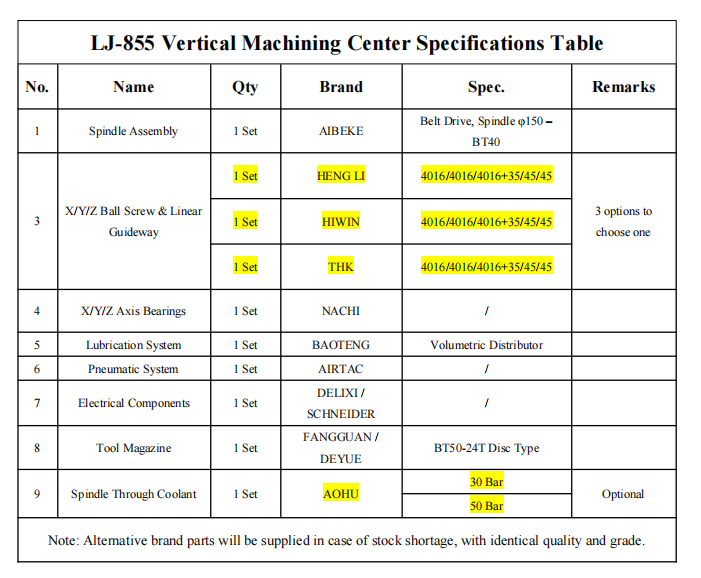
The control specification should name the functions enabled at delivery. “Fourth-axis ready” may exclude the rotary table, drive, cables, control license, or commissioning. Ask for the price of a working fourth-axis package, including whether it supports indexing or simultaneous machining.
Tooling and Fixtures
If your jobs require 18 toolholders and the quote includes six, you need another 12. At an assumed RMB 800 each, the shortfall costs RMB 9,600, before cutting tools and inserts, pull studs, and other accessories.
For a lathe, list the turret stations that accept driven tools separately from the driven toolholders actually supplied. For a hydraulic clamping system, check the clamps, pressure supply, hoses, fittings, mounting hardware, and any part-specific fixture machining.
Probing and Coolant
A probe package should identify the hardware, receiver, macros, installation, and calibration. Specify the required task—workpiece setup, tool setting, or broken-tool detection—because these may require different devices.
For high-pressure coolant, request flow at the quoted pressure, filtration rating in microns, and replacement filter prices. Confirm that the spindle, holders, and cutting tools support the intended coolant delivery method.
Software
A software subscription at RMB 12,000 per year costs RMB 36,000 over three years if the price stays unchanged. Check whether training, extra machining modules, and post-processor development are separate charges.
The post processor must match the machine, control, and axis configuration. Agree on program checks, any required simulation, controlled machine validation, and who pays for corrections.
Delivery and Site Costs
“Freight included” may stop at the destination port or factory unloading area. The order should name the delivery point and assign unloading, lifting, internal moving, waiting charges, and redelivery costs.
- CIF: The seller pays the agreed freight and insurance to the named destination port. Risk generally transfers when the goods are loaded aboard the vessel at the shipment port. Check destination charges and onward delivery separately.
- DAP: The seller delivers to the named place, ready for unloading. The buyer normally handles unloading and import clearance, including applicable duties and taxes.
- DDP: The seller normally handles import clearance and applicable duties and taxes. Delivery is generally on the arriving vehicle, ready for unloading. Machine installation requires a separate agreement.
State the named place or port and “Incoterms® 2020” in the quote. Check the selected rule’s A9/B9 cost allocation against the supplier’s exclusions; unloading charges can also depend on the carriage contract.[1]
A customs broker should estimate duty, import taxes, and brokerage fees using the verified commodity code, origin, destination, and declared value.
Site contractors need these figures before pricing the work:
- Electrical: Voltage, frequency, phase, required supply capacity, grounding, and protection. The LJ-855 specification, for example, lists a 15 kW spindle motor and approximately 20 kW total machine power. Obtain the installation requirements rather than sizing the supply from the spindle rating.
- Compressed air: Minimum inlet pressure, consumption and its measurement conditions, plus drying and filtration requirements.
- Floor and access: Operating weight, foundation requirements, doorway dimensions, moving route, and clearance for auxiliary equipment and maintenance.
Installation and Acceptance
An allowance of “one technician for two working days” should specify daily hours, leveling, accessory connections, option setup, and test cutting. Travel, overtime, waiting time, and return visits need separate terms.
Training should name the attendees and tasks. For example: “Two operators, two days, covering tool changes, tool setting, routine care, and operation of the agreed sample part.” Complex programming or extra training days may be outside that allowance.
For test cutting, specify the drawing revision, material, tooling, fixtures, sample quantity, measurement conditions, and pass criteria. A ±0.01 mm part tolerance must be checked on the finished part. ISO 230-2 covers the positioning accuracy and repeatability of machine axes; an axis test report is not a finished-part inspection report.[2]
Request calibration records and measurement uncertainty for the inspection method. NIST states that traceability alone does not establish fitness for purpose; the uncertainty must suit the measurement task.[3]
Assign the costs of test material, tool wear, inspection, corrective work, and retesting. Link payment milestones to specific events, such as factory acceptance, delivery, or site acceptance.
Warranty Charges
A 12-month warranty starting at shipment may leave only 10 months when production begins if transport and installation delays take two months. Specify the start event and coverage for parts, labor, travel, and spare-parts freight.
“24-hour response” might mean an initial reply, not a repair. Set separate terms for remote diagnosis, site attendance, and parts dispatch, and state whether the deadlines use working or calendar hours. Request out-of-warranty labor and travel rates before ordering.
Compare the Total Cost
This example compares the same required configuration and delivery scope. Figures are in RMB thousands, excluding tax.
| Cost | Supplier A | Supplier B |
|---|---|---|
| Base machine | 300 | 330 |
| Required options | 40 | 15 |
| Tooling, fixtures, and software | 30 | 30 |
| Freight, unloading, and positioning | 15 | 10 |
| Installation, training, and acceptance | 10 | 5 |
| Site preparation | 20 | 20 |
| Total | 415 | 410 |
Supplier A’s base price is RMB 30,000 lower, but its total is RMB 5,000 higher. Apply the same tax treatment and exchange-rate date to both quotes. Keep recurring software fees, tooling consumption, and maintenance in a separate operating budget.
Attach the agreed configuration and exclusions to the contract with the quote number, revision, validity period, and delivery lead-time trigger. For unresolved costs, record the pricing method, responsible party, and change-approval process.