

For steel, stainless steel, deep pockets, and tight-tolerance metal parts, a CNC mill is usually the safer choice. A 1,200 × 600 × 3 mm aluminum panel with cutouts is a different job and may suit a metal-capable router better. For a 100 × 80 × 40 mm housing with a 25 mm-deep pocket and a ±0.02 mm bore, start with a mill. These are job examples, not fixed machine limits.
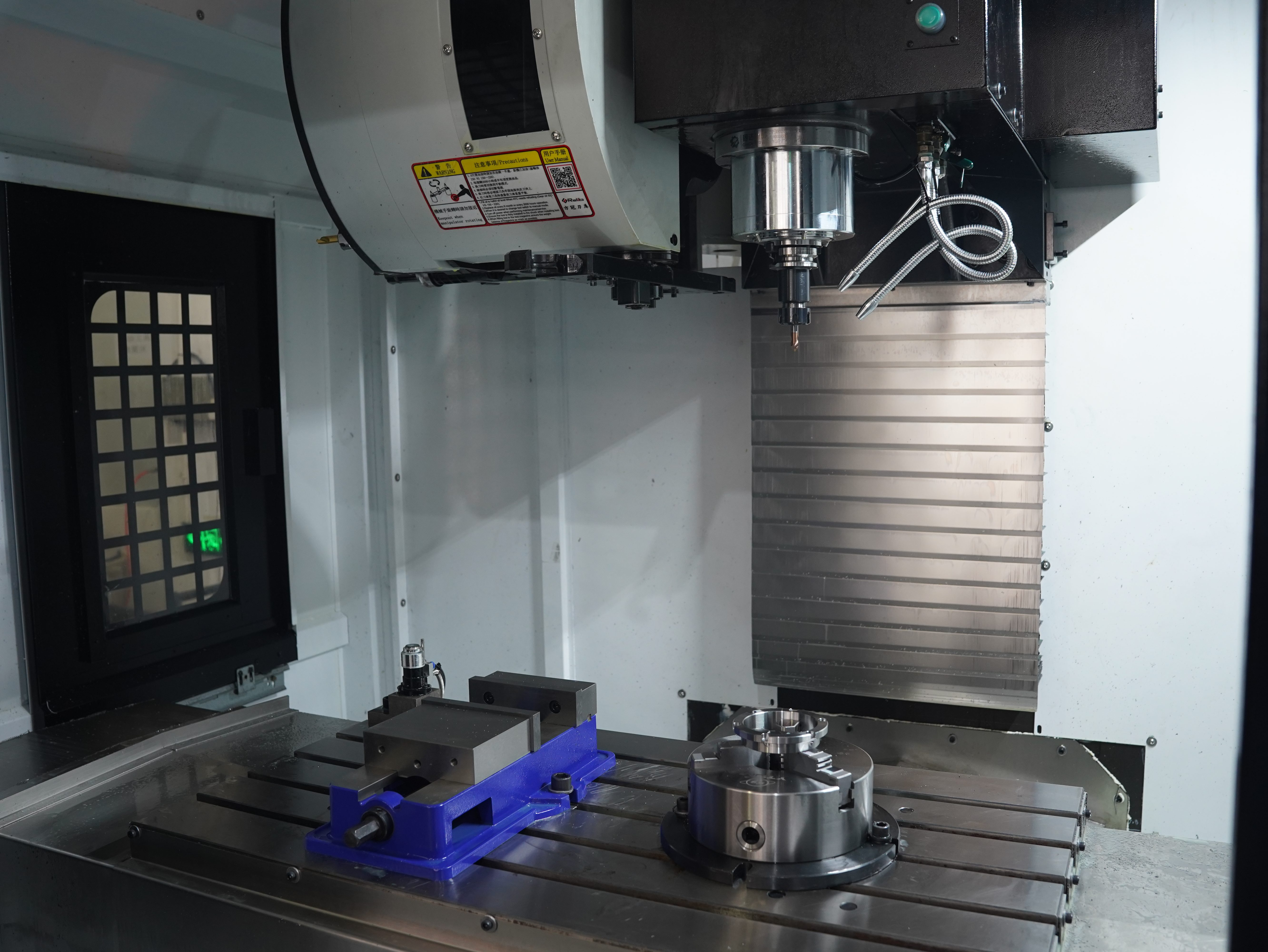
Which Machine Fits Your Metal Parts?
Here is a practical comparison between a metal-capable sheet router and a conventional vertical CNC mill.
| Example part | Better starting choice | What should decide the purchase |
|---|---|---|
| 1,200 × 600 × 3 mm aluminum panel with cutouts | Metal-capable CNC router | Sheet support, cut-edge quality, and retention during through-cutting |
| 300 × 200 × 6 mm aluminum mounting plate | Compare both | Hole requirements, setup time, and complete part cost |
| 100 × 80 × 40 mm aluminum housing with a 25 mm-deep pocket | CNC mill | Pocket finish, tool reach, chip removal, and roughing time |
| Steel bracket requiring machining on 3 faces | CNC mill | Fixture access and alignment between setups |
| Aluminum component with a 20.000 ±0.010 mm bore | CNC mill as the initial shortlist | Measured bore size and geometry across repeated parts |
| Brass plate with 0.3 mm-deep engraving | Either suitable machine | Spindle runout, surface support, and engraving consistency |
Sometimes the cheapest route uses both machines. A router can cut the outside profile, then a mill finishes the critical holes. Just remember that the second setup and transfer time still count.
When a CNC Router Makes Sense for Aluminum
A metal-capable router makes sense when the job is mostly sheet work: load a sheet, cut several profiles, and remove only a small amount of material through the thickness.
Take a 1,000 × 500 × 4 mm aluminum panel with rectangular openings and mounting holes. The big issues are simple: can the machine reach the full panel, support it properly, and keep each part secure as the cut breaks through?
Now take a 100 × 100 × 40 mm aluminum block with a deep cavity. It is much smaller, but it may take longer because far more material has to come out.
| Material removed | Calculation | Volume |
|---|---|---|
| A 4 mm-wide slot through 4 mm sheet over a 1,000 mm path | 4 × 4 × 1,000 mm³ | 16 cm³ |
| An idealized 80 × 60 × 25 mm rectangular pocket | 80 × 60 × 25 mm³ | 120 cm³ |
The pocket removes 7.5 times more material. Real parts have corner radii and other features, but the point is clear: a smaller part does not always mean a faster job.
During a router trial, look at the underside burr, narrow internal cutouts, and the edge left when the part separates from the sheet. Measure the part after tabs or other temporary supports have been removed.
Chip removal matters too, especially in deeper slots. MIT machining guidance notes that chip formation affects heat removal and that flute geometry affects chip clearance.[1]
Not sure which machine fits your part?
Send ASIATOOLS your drawing, material grade, stock size, deepest feature, and critical tolerances. The machine choice can then be based on the actual job rather than a general machine category.
Request a Drawing ReviewWhen a CNC Mill Is the Better Starting Choice
Start with a CNC mill if your regular work includes steel, stainless steel, deep cavities, precision bores, or features on several faces.
Say a housing needs 6 tools: facing, roughing, finishing, drilling, threading, and chamfering. The whole sequence matters, not one cutting operation in isolation.
If that job needs 5 manual tool changes at an assumed 90 seconds each, including setting checks, that adds 7.5 minutes per cycle. Across 40 cycles, you have spent another 5 hours just changing tools.
An automatic tool changer cuts those interruptions. Some industrial routers have them too, so compare the actual machine configurations rather than the labels.
Magazine capacity also matters once several jobs share one machine. A dual-tool-magazine vertical machining center with 64 listed tool positions gives more room for different jobs and spare cutters. Tool diameter, weight, and adjacent-pocket restrictions still decide how many positions you can really use.
Rigidity is not just about the machine casting. The fixture and toolholder have to hold up as well. MIT machining material points to secure fixturing and robust tools and holders when cutting forces get high.[2]
Compare Spindle Performance at Your Required RPM
A bigger maximum-rpm number does not automatically make a spindle better. What matters is whether the spindle works well at the speed your cutter actually needs.
Use this metric formula: RPM = cutting speed × 1,000 ÷ (π × cutter diameter). Cutting speed is in m/min and cutter diameter is in millimeters. MIT's feeds-and-speeds calculator uses the equivalent relationship in inch units.[3]
| Cutter diameter | Illustrative cutting speed | Calculated spindle speed |
|---|---|---|
| 4 mm | 100 m/min | 7,958 rpm |
| 8 mm | 100 m/min | 3,979 rpm |
| 16 mm | 100 m/min | 1,989 rpm |
These numbers only show the calculation. They are not cutting settings for a specific metal.
If your cutter works around 2,000 rpm, that is where you need the torque data. Look at continuous power and torque, minimum operating speed, and any duty limits.
Pick CNC cutting tools around the material, operation, diameter, and reach. A tiny engraving cutter and a large roughing tool live in very different rpm ranges.
Use Tolerance Numbers Correctly
Do not treat every router or every mill as if it has one universal accuracy number. NIST machine-tool calibration work separates errors within individual axes, between axes, and across the working volume.[4]
| Drawing requirement | Acceptable size | Total tolerance width |
|---|---|---|
| 100.00 ±0.10 mm | 99.90–100.10 mm | 0.20 mm |
| 100.00 ±0.02 mm | 99.98–100.02 mm | 0.04 mm |
| 20.000 ±0.010 mm | 19.990–20.010 mm | 0.020 mm |
The second tolerance band is 5 times narrower than the first. That does not mean the part costs five times more, but it does raise the bar for the process.
For a fitted bore, diameter alone may not be enough. Roundness, cylindricity, and position can matter just as much when the part goes into an assembly.
Thin parts should also be checked after unclamping. On a large panel, measure features in different areas instead of checking only the easy spot near the center.
For a first screening test, measure 10 consecutive parts and record the critical dimensions and any offset changes. It is a useful trial, but it is not proof of long-term process capability.
Check Deep Features and Tool Reach
Deep pockets usually mean more tool overhang. If your production part needs that reach, the trial should too.
An 8 mm cutter extending 24 mm has a 3:1 overhang-to-diameter ratio. At 40 mm, it becomes 5:1. These figures describe the setup; they are not universal pass-or-fail limits.
Measure a deep wall near both the top and bottom. The dimensional difference matters, but so does the cutting time needed to get that result.
If tool projection changes during roughing, check for end mill pull-out from the holder before chasing the problem with offsets. Record tool projection before and after the cut.
Check the Fixture and Part Together
Machine travel is only part of the fit check. The fixture, part, tool, and clearance all stack up.
- A fixture standing 80 mm above the table.
- A workpiece projecting 40 mm above the fixture.
- A tool tip extending 60 mm below the spindle nose.
- A required retract clearance of 20 mm above the workpiece.
That setup needs about 200 mm of spindle-nose-to-table space at the stated retract position. Holder shape, clamps, approach moves, and tool changes still need their own collision check.
This is not the same thing as Z-axis travel. Travel tells you how far the axis moves. Spindle-nose-to-table distance tells you how much physical space is available at a given position.
For sheet routing, also think about what happens after the outline is cut. Tabs, thin onion-skin material, and edge cleanup all add time.
Check the whole machine setup, not one specification.
Provide your fixture height, workpiece weight, longest tool, required rpm, and tool count. ASIATOOLS can match those numbers to a machining-center configuration and list the required options.
Request a Machine ConfigurationCompare Material Removal and Complete Cycle Time
Feed rate by itself tells you very little about total machining time. For a steady rectangular cut, use material removal rate = depth × width × feed rate ÷ 1,000, with millimeters and mm/min to get cm³/min.
| Hypothetical cut | Depth | Width | Feed rate | Removal rate |
|---|---|---|---|---|
| A | 1 mm | 4 mm | 3,000 mm/min | 12 cm³/min |
| B | 6 mm | 4 mm | 1,000 mm/min | 24 cm³/min |
Cut B removes twice as much material even though its feed rate is only one-third as high. Again, these are calculation examples, not measured router or mill performance.
After that, look at the whole cycle: loading, cutting, tool changes, repositioning, unloading, and finishing. If one route takes 18 minutes per part and another takes 12 minutes, the difference reaches 10 hours across 100 parts.
Calculate Cost at Your Actual Batch Size
Use the same drawing, stock, inspection requirement, and accepted quantity for both quotes. The figures below are assumed setup and machining costs, not market prices.
| Cost item | Router process | Mill process |
|---|---|---|
| Hourly rate | $40 | $75 |
| Machining time per part | 18 minutes | 7 minutes |
| Machining cost per part | $12.00 | $8.75 |
| Batch setup cost | $80 | $150 |
| Cost per part at 10 pieces | $20.00 | $23.75 |
| Cost per part at 100 pieces | $12.80 | $10.25 |
At 10 pieces, the router route is cheaper. At 100 pieces, the mill route comes out lower.
The mill adds $70 in setup cost but saves $3.25 per part in machining. With these assumptions, it becomes the cheaper route at 22 parts.
For the final number, use total batch cost ÷ accepted parts.
Which Should You Buy?
For a 1,200 × 600 mm aluminum panel with cutouts, test a metal-capable router first. For a compact housing with a 25 mm-deep pocket or a ±0.02 mm critical feature, test a CNC mill first. The better machine is the one that meets the drawing, cycle-time target, and cost target over repeated parts.
Get a quote around the parts you actually make.
Send ASIATOOLS your drawing, batch quantity, annual demand, power supply, and installation location. Ask for machine pricing with tooling, fixtures, and required options shown separately.
Request an Itemized Quote