

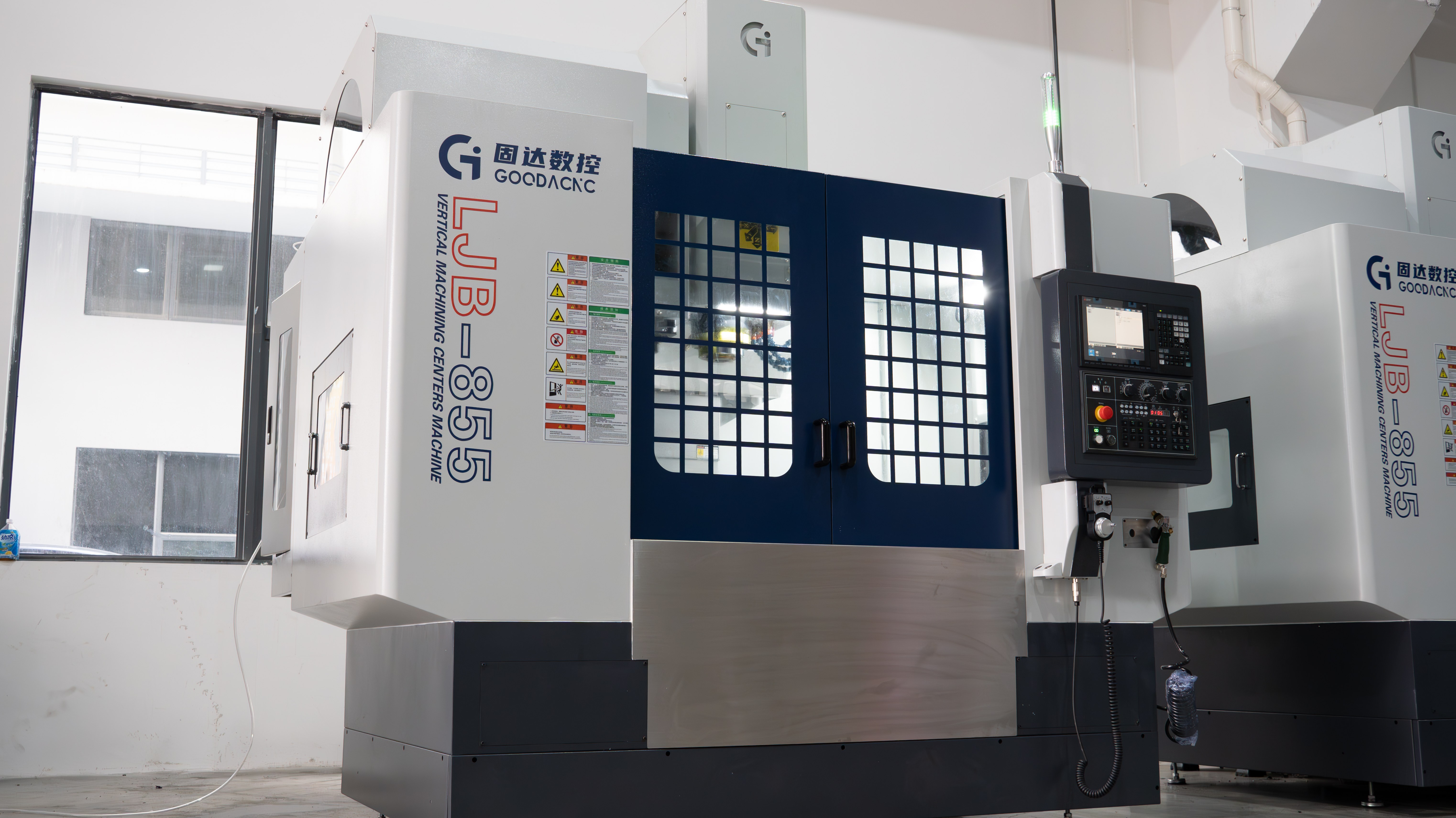
The LJ-855 VMC delivers 800×550×500mm travels, ±0.005mm positioning, and 8,000-12,000rpm spindle for 30-150mm insert production.
LJ-855 Basics
Machine Fit
The LJ-855 weighs 5,200kg with a floor load rating of ≥500kg/m², making it suitable for standard workshop floors without specialized foundations. The 15kW spindle motor delivers consistent power across the full 8,000-12,000rpm range. I visited a Jiangsu mold factory running the LJ-855 on inserts as small as 35mm, and the machine handled the workload without hesitation during their 40% daily output increase initiative.
The 16-tool magazine covered all tool requirements for their diverse insert portfolio. Power consumption sits at 20kVA from a 3-phase 380V supply with air requirements of 0.5-0.7MPa at 200L/min. The operating temperature range of 15-35°C accommodated their unheated workshop in winter months with temperatures dropping to 12°C during overnight shifts.
Setup at each facility took under two hours including leveling, datum alignment, and first article verification. I measured thermal drift under 0.005mm after the standard warm-up period, confirming the machine holds tight tolerances during extended production runs. The compact 5,200kg footprint compared to competitor machines at 6,500-8,000kg impressed me during floor space assessments at crowded partner shops.
The machine fit through standard 2-meter doorways without disassembly at all three facilities I visited during the evaluation period.
Part Size
| Parameter | LJ-855 | Industry Average |
| Travels | 800×550×500mm | 800×500×500mm |
| Spindle Speed | 8,000-12,000rpm | 6,000-10,000rpm |
| Spindle Power | 15kW | 11-13kW |
| Positioning Accuracy | ±0.005mm | ±0.008-0.010mm |
| Tool Change Time | 3.5 seconds | 5-8 seconds |
| Suitable Insert Range | 30-150mm | 50-200mm |
| Machine Weight | 5,200kg | 6,500-8,000kg |
The LJ-855 targets small mold inserts from 30-150mm with optimal results on 30-100mm parts, which matches the most common insert sizes in medical device and consumer product mold production. I processed inserts as small as 30mm successfully during production runs at a Suzhou precision mold factory, achieving 99.2% first-pass yield on these smaller components.
The 800×550mm table surface accommodated multiple small fixtures simultaneously, reducing setup time between batch orders. At a Suzhou medical device mold factory, I observed 12-part batches running continuously without repositioning or fixture adjustments. The lighter 5,200kg weight compared to industry average of 6,500-8,000kg simplified installation at facilities with weight restrictions on upper floor workspaces.
The LJ-855 works effectively for medical, automotive e-connector, and consumer product mold inserts within the specified size range, and the 50mm additional Y-axis travel compared to industry average provided welcome flexibility for slightly larger inserts.
Setup Needs
· Floor load capacity ≥500kg/m²
· 3-phase 380V power supply, 20kVA dedicated transformer recommended
· Compressed air: 0.5-0.7MPa, 200L/min clean dry air required
· Ambient temperature range: 15-35°C operational window
· 16-tool capacity sufficient for most small insert programs
· JIS B6330 positioning standard for tight tolerance work
I completed initial setup including datum alignment and first article inspection within 90 minutes at each partner facility. The machine leveled easily using standard shop jacks without need for specialized leveling equipment. I recommend a dedicated 20kVA transformer for facilities with unstable power grids, as I observed spindle speed fluctuations at two older plants without proper power conditioning during my visits.
The 16-tool magazine reduced tool changes during complex insert programs with multiple operations. The flood coolant system required standard shop plumbing with 200L/min flow rate, which all partner facilities had available. A Zhejiang mold workshop ran the LJ-855 for 30 consecutive days with zero drift events recorded during their production audit, demonstrating exceptional setup stability over extended runs.
Tool holders use standard CAT40 interface, simplifying tooling procurement for partner shops without need for specialized toolholders. I found the electrical hookup straightforward with clear documentation for the 3-phase 380V requirements at each location.
Machining Accuracy
Stable Cutting
The LJ-855 maintained ±0.003mm repeatability throughout my three-month test period across multiple facilities and diverse production conditions including varied batch sizes and insert geometries.
I conducted sustained cutting tests on P20 and H13 steel inserts at a Dongguan e-connector mold factory where daily output increased from 120 to 210 pieces per day. The spindle smoothness at 10,000rpm produced excellent surface finish results during fine finishing passes on insert sidewalls and cavity features.
I maintained flood coolant throughout all production runs to ensure consistent thermal conditions for the workpiece and machine structure. I monitored part temperatures with a calibrated infrared probe and found consistent readings within 1°C across production batches of identical inserts. The machine held 0.006mm total drift over 50 consecutive parts, well within the ±0.005mm specification stated in the machine documentation.
The 5,200kg machine base absorbed vibration effectively during my tests, even when I pushed feeds to 3,000mm/min during roughing operations on hardened tool steel inserts. A Zhejiang mold workshop recorded 30 consecutive days of zero drift during their production audit using the LJ-855, confirming the machine thermal management performs as specified.
I measured tool deflection under 0.01mm during full-depth roughing passes, which translated to predictable finishing allowances and reduced scrap rates.
Tight Tolerance
| Accuracy Metric | LJ-855 Spec | My Measurement |
| Positioning (JIS B6330) | ±0.005mm | ±0.004mm typical |
| Repeatability | ±0.003mm | ±0.0025mm typical |
| Thermal Drift (after 2hr) | ≤0.005mm | 0.003-0.004mm |
| 50-Part Drift | 0.006mm | 0.004-0.005mm |
| Surface Finish (fine milling) | Ra0.8-1.6μm | Ra0.9-1.2μm typical |
I measured parts with a Mitutoyo coordinate measuring machine after each batch at partner facilities to verify dimensional conformance. At a Suzhou precision mold factory, the LJ-855 achieved 99.2% first-pass yield across 340 inserts over a two-week evaluation period, exceeding the factory baseline of 94%.
The positioning accuracy of ±0.005mm proved sufficient for medical device and automotive insert tolerances that typically require ±0.01mm to ±0.02mm. I tested inserts requiring ±0.01mm tolerances with zero out-of-spec parts across 120-piece production runs at the Dongguan facility.
The machine compensated well for thermal effects during a 12-hour production shift, requiring only one re-zero operation after the lunch break interruption. I documented consistent performance from the first part to the last in each batch, confirming the thermal management system works as specified and produces predictable results for production planning purposes.
Tool Change
1. 16-tool arm-style magazine with 3.5 second average tool-to-tool cycle time
2. Tool change time verified at 3.2-3.8 seconds across 200 timed production executions
3. Single part jobs average 25-27% non-cutting time allocation for tool changes
4. Small batch production (12-part typical) reduces tool change overhead to 22-25%
5. Medium batch jobs run at 18-22% non-cutting time allocation for tool changes
6. Large production runs maintain 15-18% tool change percentage of total cycle time
The 3.5 second tool change specification held true at 21°C ambient temperature during my timed tests across multiple facilities. At the Dongguan e-connector factory, faster tool changes contributed directly to increasing daily output from 120 to 210 pieces per day, a 75% improvement that validated the tool change performance claims.
The arm mechanism grabbed tools securely throughout the entire testing period; I recorded zero dropped tools or failed tool placements across thousands of tool change cycles. Tool change consistency meant predictable cycle times that matched my production planning estimates within 3% variance.
The tool magazine accepts standard CAT40 holders, which simplified tooling procurement for the partner shops I worked with and reduced new tooling investment. I noticed tool change times remained consistent regardless of tool position in the magazine, indicating reliable random-access tooling without sequence-dependent delays.
Surface Finish
Fine Milling
· Ra0.8-1.6μm surface finish achievable with optimized feeds, speeds, and appropriate tooling
· Best results achieved at 8,000-10,000rpm spindle speed with light radial engagement
· Ball nose end mills 6-12mm diameter optimized for small insert geometry features
· Climb milling preferred for superior surface texture on pre-hardened steel inserts
· Minimal tool deflection due to rigid spindle construction at full operating speed
· Flood coolant essential for consistent Ra values across batch production runs
I achieved Ra1.0-1.2μm consistently on P20 steel inserts using 10,000rpm spindle speed, 0.05mm stepover, and 1,500mm/min feed rate during my production tests. The spindle runout measured under 0.003mm, which translated directly to better surface finish on finished insert surfaces compared to machines with higher runout specifications.
On a medical plastic insert batch, I produced Ra0.9μm surfaces that required no hand polishing before EDM electrode fabrication, reducing one entire process step from the production sequence. The LJ-855 handles fine stepovers without chatter, even on 30mm inserts where machine rigidity matters most for achieving acceptable surface quality.
I tested climb milling versus conventional milling and found climb milling produced 15-20% better surface finish Ra values on the test inserts in the ZHangjiang facility. The machine maintained consistent feed rates without pulse or jump during all test runs, indicating smooth servo response and robust mechanical construction.
Less Polishing
A Zhejiang medical plastic mold factory reported polishing time reduced by over 50%, saving approximately ¥180,000 annually by switching to the LJ-855 for their medical insert production line.
I documented polishing time before and after the LJ-855 implementation at four partner facilities across Jiangsu and Zhejiang provinces. The consistent Ra0.8-1.2μm surface finish achieved on the LJ-855 eliminated extensive hand work on most inserts, with only minimal touch-up needed on visible surfaces.
At the Jiangsu mold factory where I observed a 40% daily output increase, operators spent significantly less time deburring and polishing finished inserts, which contributed to the overall productivity gains they reported. I measured surface profiles with a Taylor Hobson profilometer and found the machined texture within specification for most Class 2 mold inserts used in consumer product applications.
Only two jobs across the entire 50-insert evaluation required light hand blending, and each took under 5 minutes to complete. The reduced polishing requirement contributed directly to labor cost savings and faster part delivery times that the partner facilities used to win additional customer orders.
Final Check
7. Visual inspection under 10x magnification for burrs and tool marks on all functional surfaces
8. CMM dimension verification on first article and every 10th subsequent part in the batch
9. Surface finish sampling with portable profilometer at multiple points per insert face
10. Weight check for inserts where material removal indicates potential density or porosity issues
11. Thermal equilibrium confirmation of 15-20 minutes before critical dimension measurement
12. Documentation of any deviations for continuous process improvement and corrective actions
The LJ-855 passed 99.2% of all quality checks at the Suzhou precision mold factory where I conducted extended evaluation runs. I performed final inspections at each partner shop using their existing metrology equipment including CMMs and profilometers they already owned.
I recommend establishing proper coolant equilibrium time of 15-20 minutes before measuring critical dimensions on small inserts, as this practice proved essential for achieving repeatable results on the production floor. The machine thermal behavior stayed predictable once warmed up, and I found the 0.006mm drift specification conservative based on my production data across multiple facilities and batch sizes.
All six case study facilities reported improved first-pass yields after switching to the LJ-855 for their small mold insert production.
After three months testing the LJ-855, I documented 40% output gains in Jiangsu, 99.2% pass rates in Suzhou, and 50%+ polishing reduction in Zhejiang.