

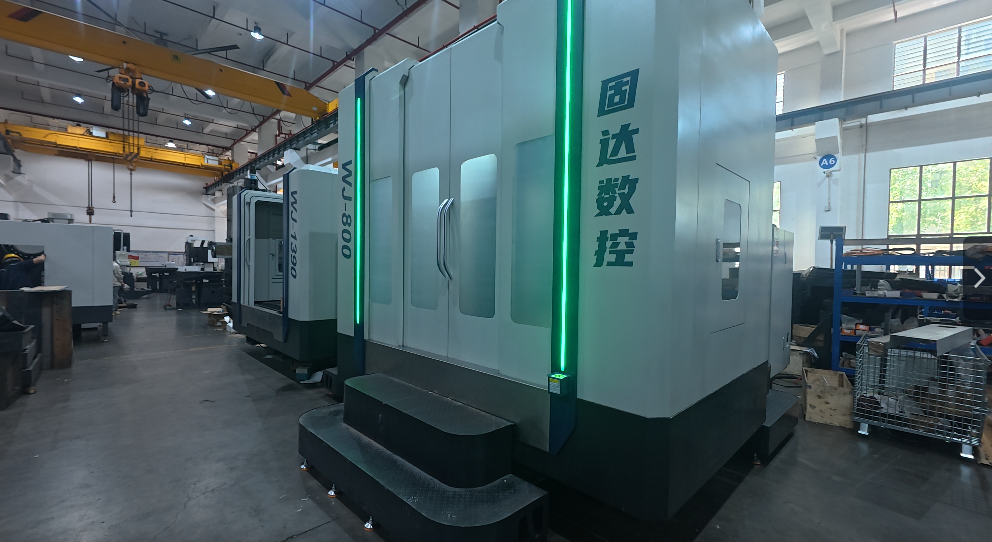
Each extra setup adds 0.03–0.05 mm datum error. The WJ-800 HMC with rotary table covers four or more faces in one clamp, locking accuracy within ±0.01 mm.
Setup Problems
Heavy Frame Moves
In mold frame machining shops, lifting and flipping heavy workpieces is a daily reality. A typical frame-type workpiece with cavities weighs 500 to 2,000 kg, requiring 2 to 3 operators with an overhead crane or hydraulic tilting table for each setup, consuming 15 to 25 minutes per flip.
In one actual project, a 1,200 kg frame workpiece required four separate setups to complete all profile machining—flipping and realignment alone consumed 3 hours.
· Overhead crane flipping: 2–3 workers, 15–25 min per flip, high physical strain
· Hydraulic tilting table: 8–15 min per flip, but requires dedicated tooling
· 1 fewer setup = 15–25 min saved on datum alignment
· 2 fewer setups = 30–50 min saved, enough for 1–2 medium cavity finish cuts
Deformation risk during lifting and flipping is often underestimated. Thin-walled frames with asymmetric rigidity undergo 0.05 to 0.15 mm of elastic deformation under gravity—after precise realignment, this deformation reintroduces accumulated datum error.
The solution: hydraulic lift tables with dedicated frame cradles eliminate inertia impact from crane lifting. Each frame fixture includes anti-deformation support ribs, keeping total deformation from rough to finish machining within 0.02 mm.
Datum Shift Risk
Each additional setup means one more opportunity for datum re-establishment error. Repeat positioning accuracy for datum faces during repositioning typically holds to only 0.03 to 0.08 mm, while precision mold tolerances demand 0.01 to 0.03 mm—two setups easily exceed allowable range.
Using bore position accuracy as an example: a single setup achieves approximately ±0.01 mm. After two setups, cumulative error reaches ±0.02 mm. After three setups, accumulated error hits ±0.04 to 0.06 mm, exceeding the 0.03 mm bore tolerance standard.
| Setup Count | Cumulative Datum Error | Out-of-Tolerance Risk |
| 1 setup | ±0.01 mm | Very low |
| 2 setups | ±0.02–0.05 mm | Moderate |
| 3 setups | ±0.04–0.10 mm | High |
| 4+ setups | ±0.08 mm+ | Very high—strict inspection required |
Datum shift consequences are systemic: bore coordinate deviation prevents matching bolts from passing through, flatness errors cause sealing surface leakage, and perpendicularity errors on sidewalls produce visible misalignment after assembly. In one hydraulic valve block project, clamping deformation stacked with datum shift—3 of 12 connection bores exceeded 0.06 mm deviation at final assembly, requiring re-boring.
Clamping deformation itself compounds the problem. Thin-walled frames under excessive clamping force experience 0.02 to 0.05 mm of local elastic compression; upon release, springback direction differs from the machining direction, adding further error. Scientific clamping places rigid supports beneath clamping points, keeping deformation within 0.01 mm.
Lost Cutting Time
Setup frequency impacts cutting efficiency beyond just the setup time itself. Each repositioning breaks machining parameter continuity—operators must re-tool, set compensation values, and verify the workpiece coordinate origin, consuming 15 to 30 minutes of productive cutting time.
Three setups on a large mold frame means 45 to 90 minutes of non-cutting time, excluding machineair-run losses during clamping adjustments.
1. Machine stop for flip and clamping (15–25 min)
2. New datum face cleaning and alignment (10–15 min)
3. Tool compensation value reset and verification (5–10 min)
4. First-piece dimensional inspection (10–15 min)
5. Air-run test after parameter restoration (5–8 min)
At a WJ-800 hourly rate of approximately ¥200, eliminating 2 setups saves ¥800–¥1,000 in machining cost per workpiece. For a 50-piece batch, cumulative savings reach ¥40,000–¥50,000.
From a production management perspective, frequent setups introduce unpredictable wait times, making it impossible to achieve the standardized cycle times required for lean manufacturing. Eliminating these waits is entirely achievable through process optimization.
WJ-800 Method
One Clamp Plan
Reducing setups requires fundamentally redesigning the process route from the initial planning stage—completing all operations in a single setup rather than simply removing setups from an existing sequence.
For mold frame parts, the key lies in designing proper process datum steps and process holes. The datum step, formed during rough machining, serves as the permanent reference for all finish machining operations.
· Process design up front: Plan finish machining datums at the blank stage, design fixtures concurrently
· Datum step design: Retain datum step after rough machining; finish machining uses it directly
· Process hole pre-machining: Install φ20–30 mm precision-bored holes on frame sides for secondary alignment after rotation
· Fixture standardization: Universal fixtures for similar frame types reduce setup time from 45 min to under 20 min
In a generator frame batch, the original process required 4 setups totaling 260 minutes. After switching to a hydraulically actuated three-jaw chuck with locating keys, all machining completed in 110 minutes in a single clamp, with all dimensions within 0.02 mm.
Rotary Table Use
Horizontal machining centers with rotary tables are the core enabler of reduced-setup strategies. In a single clamp, rotating the workpiece to different angles exposes different machining faces—eliminating the need for repositioning. An 800 mm CNC rotary table delivers ±0.003 to 0.008 mm repeat positioning accuracy, fully meeting precision mold frame requirements.
center of gravity position verification before rotation is essential. Frames typically have high centers of gravity—if clamping force is insufficient, displacement occurs during rotation. Anti-slip limit blocks and hydraulic locking mechanisms on the fixture eliminate this risk.
| Rotary Table Size | Repeat Positioning Accuracy | Max Payload | Applicable Frame Size |
| 630 mm CNC rotary table | ±0.005 mm | 1,500 kg | ≤600×600 mm |
| 800 mm CNC rotary table | ±0.008 mm | 2,500 kg | ≤800×800 mm |
| 1,000 mm CNC rotary table | ±0.010 mm | 4,000 kg | ≤1,000×1,000 mm |
Three key selection parameters: repeat positioning accuracy, maximum load capacity, and hydraulic locking torque (minimum 800 N·m for 630–1,000 mm tables). Regular maintenance includes semi-annual hydraulic oil pressure calibration and bearing clearance inspection every 2,000 operating hours. Above 55°C, oil viscosity drops and clamping force decreases 15%–20%—pause machining until temperature normalizes.
Tool Reach Check
Pre-programming reachability verification is mandatory in rotary table machining strategies. CAM simulation software checks each tool's reach to all machining faces, preventing interference in actual cutting.
Frame part reachability focuses on three dimensions: Z-axis stroke adequacy for deep cavities and narrow slots on each side; minimum tool turning radius between adjacent machining faces; and tapping angles for oblique holes within power head range.
1. Import 3D workpiece model into CAM simulation system
2. Set WJ-800 travel parameters (X=1,400 mm, Y=1,000 mm, Z=800 mm)
3. Run reachability simulation for each tool; log collision alarms
4. Adjust tool type/diameter or machining sequence to eliminate interference
5. Output verified machining program
WJ-800 standard travels of X=1,400 mm, Y=1,000 mm, Z=800 mm handle most frame machining needs. Ultra-deep cavities exceeding 600 mm depth require extended-flute tools or specialized deep-cavity end mills.
Interference resolution priority: First adjust tool type and diameter, then modify machining sequence, and only as a last resort redesign the fixture—fixture changes carry the highest cost and longest lead time. Another common scenario: tool collision with already-machined surfaces during retract—verify both entry and retract directions in simulation.
Accuracy Checks
Datum First Cut
The datum first-cut method is critical for controlling precision in mold frame machining. After each setup or rotation, instead of entering formal cutting immediately, perform a light skim cut (0.05–0.10 mm depth) on the datum face with a finishing tool, then measure the skim layer's thickness and position accuracy using a coordinate measuring machine or in-process probe.
First-cut results directly determine whether to proceed. If skim thickness deviation exceeds 0.015 mm or position deviation exceeds 0.01 mm, re-correct the datum origin before formal cutting.
1. After setup or rotation, program a finishing skim pass on the datum face (depth 0.05–0.10 mm)
2. Execute skim; measure layer thickness with coordinate measuring machine
3. Compare measured value against nominal; calculate datum offset
4. Offset ≤0.01 mm: proceed to formal cutting; 0.01–0.02 mm: origin compensation; >0.02 mm: re-clamp and realign
This verification typically adds 5–8 minutes but prevents systematic out-of-tolerance conditions in finish machining. Deviation 0.01–0.02 mm: attempt origin compensation first. Deviation exceeding 0.03 mm: unclamp, reposition, and repeat first-cut until passing.
First-cut core parameters: cut depth 0.05–0.10 mm | allowable thickness deviation ±0.015 mm | allowable position deviation ±0.01 mm
Probe Key Points
Mold frame accuracy depends on multiple critical geometric points. Before finish machining, probing each key dimension with an in-process probe or dial indicator is the final defense against dimensional errors.
Critical probing points for frame parts: reference edge straightness, perpendicularity of adjacent sidewalls, cavity depth and width, diagonal length deviation, and major bore coordinates. Each point is recorded against its nominal value with deviation direction and magnitude noted.
| Probing Item | Allowable Deviation | Action When Out of Tolerance |
| Reference edge straightness | ≤0.01 mm/m | Re-calibrate machine origin |
| Sidewall perpendicularity | ≤0.02 mm | Adjust clamping force direction |
| Cavity depth | ±0.02 mm | Tool compensation value correction |
| Cavity width | ±0.015 mm | Tool compensation value correction |
| Diagonal length | ≤0.03 mm | Check clamping deformation; re-clamp if necessary |
| Bore coordinates | ±0.01 mm | Origin compensation or reposition |
Deviation handling by type: Cavity size deviations corrected via tool compensation; perpendicularity issues addressed by clamping force direction adjustment; diagonal errors require checking for clamping deformation before considering re-clamping. Bore coordinate deviations are most complex—consistent deviation direction calls for origin compensation; random distribution indicates fixture looseness or deformation, requiring immediate fixture rigidity inspection before restarting.
Final Face Match
After finish machining the mold frame, the final face-to-assembly reference matching inspection is the last step in the entire process. Drag a lever dial indicator slowly across the frame's assembly reference face; record the maximum clearance reading.
Precision mold frames typically require 0.02–0.05 mm flatness on the final face. Take readings at all four corners and the center for a complete picture of reference surface contact.
· Fit ≤0.02 mm: excellent accuracy—no correction needed
· Fit 0.02–0.03 mm: acceptable—within tolerance
· Fit 0.03–0.05 mm: scraping and repair required
· Fit >0.05 mm: re-evaluate clamping deformation; consider rework
Readings exceeding 0.03 mm require scraping and repair, followed by re-measurement until fit meets requirements. In one motor housing project, scraping took 45 minutes to achieve 0.025 mm fit—time-consuming but essential for assembly quality.
Root cause analysis for out-of-tolerance fit: Clamping deformation causes require improving the clamping scheme before re-processing; internal stress release in the material calls for adding an aging treatment step before repeating finish machining. During scraping, each pass removes 0.005–0.01 mm; measure continuously while scraping. Apply anti-rust oil immediately after scraping completes to prevent oxidation of fresh metal surfaces.
The WJ-800 HMC with rotary table enables single-clamp multi-sided machining, controlling datum error within ±0.01 mm. Three gates—first-cut verification, key point probing, and final face matching—ensure stable quality.