

Cold Saw vs Abrasive Chop Saw: Which Is Better for Steel Cutting?
A cold saw is usually the better choice when steel parts need clean edges, repeatable lengths, accurate mitre joints and limited heat. An abrasive chop saw is the better choice for occasional carbon-steel cutting, jobsite work, rusty stock and a lower purchase price.
- Choose a cold saw for stainless tube, thin-wall tube, visible weld joints, batch cutting and tolerances tighter than approximately ±0.5 mm.
- Choose an abrasive chop saw for rebar, angle iron, rusty steel and rough cuts where ±1 mm is acceptable and the cut will be ground or machined later.
This comparison covers common 305–355 mm shop-floor metal-cutting saws. Large CNC plate saws use different cutting capacities, clamping systems and feed controls, so they should be evaluated separately.
Cold Saw or Abrasive Saw at a Glance
| Requirement | Better choice | Reason |
|---|---|---|
| Clean 45-degree joints | Cold saw | Lower burr and better angle repeatability |
| Thin stainless tube | Cold saw | Less discoloration and heat distortion |
| Rusty or dirty stock | Abrasive chop saw | More tolerant of scale, rust and weld residue |
| Low purchase budget | Abrasive chop saw | Typical machine cost is lower |
| High-volume repeat cutting | Cold saw | Less deburring and more consistent results |
| Portable jobsite cutting | Abrasive chop saw | Simple setup and easy transport |
Comparison Data
The ranges below are planning figures for 355 mm machines cutting 50 × 50 × 2 mm carbon-steel tube. Actual results depend on blade condition, tooth count, machine rigidity, clamping, feed pressure and operator technique. Test the actual material before setting a production tolerance.
| Item | Cold saw | Abrasive chop saw |
|---|---|---|
| Typical blade or wheel speed | Approximately 1,300–1,500 RPM for dry-cut models | Approximately 3,400–3,900 RPM |
| Single cut | Approximately 8–15 seconds | Approximately 5–10 seconds |
| Deburring and cooling | Approximately 0–10 seconds per piece | Approximately 30–90 seconds per piece |
| 100-cut workflow | Approximately 25–35 minutes | Approximately 60–120 minutes |
| Length tolerance | Approximately ±0.2–0.5 mm manual; ±0.1–0.3 mm with automatic or CNC feed | Approximately ±0.5–1.0 mm with a stable fence and experienced operator |
| Mitre angle repeatability | Approximately within ±0.5 degrees with a rigid vise | Approximately ±1–2 degrees, depending on the fence and wheel wear |
| Burr height | Often below 0.3 mm on suitable stock | Approximately 0.5–1.5 mm before grinding |
| Noise at the operator position | Approximately 80–92 dB | Approximately 95–105 dB |
| Typical machine price | Approximately RMB 3,000–9,000 for common shop models | Approximately RMB 400–1,200 for common models |
These figures are not machine guarantees. A worn blade, poor clamping or an inaccurate fence can make a good machine miss its normal range.
Where the Cold Saw Wins
A cold saw uses a toothed metal-cutting blade and removes material through controlled cutting rather than continuous abrasive grinding. The result is usually a cooler cut with less discoloration, fewer burrs and a more consistent angle.
For a thin tube or a visible 45-degree joint, that difference matters. A joint that needs less filing also needs less welding correction and less cosmetic finishing. A well-set-up automatic or CNC saw can hold tighter tolerances than a manually fed saw, but the machine’s actual specification still needs to be checked.
For a 355 mm machine, the nominal cutting capacity may fall around 90–120 mm, but that is not a universal rule. Check the manufacturer’s cutting chart, the workpiece diagonal, the vise opening and the available blade travel before buying. ASIATOOLS explains these checks in its guide to steel block saw selection, blade size and kerf loss.
Tooth count must match the material. Fine-tooth blades are generally better for thin-wall tube, while coarse-tooth blades provide more chip space for thicker sections and solid bar. The exact tooth count should come from the blade manufacturer’s chart, not from diameter alone.
Where the Abrasive Chop Saw Wins
An abrasive chop saw costs less, is easy to move and can handle carbon-steel stock that would be a poor match for an expensive carbide blade. It is useful for rebar, angle iron, rusty sections, repair work and rough cutting where the edge will be ground, welded or machined later.
The trade-off is heat, sparks and cleanup. The cut edge may discolor, stay hot after cutting and require more deburring. Thin stainless tube is especially vulnerable to heat tint and distortion. Abrasive wheels also become smaller as they wear, which can change the effective cutting angle and reduce usable cut depth.
Abrasive wheels must be used with the correct guard, rated speed and machine setup. OSHA requires safeguards for abrasive wheel machinery, including protection against contact with the wheel and flying fragments.[1]
Material-by-Material Choice
- Thin stainless tube: Use a cold saw with a blade specified for stainless steel when appearance, straightness and low heat matter.
- Carbon-steel square and round tube: Use a cold saw for repeatable lengths, mitre joints and low burr. Use an abrasive saw for occasional straight cuts.
- Solid bar above approximately 25 mm: A cold saw is usually more efficient when the job requires repeatable length and limited heat. An abrasive saw can still work for occasional rough cutting.
- Rebar, rusty stock and material with weld residue: An abrasive chop saw is often more practical because the wheel is less vulnerable to isolated surface contamination.
- Mold and tool steel: Confirm the grade, hardness, section size and machining allowance before choosing the blade. For example, 1045 steel and pre-hardened mold steels can require different cutting and downstream machining plans.
Cutting Cost
Consumable cost depends heavily on material hardness, blade quality, feed rate and operator technique. Use the following as an illustration, not as a universal industry rate:
- One abrasive wheel costs RMB 20 and lasts 20 cuts: RMB 1.00 per cut.
- One cold-saw blade costs RMB 600 and lasts 1,200 cuts on clean thin-wall tube: RMB 0.50 per cut.
The example excludes labor, grinding discs, blade sharpening, coolant, machine depreciation and scrap. At 300 cuts per month, the blade-only difference is approximately RMB 150. A RMB 4,000 machine price gap would therefore take about 26 months to recover from consumables alone. If the cold saw also removes 30–60 seconds of deburring per part, labor can change the result substantially.
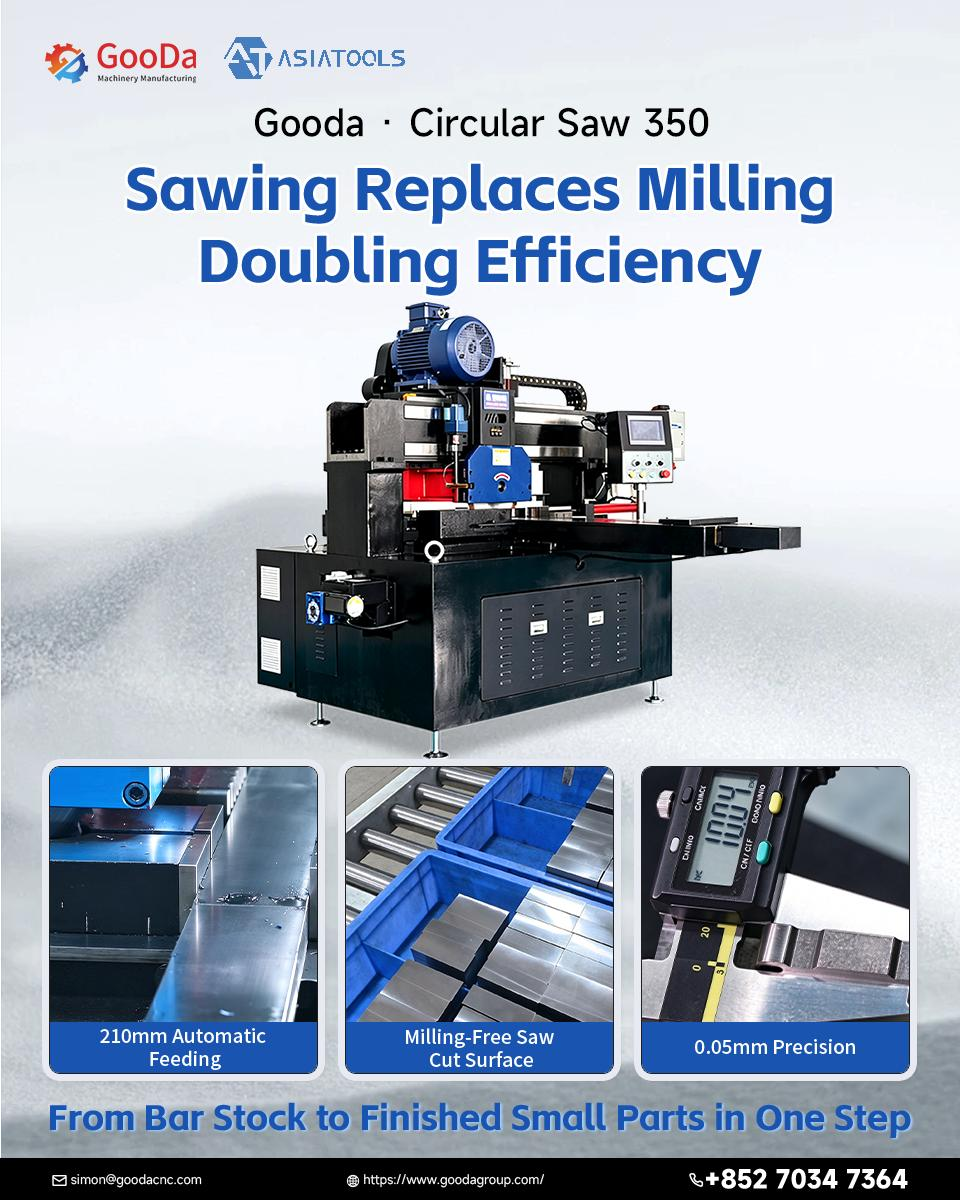
For large steel blocks or plate stock, the equipment category is different. A CNC machine such as the ASIATOOLS PCS-2300NC flat-plate circular saw uses hydraulic clamping, carbide cutting and controlled feed. Its capacity and cost should not be compared directly with a portable 355 mm saw.
How to Check a Saw Before Buying
Check the workpiece
- Measure the largest width, height, diagonal and wall thickness.
- Check whether the 45-degree cutting capacity is lower than the straight-cut capacity.
- Allow for the blade kerf and at least 10 mm of practical capacity above the largest regular workpiece.
- Confirm that the vise can support thin-wall tube without crushing it.
Check the machine
- Confirm the manufacturer’s cutting chart rather than relying only on blade diameter.
- Check the fence and 45-degree stop with a calibrated square or angle gauge.
- Look for a rigid vise, a secure guard and overload protection.
- Match blade material, tooth count and RPM to the steel grade and section size.
Run a practical test
Bring the actual tube, bar or plate to the supplier if possible. Make three cuts on each machine and record:
- Cut time from blade contact to separation;
- Length error measured with a caliper;
- Mitre gap measured after placing two pieces together;
- Burr height before grinding;
- Visible heat tint or distortion;
- Time required for deburring and cleanup.
Use the same material, blade condition, clamping method and cut angle for both machines. Three identical test pieces are more useful than a single showroom cut.
Safety Requirements
Clear the complete spark path and remove gasoline, paper, wood dust, packaging and other combustible materials. Follow the site’s hot-work and fire-prevention procedure rather than using a fixed distance as a universal safety rule.[2]
Measure actual noise exposure where possible. OSHA’s requirements depend on sound level and exposure duration, not on machine type alone. Hearing protection may be required, and dual protection may be appropriate for high-exposure cutting tasks.[3]
Wear safety glasses with suitable side protection and add a face shield where sparks, fragments or wheel failure could reach the face. OSHA’s eye and face protection requirements should be applied to the specific hazard and workplace assessment.[4]
- Clamp the workpiece before cutting.
- Inspect the wheel or blade before installation.
- Never use a wheel with cracks, damage or an unsuitable speed rating.
- Keep loose clothing, hair and hands away from the rotating assembly.
- Use task lighting that clearly shows the cut line, vise and guard.
- Follow the machine manual for wheel changes, blade changes and maintenance.
Common Questions
Is a cold saw better for stainless steel?
Usually, yes, when the stainless tube is thin, visible or dimension-sensitive. A suitable blade and the correct cutting method reduce heat tint and distortion. Abrasive cutting remains possible for rough work, but the edge normally needs more finishing.
Can an abrasive chop saw cut hardened steel?
It may be able to cut some hardened or contaminated stock, but wheel selection, machine power and the manufacturer’s material limits still apply. Do not assume that a wheel rated for carbon steel is suitable for every alloy or hardness.
Is a cold saw worth the higher price?
It is usually worth considering when the job has repeated cuts, visible joints, stainless tube, tight length control or significant deburring labor. For fewer than roughly 50 rough cuts per month, an abrasive saw often has the lower entry cost. These are planning breakpoints, not fixed rules.
Can an angle grinder replace a chop saw?
No. An angle grinder is useful for trimming, repair work and small adjustments, but it does not provide the same clamping, repeatability or cutting speed as a dedicated chop saw.
Final Choice
- Choose a cold saw for clean mitre joints, thin stainless, repeatable batch work and lower downstream finishing time.
- Choose an abrasive chop saw for occasional carbon-steel cutting, jobsite work, rusty stock and a lower initial budget.
- When the choice is unclear, test three cuts with the actual material and measure length, angle, burr and finishing time before placing the order.