

Gray Iron vs Ductile Iron for Machine Tool Castings
Buy raw castings if your shop can handle roughing, finishing and inspection without delaying other work. Buy pre-machined castings if the supplier can remove those operations at a lower total cost or free up a busy machine. Pre-machined does not mean ready to assemble: the purchase drawing must state which surfaces are finished and which still need machining.
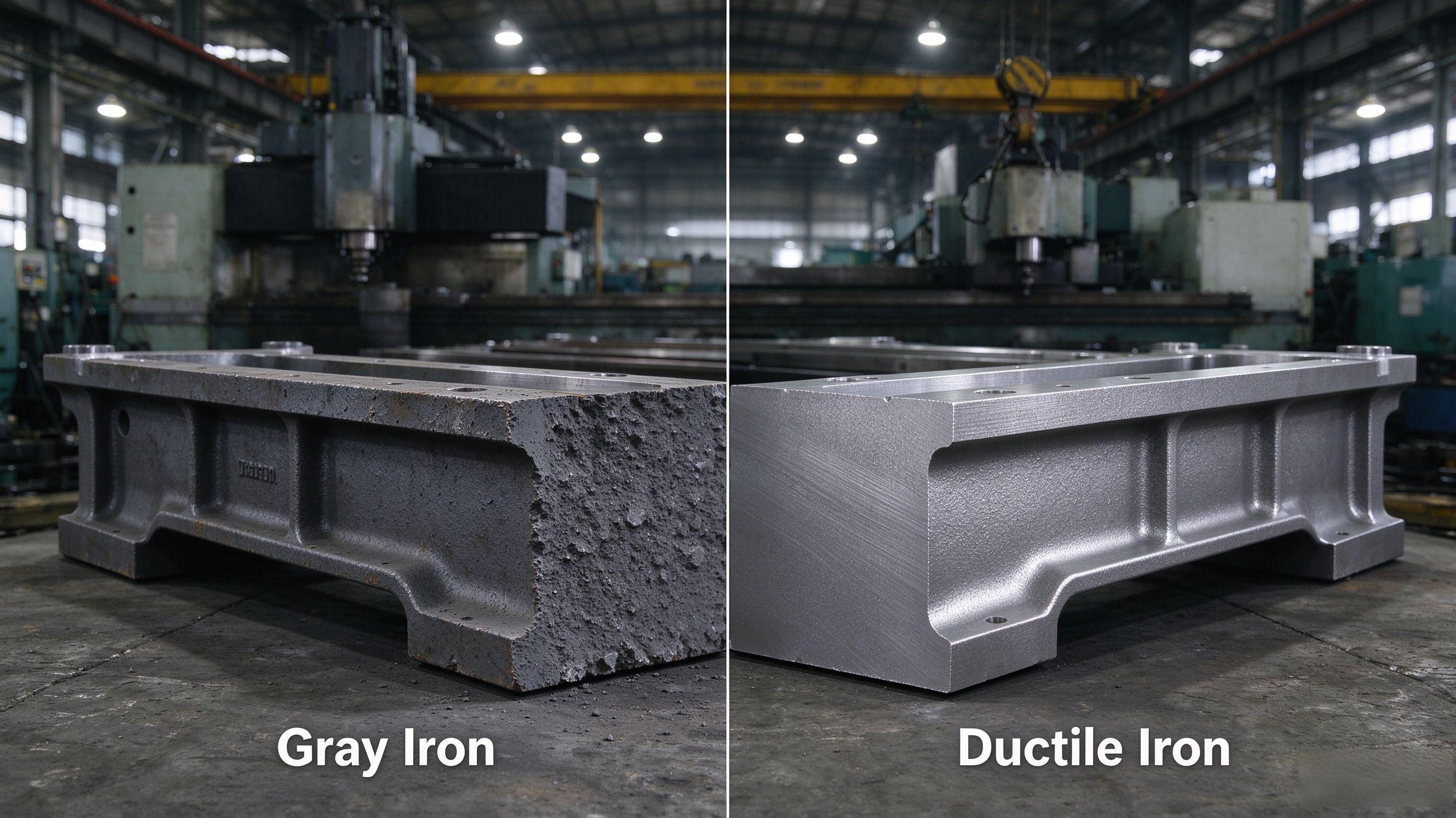
Machine Tool Castings: Should You Buy Raw or Pre-Machined Parts?
Compare the Delivery Scope
A supplier may use “pre-machined” for anything from a few milled datum pads to a nearly finished bed. Before comparing prices, mark each machined face and bore on the same drawing revision.
| Purchase condition | Supplier’s agreed scope | Work remaining at your shop |
|---|---|---|
| Raw casting | Casting, cleaning and any specified heat treatment or inspection | Datum creation, roughing, finishing and dimensional inspection |
| Pre-machined casting | Specified roughing or semi-finishing, with agreed datums and remaining stock | Unfinished faces, final bores, grinding or scraping as shown on the drawing |
| Fully machined casting | All contracted machining and inspection | Incoming checks, cleaning and assembly preparation; fitting work if specified |
Specify casting tolerances separately from machined tolerances. ISO 8062-3 covers dimensional and geometrical tolerances and machining allowance grades for castings; it does not assign one tolerance grade to every machine-tool bed.[1]
Calculate Cost to the Same Finished Condition
Compare both routes at the point where the casting is ready for your next production operation. A raw casting price excludes machining. A pre-machined quote may still exclude final grinding, bore finishing, freight or inspection.
The following is a hypothetical budgeting example for one 1.5-ton bed, not a supplier quotation or an ASIATOOLS project record. Both routes include the work needed to reach the same drawing requirements.
| Cost item | Buy raw | Buy pre-machined |
|---|---|---|
| Purchase price | RMB 12,000 | RMB 20,000 |
| Machining at the buyer’s shop | 35 hours × RMB 280 = RMB 9,800 | 10 hours × RMB 280 = RMB 2,800 |
| Freight, handling and inspection | RMB 1,200 | RMB 1,200 |
| Total before unexpected rework | RMB 23,000 | RMB 24,000 |
In this example, pre-machining costs RMB 1,000 more, or about 4.3%, and releases 25 machine hours. That is RMB 40 for each hour released. A shop with spare capacity may keep the work in-house. A shop with profitable jobs waiting for that machine has a different calculation.
Use a machine-hour rate that includes the costs you actually incur. Check whether tooling, setup and inspection are already included before adding them again. Spread dedicated fixture costs over the confirmed order quantity, not an uncommitted annual forecast.
Check Equipment Beyond Table Length
A “3 m gantry” is not enough information to approve a 3 m casting. Check axis travel, clearance between columns, spindle reach, fixture height, table load and lifting access. Fixtures and supports add weight and occupy working space.
A double-column machining center may suit long mounting faces, while a horizontal boring and milling center may provide better access to side bores. Neither machine’s positioning specification alone proves that a supported, clamped casting will meet its finished geometry.
Keep Enough Stock for Finishing
State the remaining allowance for each unfinished feature, including whether it is per face or on diameter. “Leave 0.5 mm” is ambiguous: 0.5 mm on a bore diameter means 0.25 mm of radial stock.
For example, if an approved process calls for 0.5 mm on each of two opposing faces, their delivered separation is 1.0 mm above the final dimension. This is a drawing example, not a recommended allowance for every casting.
If your shop will carry out final surface grinding, agree on the delivery datums, support points and stock distribution before roughing begins. A casting can have enough stock overall but too little at one corner.
Verify Stability and Defects Separately
Residual stress can cause movement when material is removed. Porosity, shrinkage and inclusions are casting defects. Stress-relief treatment does not remove those defects.
Ask for the agreed heat-treatment record and identify any treatment between roughing and finishing. Do not prescribe one temperature, holding time or number of cycles for every grade and wall thickness.
Inspection should name the method, examination areas and acceptance criteria. No single ultrasonic detection percentage applies to all iron castings. Material structure, section thickness, surface condition and defect orientation affect what can be detected.
Specify the material standard and test requirements as well as the grade name. ASTM A48 classifies gray iron using tensile results from separately cast test bars; that is not a guarantee that every location in a large bed has the same strength.[2]
Approve One Part Before Releasing the Batch
For a new supplier or machining route, use a first article to check the handoff between shops. Record the incoming dimensions, remaining stock and inspection results, then compare them after your finishing operations.
- Match the casting identification to the material and treatment records.
- Check that every unfinished face and bore has usable stock.
- Confirm that the supplier’s datums can be used in your fixtures.
- Record actual setup, machining and inspection hours.
- Inspect finished geometry under the agreed support and temperature conditions.
Those records provide a defensible basis for the next order’s cost and lead time. A supplier’s sample report cannot replace measurements from your own part.
Set Dates and Responsibility Before Ordering
Ask for separate dates for casting completion, supplier machining, dispatch and readiness for your next operation. Include transit, incoming inspection and your remaining machining. A shorter supplier delivery date may still produce a later assembly date.
The purchase agreement should also cover defects discovered during finishing: who authorizes repair, who pays for machining already completed, who pays return freight and how replacement dates are agreed. Pre-machining exposes some defects earlier, but it does not automatically transfer every loss to the supplier.
For the final decision, request two quotations against one drawing: raw and pre-machined. Compare total cost, remaining machine hours and the date each route reaches the same finished condition.