

1045 steel (equivalent to German C45 or US AISI 1045) is a quintessential medium carbon steel.
It is widely used in manufacturing moderate-strength mechanical parts such as shafts, gears, and mold templates.
Before formal CNC machining begins, determining how much allowance a blank should retain directly affects machining costs, tool life, heat treatment deformation control, and finished part dimensional stability.
This article systematically examines the complete chain from blank dimension selection and rough machining strategy to stress treatment methods, providing production-validated parameter references for shop floor engineers.
Determining 1045 steel CNC rough machining allowance is essentially a comprehensive judgment across three dimensions: material characteristics, machine tool rigidity, and heat treatment process route.
· Material characteristics include hardenability and thermal stress distribution.
· Machine tool rigidity affects cutting depth, feed rate, and deformation control.
· The heat treatment process route determines how much allowance must remain before and after rough machining.
Selecting standard-spec blanks, maintaining 2mm to 3mm single-sided allowance before heat treatment, and checking deformation trends after rough machining to decide whether stress-relief annealing is needed -- executing these three steps properly covers the machining needs of most moderate-complexity parts.
Data sources: AZOM Materials Database[1], AZOM Medium Carbon Steel Overview[2], Springer Cutting Force Study[3], tec-science Stress Relief Annealing[4], WorldMaterial 1045 Steel Properties[5].
Selecting Blank Dimensions
Common Steel Thicknesses
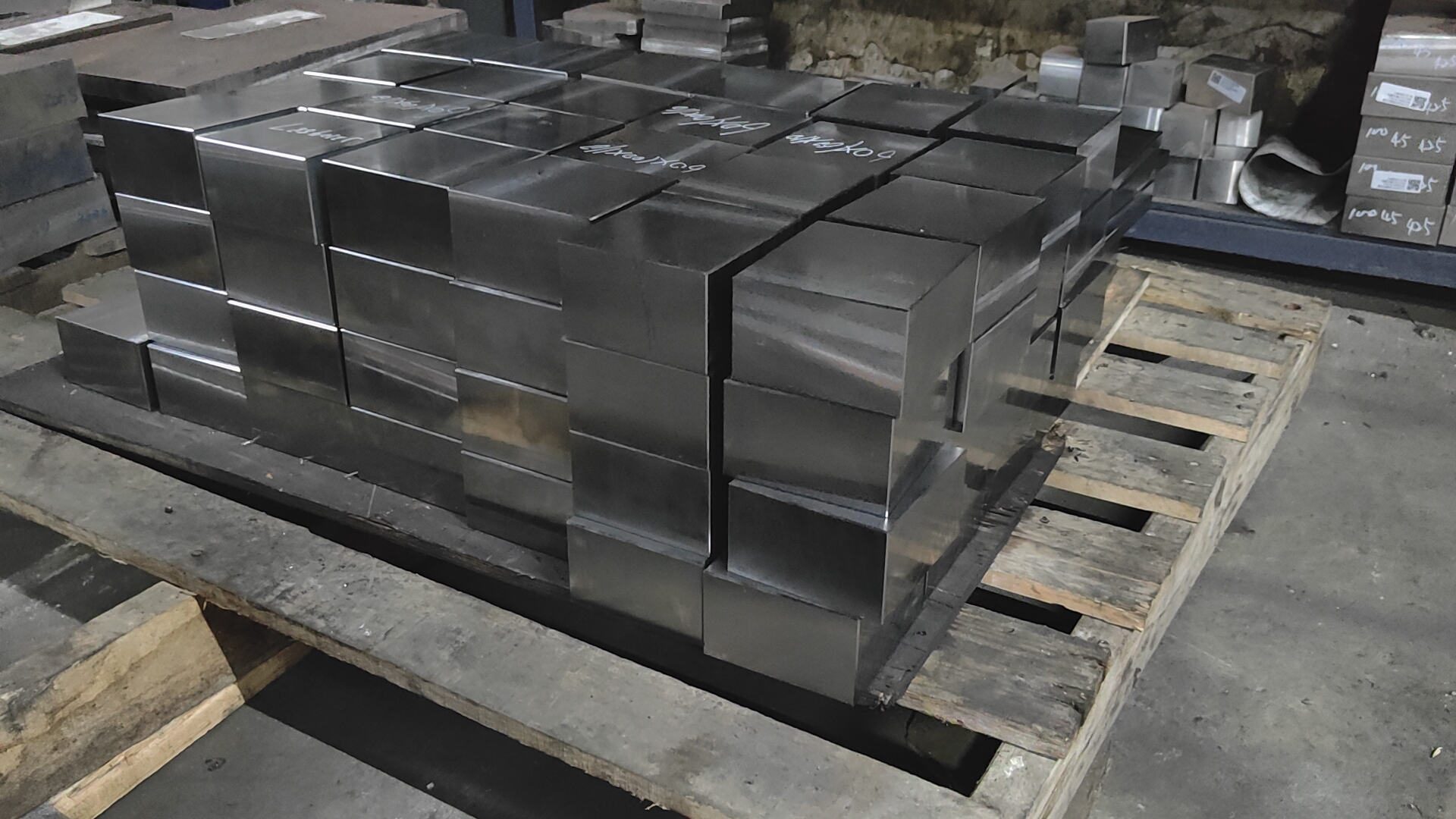
1045 steel (C45 steel) is commonly available in hot-rolled or normalized medium plate form on the domestic market.
| Common stock thickness | Availability note |
| 12mm, 15mm, 20mm, 25mm[5] | Common domestic market thickness range |
| 30mm, 35mm, 40mm[2], 50mm | Common domestic market thickness range |
| 60mm or 80mm | Non-standard thicknesses that usually require forward orders from steel mills or major distributors |
| 15 to 30 working days | Typical lead time for non-standard thicknesses |
From a rough machining perspective, selecting a blank that is too thin directly compresses the available machining allowance.
· When tool paths approach the finished contour, actual cutting volume may exceed expectations.
· This accelerates tool wear or may even cause insert fracture.
· The risk of finished dimensions falling below minimum tolerances increases dramatically.
· If the workpiece deforms during heat treatment, there will be insufficient stock left for re-machining correction.
Choosing an excessively thick blank does provide a safety margin for machining.
However, it directly drives up material costs and rough machining labor hours.
| Example part | Thickness change | Cost impact |
| 1045 steel part of 200mm × 150mm × 30mm | Blank thickness increases from 30mm to 40mm | Material weight increases by approximately 33% |
| Same example | Extra milling volume is also added | Total cost increases by 15% to 25% |
The guiding principle is to prioritize the standard size closest to the target finished thickness while ensuring the minimum machining requirements for the finished part.
In actual production, if the finished part requires a total thickness of 20mm, it is advisable to select a 25mm or 30mm hot-rolled plate as the blank.
It is not advisable to pursue a closer-but-non-standard 22mm thickness.
· Non-standard sizes have longer lead times.
· They are typically priced 10% to 20% higher than equivalent standard plates.
China's 1045 steel, corresponding to German C45 or US AISI 1045, plate supply specifications follow GB/T 711-2017 "Hot-Rolled Steel Plates and Strips."
Common thickness tolerance grades are PT.A, which means ordinary accuracy.
For blank material selection for rough machining, the practical significance of understanding this tolerance grade is that a nominally 25mm hot-rolled plate may actually fluctuate between 24.5mm and 25.6mm.
This fluctuation range must be fully covered by the machining allowance before finished part machining.
Material surface condition is another critical factor in selection.
· Hot-rolled plate surfaces are typically covered with a layer of oxide scale.
· This oxide scale is a FeO/Fe₂O₃ mixed layer, approximately 50μm to 150μm[2] thick.
· It is completely removed during the first rough machining pass.
· It does not count toward effective machining allowance.
In other words, if the blank drawing specifies a "finished thickness of 20mm" and you select a 25mm hot-rolled plate, the actual effective allowance is only about 4mm.
This is the remaining machining capability after subtracting the oxide scale and basic thickness deviation.
Blank flatness is also an indicator that requires on-site verification during material selection.
If residual stress in a hot-rolled plate has not been adequately released after straightening, it tends to warp under the rapid cutting forces of CNC machining.
| Condition | Possible result | Recommendation |
| 1045 hot-rolled plate with 30mm thickness and length exceeding 500mm | If residual stress exceeds standards, the first rough milling pass on one side often produces warping of 0.3mm to 0.8mm[2] | Verify blank flatness on site |
| Workpieces exceeding 400mm in the length direction | Uneven allowance distribution may occur during second-side machining | Inform the supplier that the material is for CNC machining |
| When necessary | Stress distribution uniformity needs improvement | Request normalizing treatment |
Initial Allowance Recommendations
Determining the machining allowance for 1045 steel before rough machining is not a matter of guesswork.
It requires a systematic decision based on three variables:
1. Workpiece dimensions
2. Machine tool rigidity
3. Heat treatment condition
For medium and small 1045 steel workpieces with overall dimensions in the 100mm to 300mm range and thickness between 20mm and 50mm, leaving a single-sided allowance of 2mm to 3mm before rough machining is an empirically validated range supported by extensive production practice.
| Allowance basis | Typical value | Purpose |
| Surface decarburized layer of normalized hot-rolled plate | Typically 0.5mm[3] to 1.5mm[2] deep | Must be covered by the rough machining allowance |
| Effective stock removal for semi-finish machining | 0.5mm to 1.0mm | Leaves material for subsequent machining |
| Remaining allowance space | Included in the 2mm to 3mm range | Absorbs heat treatment deformation |
If the workpiece length exceeds 500mm, placing it in the slender shaft or large plate category, the single-sided allowance should be expanded to 3mm to 4mm.
The reason is that during heating and cooling in a heat treatment furnace, temperature gradient non-uniformity causes thermal stress deformation proportional to the square of the workpiece length.
The deformation of an 800mm-long 1045 steel part after quenching is typically more than four times that of a 200mm-long workpiece.
Without sufficient allowance coverage, achieving dimensional requirements through subsequent corrective machining is simply impossible.
The surface quality of rough machining before heat treatment directly affects heat treatment deformation.
· If the rough-machined workpiece surface retains deep tool marks with depth exceeding 0.1mm, these stress concentration points become preferred crack initiation sites during heat treatment.
· Before heat treatment, it is recommended to lightly skim all machined surfaces with a finishing mill, not a rough mill.
· Surface roughness should be controlled to Ra 3.2μm or better.
· This can effectively reduce the risk of heat treatment cracking and excessive deformation.
The core reference basis for allowance calculation is the post-heat-treatment deformation pattern of the workpiece, not its pre-heat-treatment initial state.
As a medium carbon steel, 1045 steel exhibits relatively reliable hardenability when the diameter or thickness is below 25mm.
Beyond this critical size, quenching effectiveness decreases noticeably.
When the workpiece cross-section dimension is between 30mm and 60mm, the difference in quenching cooling speed across the entire cross-section leads to increased hardness gradients between the core and surface.
This non-uniform hardened structure is the direct cause of heat treatment deformation.
At the numerical level, a practical allowance estimation formula has been developed through actual factory production.
| Formula item | Typical value | Note |
| Total allowance (single-sided) | Heat treatment deformation compensation value + Surface decarburized layer depth + Finish machining reserve | Practical allowance estimation formula |
| Heat treatment deformation compensation value | Typically 1.0mm to 1.5mm[5] | For normalized or annealed 1045 steel blanks |
| Surface decarburized layer | Approximately 0.3mm to 0.8mm | For normalized condition |
| Hot-rolled oxide scale | About 0.05mm[1] to 0.15mm | Must be removed during machining |
| Milling finish machining reserve | 0.3mm to 0.5mm | Depends on the subsequent process |
| Grinding reserve | 0.05mm to 0.10mm | Lower than milling finish machining reserve |
Combining these values, the typical single-sided allowance range before rough machining of 1045 steel can be summarized as follows:
· 1.5mm to 2.0mm for ordinary precision workpieces.
· 2.5mm to 3.5mm for high-precision or slender workpieces.
These values apply to blanks in normalized or annealed heat treatment condition.
If the blank is in the quenched condition, already quenched and tempered, the deformation risk is greatly reduced, and allowance can be reduced by 30% to 50%[4].
However, such blanks typically have higher hardness, HB 250 to 320, and impose completely different requirements on tools and cutting parameters.
This is outside the scope of this article's rough machining allowance discussion.
Dimensional Tolerance Considerations
There is a direct correlation between blank dimensional tolerances and machining allowances.
Domestic hot-rolled plate thickness tolerances follow GB/T 708-2019 "Dimension, Shape, Weight and Permissible Deviations of Cold-Rolled Steel Plates and Strips" or GB/T 709-2019 "Dimension, Shape, Weight and Permissible Deviations of Hot-Rolled Steel Plates and Strips."
Different accuracy grades correspond to significantly different tolerance band widths.
| Nominal thickness example | Accuracy grade | Permitted deviation | Actual thickness range |
| 25mm | Ordinary accuracy (PT.A) | ±0.8mm[5] | 24.2mm to 25.8mm |
| 25mm | Higher accuracy (PT.B) | ±0.5mm[5] | 24.5mm to 25.5mm |
For CNC machining, this means that for every 0.1mm deviation in blank thickness, during the 2mm rough machining stock removal process, the effective finish machining allowance fluctuates by 0.1mm.
This variable progressively accumulates through multi-step machining.
Blank length and width tolerances are equally important.
| Blank dimension item | Typical tolerance | Machining impact |
| Hot-rolled medium plate length and width | Typically +10mm/-0mm[5] | The plate may be longer than nominal but never shorter |
| Some precision-cut plates | ±3mm[5] | Higher dimensional accuracy |
| Actual blank length exceeds nominal value by 5mm to 10mm | Longer than programmed expectation | Contour rough machining or cavity machining will experience increased air-cutting paths and extended cutting time |
| Actual blank length falls short by more than 5mm | Shorter than programmed expectation | Under-cutting may occur, and tool paths may extend beyond the blank boundary, triggering collision risks |
Therefore, physically measuring all three dimensions upon blank delivery is a mandatory step for any responsible programmer before setting the machining coordinate system.
This procedure typically takes no more than five minutes but completely avoids the above risks.
Understanding the relationship between tolerances and allowances from a process route perspective requires distinguishing between two fundamentally different routes.
1. Blank → Rough Machining → Heat Treatment → Semi-Finish Machining → Finish Machining
2. Blank → Rough Machining → Semi-Finish Machining → Heat Treatment → Finish Machining
The allowance requirements for these two routes are completely different, and the choice must be determined before programming.
| Process route | Allowance logic | Risk if selected incorrectly |
| Heat treatment in the middle | Rough machining allowance must cover heat treatment deformation, resulting in larger allowances. Semi-finish machining after heat treatment primarily removes heat treatment deformation to restore dimensions close to finished specifications. | Using insufficient allowance causes finished part scrapping due to heat treatment deformation. |
| Heat treatment last | Semi-finish machining allowance must be precisely controlled because after heat treatment there is no subsequent stock removal step. The finished dimensions are essentially set. | Using excessive allowance unnecessarily increases finish machining costs by 30% to 50%. |
For 1045 steel, the core basis for determining which route to use is the finished part hardness requirement.
· If the drawing specifies finished hardness of HRC 45 to 50[2], such as mold templates and gear-type parts, the first route must be used.
· Quenching is the necessary process to achieve this hardness range.
· Stock removal for semi-finish and finish machining after quenching is typically 0.2mm to 0.5mm.
· If the drawing only requires HB 180 to 220[1], ordinary mechanical parts can be satisfied by normalizing treatment.
· In this case, the second route may be considered to simplify the process.
Rough Machining Strategy
Cutting Depth Settings
The primary consideration when setting cutting depth for 1045 steel rough machining is workpiece clamping stability.
The rapid Z-axis movement and axial cutting forces of a CNC vertical machining center can cause tiny elastic deformation or deflection in the workpiece.
If cutting depth is set too large, this deflection increases dramatically, actual cutting thickness exceeds programmed theoretical values, and peak cutting forces surpass expected ranges.
| Workpiece and clamping condition | Recommended cutting depth | Key control point |
| Small workpieces clamped with a vise, clamping height within 30mm | 2mm to 4mm[3] | Ensures metal removal efficiency of 30cm³ to 60cm³ per minute while staying within clamping rigidity capacity |
| Depths exceeding 4mm under vise clamping conditions | Not recommended | Easily causes workpiece lift, with severe lift reaching 0.2mm to 0.5mm |
| Medium and large workpieces clamped with process bolts or vacuum chucks | 4mm to 8mm[3] | Feed rate must be simultaneously increased to maintain reasonable chip load per tooth |
The direct indicator for judging whether cutting depth is appropriate is observing spindle current load.
· Under normal conditions, rough machining spindle current should be controlled between 60% and 80%[3] of rated current.
· Exceeding 85% indicates excessive cutting force and requires immediate reduction of cutting depth or feed rate.
· Below 50% indicates overly conservative cutting parameters and suboptimal machining efficiency.
Setting rough machining cutting depth also needs to consider the cutting parameter recommendations provided by tool suppliers.
| Tool or machine condition | Recommended range or requirement |
| Mainstream coated carbide tools on the market, such as ISO P10 to P20[1] material grades | Typically recommend cutting depths in the 2mm to 6mm[1] range for 1045 medium carbon steel |
| Boundary condition 1 | Sufficient workpiece clamping rigidity |
| Boundary condition 2 | Machine tool power above 7.5kW[1] |
| Boundary condition 3 | Adequate coolant supply |
| If any one condition is not met | Cutting depth should be moved toward the lower end, 2mm to 3mm |
Cutting depth is neither more efficient when larger nor safer when smaller.
When cutting depth is too small, such as below 0.5mm, the chip thickness during tool tip traversal over the workpiece surface becomes excessively thin.
Cutting forces become abnormally high, and the tool tip primarily squeezes rather than shears the workpiece surface, accelerating tool wear.
This explains why in some shops, even with high-quality coated tools, rough machining tool life falls far below expectations.
The problem is often high-speed rubbing wear caused by per-pass cutting depth set too small, not cutting parameter selection errors.
For multi-step profile machining, a "layered rough milling" strategy is recommended.
1. First use a deeper cutting depth of 4mm to 6mm with large tool paths to quickly remove most of the stock.
2. Then use a shallower cutting depth of 1mm to 2mm for a "root cleaning" pass.
3. This trims profile sidewalls and removes the residual stress layer left by the previous pass.
This layered strategy's comprehensive efficiency is 20% to 35% higher than single-pass depth, while improving profile machining accuracy by one grade.
Tool Selection
Tool selection for 1045 steel rough machining requires first distinguishing between two machining phases:
1. Face machining, including step faces and bottom surfaces.
2. Profile machining, including external contours and cavity sidewalls.
The tool selection logic for these two machining types is fundamentally different.
| Machining type | Recommended tool | Key parameters |
| Face rough machining | 80° diamond-faced mills, square or round insert face mills | Insert material recommended as P20 to P30 grade coated carbide |
| Face rough machining of 1045 steel | Coated carbide inserts | Can withstand 0.15mm to 0.25mm per tooth feed |
| Face rough machining cutting speed | 150m/min to 200m/min[1] | Minimizes wear rate and achieves tool life of 30 to 60 minutes per insert before replacement |
| Medium-sized vertical machining centers | 7.5kW to 11kW power | A 4mm deep cut with step-over set at 50% to 60% of tool diameter ensures both efficiency and tool life maintenance |
Profile rough machining, including cavity machining, recommends 55° or 65° helix end mills.
· For closed cavities, a solid carbide helix end mill is preferred.
· The helix angle should be 30° to 38°[1].
· Its chip evacuation flute design smoothly evacuates 1045 steel chips upward.
· This avoids chip accumulation at cavity bottoms that causes tool sticking and re-cutting problems.
For shallow cavities with depth less than 3×[1] the tool diameter, indexable corncob end mills may be considered.
Their multiple cutting edges simultaneously engaged provide 40% to 60% higher metal removal rates than ordinary end mills, though with correspondingly increased noise and machine wear.
Tool diameter selection is directly related to the minimum turning radius of the workpiece cavity or step.
Before tool selection, programmers must reference the workpiece 3D model and measure all internal corner radii and minimum cavity widths.
| Selection rule or example | Meaning |
| Tool diameter should be less than 1.5× the minimum corner radius | This leaves sufficient side milling allowance, typically 0.3mm to 0.5mm per side, for finishing the corner smoothly |
| Internal corner R3mm | The maximum diameter for rough machining end mill should not exceed R2mm, which means 4mm diameter |
| Using a 4mm diameter end mill to machine an R3mm corner | Provides approximately 1mm of stock per side and requires one additional side milling pass during finish machining |
| Selecting a 6mm diameter tool for the same R3mm corner | The corner will directly under-cut, making it impossible to produce a qualified R3mm rounded corner |
Tool length and extension ratio are also easily overlooked selection criteria.
1045 steel generates significant lateral cutting forces during rough machining.
· If tool extension length exceeds 3× the tool diameter, such as a 10mm diameter tool extended beyond 30mm, the machining process easily produces deflection and vibration marks.
· The solution is to orient the workpiece reference surface upward as much as possible to minimize tool extension.
· For cavities requiring deep cutting, use extended-shank tools, not just extended cutting edges, to increase overall rigidity.
Feed Rate Adjustment
Feed rate, meaning feed per minute, is the most sensitive parameter in CNC machining affecting both tool life and workpiece surface quality.
During 1045 steel rough machining, the matching relationship between feed rate and cutting depth requires adherence to one fundamental principle.
Greater cutting depth demands lower feed rate; smaller cutting depth permits correspondingly higher feed rate.
The product of both, chip load per tooth (fz), is the true core indicator determining cutting condition.
For coated carbide tools machining 1045 steel, the recommended chip load per tooth fz ranges from 0.12mm/z to 0.25mm/z[3].
| Parameter combination | Cutting depth | Feed rate | Spindle speed | Teeth | Chip load | Suitable condition |
| Deep depth + low feed | 4mm | 300mm/min | 800rpm | 4 teeth | Approximately 0.09mm/z[3] | Conservative, suitable for workpieces with rigidity concerns |
| Shallow depth + high feed | 2mm | 600mm/min | 1200rpm | 4 teeth | Approximately 0.12mm/z | Higher efficiency, suitable for systems with sufficient rigidity |
Monitoring whether feed rate is reasonable during machining primarily relies on observing chip morphology.
| Chip appearance | Meaning | Adjustment |
| Light yellow or orange-yellow, slightly curled short chips, approximately 5mm to 15mm[3] long | Ideal 1045 steel chips | Cutting condition is reasonable |
| Dark blue or black chips | Cutting temperature is too high | Reduce feed rate or increase cutting speed |
| Gray-white powdery chips or needle-shaped long chips | Feed is too small, and the tool is rubbing rather than shearing the workpiece surface | Increase feed rate |
In cavity machining, the feed rate adjustment strategy differs significantly from face machining.
The enclosed cavity interior makes chip evacuation difficult.
If feed rate is too fast, chips become compressed and recut within the cavity, causing cutting temperature to rise sharply and triggering tool sticking.
Tool sticking means chips adhere to the tool tip and continue to cut, equivalent to the tool tip directly rubbing against high-temperature metal.
Once tool sticking occurs, the surface quality of that machining pass immediately deteriorates, and tool life shortens by more than 50%.
Cavity rough machining recommends adopting a "peck drilling-style" layered feed strategy.
1. Instead of continuous feeding to depth, the tool uses segmented entry.
2. The tool feeds to a certain depth and then rapidly retracts to the safe plane.
3. During retraction, coolant flushes chips away.
4. The tool then rapidly feeds to the next depth.
Although this rhythmic feed method slightly increases air travel time, it keeps cavity chip accumulation within safe limits.
Its actual machining efficiency is higher than continuous feed because it avoids the downtime and tool change time caused by tool sticking.
For thin-walled 1045 steel part rough machining, feed rate also requires additional consideration of vibration issues.
· When the ratio of workpiece wall thickness to tool diameter is less than 1:5, workpiece vibration caused by cutting forces becomes the dominant factor.
· At this point, feed rate should be reduced to 60% to 70% of normal value.
· At the same time, check whether tool run-out exceeds 0.02mm[1].
· Excessive run-out causes actual cutting thickness to fluctuate violently during each tooth cycle, accelerating micro-chipping.
Stress Treatment Methods
Annealing and Aging
Annealing and aging treatment are two preparatory heat treatment processes commonly applied to 1045 steel after rough machining and before final heat treatment.
They are aimed at creating optimal microstructure and stress distribution conditions for the final heat treatment.
These two processes serve different functions and are applied at different timings—they cannot be used interchangeably.
| Process | Temperature and time | Cooling method | Main effect |
| Full Annealing | 830°C to 860°C[2], which is 30°C to 50°C above Ac3 | Slow furnace cooling, typically controlled at ≤20°C/hour[5] | Transforms the structure into equiaxed pearlite plus ferrite |
| After full annealing | Hardness reduced to HB 150 to 180[2] | Plasticity significantly improved | Steel becomes suitable for semi-finish and finish machining |
| Aging treatment | 200°C to 300°C[2], held for 2 to 8 hours | Air cooling | Allows residual stresses to slowly relax at low temperature |
| Low-temperature stress-relief aging for welded structures or complex cavities | 150°C to 200°C[2] for 4 hours[1] | Applied after rough machining | Can reduce welding residual stress and rough machining cutting residual stress by 60% to 70% |
After full annealing, 1045 steel has low hardness, small cutting resistance, and long tool life.
More importantly, steel with uniform annealed structure exhibits more consistent austenitizing during final quenching.
Its quenching deformation is 30% to 40% lower than comparable parts that were not annealed.
Aging treatment, also called precipitation hardening or low-temperature aging, is completely different.
It is not a high-temperature soaking process.
It reheats rough-machined workpieces to the 200°C to 300°C[2] range, holds for 2 to 8 hours, then air cools.
The purpose of aging treatment is to allow residual stresses within the steel to slowly relax at low temperature while enabling trace alloying elements such as Mn and Si present in 1045 steel to form fine precipitates.
This further stabilizes the microstructure.
In actual production planning, the choice between annealing and aging depends on the workpiece's final heat treatment requirements and economic considerations.
| Process | Typical cycle | Cost and time implication |
| Full annealing | Approximately 8 to 12 hours, including 2 hours heating, 3 to 5 hours soaking, and 3 to 5 hours furnace cooling | Energy consumption, fixtures, and time costs are significantly higher |
| Low-temperature aging | 3 to 6 hours on the same equipment | Shorter cycle and lower time cost |
For high-volume production enterprises, this time difference multiplied by monthly production batches represents a non-negligible labor cost.
Another practical concern requiring attention is dimensional change.
After full annealing of 1045 steel, volume contraction during cooling produces approximately 1.5‰ to 2‰[5] shrinkage in the length direction.
A 300mm-long workpiece measures approximately 298.5mm to 299.5mm after annealing.
· Programming for rough machining must anticipate this shrinkage.
· An extra 0.1mm to 0.15mm single-sided allowance should be added in the rough machining operation.
· If the rough machining allowance itself is only 1.5mm, the 0.4mm to 0.5mm shrinkage after annealing may result in insufficient semi-finish machining allowance.
For ordinary mechanical parts with low precision requirements, many shops skip annealing and proceed directly to the quench-and-temper cycle.
While this approach saves time and cost in single-piece and small-batch production, 1045 steel's hardenability begins to decline noticeably when cross-section exceeds 40mm.
This may prevent full hardening through the core and cause non-uniform hardness distribution.
If the workpiece diameter or thickness exceeds 40mm and the drawing requires consistent surface and core hardness, skipping the annealing step should be avoided.
Thermal Stress Relief
Thermal stress relief is the most underestimated link in the entire 1045 steel processing chain from blank to finished part.
Thermal stress originates from temperature gradient non-uniformity during material smelting and rolling processes.
It lies dormant within the blank and is gradually released during subsequent machining, causing unpredictable workpiece deformation.
Understanding the origin and release patterns of thermal stress is the cognitive foundation for proper machining allowance reservation.
During the cooling process after rolling, the surface of hot-rolled 1045 steel plate cools faster while the core cools more slowly.
This temperature differential creates a thickness-direction tensile-compressive stress state: surface in compression, core in tension.
This internal stress exists in the steel at factory delivery but typically remains in a self-balanced state, appearing normal on visual inspection, tap resonance, and ultrasonic thickness measurement.
However, once machining is performed on the steel, particularly rough machining that removes significant material volume, this self-balanced state is disrupted.
Stresses redistribute, manifesting as workpiece warping or twisting in a particular direction.
For workpieces that have completed rough machining at the blank stage, the timing of thermal stress release typically occurs when the first semi-finish machining pass cuts into the selected reference face.
This action releases part of the stress constraints on the blank surface layer.
Internal tensile stress begins transferring toward the surface, causing the workpiece to continuously and slowly deform over the following hours to days.
This phenomenon is particularly prominent in precision part machining.
The common factory observation of "reference face milled on day one, measured on day two and found to have deformed 0.15mm" is a classic stress relaxation manifestation.
Three stress relief methods have proven effective in engineering practice, listed in order from lowest to highest processing temperature:
1. Natural aging
2. Vibration stress relief
3. Thermal treatment aging
| Stress relief method | Process | Effect and limitation |
| Natural aging | Place rough-machined workpieces at room temperature for 30 to 60 days[4] | Requires no equipment investment and costs nothing, but the time cost is extremely high |
| Vibration Stress Relief (VSR) | Uses an eccentric motor to generate vibrations at specific frequencies, causing forced resonance in the workpiece | Processing time is approximately 30 to 60 minutes; when properly matched, residual stresses can be reduced by 30% to 50% |
| VSR limitation | Effectiveness depends on matching vibration frequency with the workpiece's natural frequency | When improperly matched, there is virtually no effect, which limits application in precision parts |
| Thermal treatment aging, also called low-temperature stress-relief annealing | Heat workpieces to 500°C to 600°C, below the Ac1[4] temperature of approximately 723°C[4], hold for 2 to 4 hours, then air cool | Allows stress concentration regions to relax without triggering phase transformation that would alter the microstructure |
Natural aging currently mainly exists in aerospace fields with extremely high requirements for material stability.
Thermal treatment aging reduces the steel's yield strength to 60% to 70% of its room temperature value in the 500°C to 600°C range.
This allows stress concentration regions to relax through micro-yielding without triggering phase transformation that would alter the microstructure.
Engineering practice has proven that adding a 550°C × 2h stress-relief annealing cycle after 1045 steel rough machining can reduce residual stresses by 70% to 85%[4].
This makes it the most commonly used thermal stress relief method in factories today.
Checking Deformation Trends
Checking workpiece deformation trends is the critical quality control node connecting rough machining and subsequent finish machining in the 1045 steel processing chain.
This inspection is not "measuring whether workpiece dimensions are acceptable" but rather "determining whether internal stresses in the workpiece have been released to a safe level before heat treatment."
The purpose and methods of these two are completely different.
The standard procedure for deformation trend detection is coordinate measuring machine (CMM) or high-precision caliper measurement of reference face flatness and parallelism.
1. Immediately after rough machining, as quickly as possible and no more than 2 hours, measure and record initial state data for all machined surfaces.
2. Place the workpiece on the fixture shelf under room temperature, normal humidity, and no additional clamping force for 24 hours.
3. Measure the same locations again.
4. Compare the difference between the two measurement datasets.
5. If the difference exceeds 0.05mm, internal stresses in the workpiece are still releasing.
6. Continue shelving or apply vibration stress relief treatment until the deformation rate converges.
7. Convergence means deformation in consecutive shelving cycles is less than 0.02mm.
It must be emphasized that the prerequisite for this detection method is a stable measurement environment.
· If room temperature differs by more than 5°C[1] between the two measurements, thermal expansion may mask the real stress deformation data.
· For example, measuring at 22°C in the morning and 30°C in the afternoon when the workshop is near the furnace will affect the result.
· Precision measurements should be conducted in a constant-temperature workshop of ±2°C[1].
· Alternatively, all measurements should be taken after the workpiece has fully cooled to room temperature.
· This typically requires more than 4 hours of shelving.
For small and medium factories without CMM access, several practical alternative detection methods can assess deformation trends:
| Detection method | How it works | Practical meaning |
| Water droplet observation method | Place the rough-machined workpiece flat on the inspection platform and place a drop of cutting fluid or clean water on the workpiece surface. | If uneven residual stresses exist, the water droplet spreads along the stress direction and forms an asymmetrical spreading pattern. |
| Water droplet observation method result | A workpiece surface with uniform stress produces a nearly circular water droplet spread. | This method has low precision but can quickly answer whether stresses are basically released. |
| Improved non-stress version of the magnetic particle inspection method | Use a magnetic flaw detector to detect magnetic flux density changes on the workpiece surface caused by stress concentration. | When significant uneven tensile stress exists, magnetic flux density in specific regions changes, displaying as faint magnetic particle patterns on the flaw detector. |
| Magnetic particle inspection method | Requires an experienced operator. | It is highly effective for identifying potential crack initiation locations after 1045 steel rough machining. |
| Visual method combined with feeler gauge inspection | Place the workpiece on a platform and use a feeler gauge of 0.05mm to 0.20mm specifications to check whether the gaps between the workpiece reference face and platform are uniform. | If the workpiece is warped, the gap readings at the four corners will be inconsistent. |
| Visual method combined with feeler gauge inspection | Requires no specialized equipment and can be performed by any factory. | It is a sufficient preliminary screening tool for deformation trends, although it has the lowest precision. |