

Choose the blade from the saw type, steel grade, and amount of metal inside the cut. Thin sheet and tube need fine teeth that stay supported by the material. Thick solid steel needs coarser teeth with larger spaces for removing chips. For most general work, a bi-metal blade is practical. M42 bi-metal, carbide-tipped, cermet, or carbide-grit blades are better for harder steel, abrasive material, or repeated production cutting.
Before buying, confirm the blade dimensions, mounting type, maximum speed, cutting direction, and approved material range. A blade that fits the machine is not automatically suitable for cutting steel.
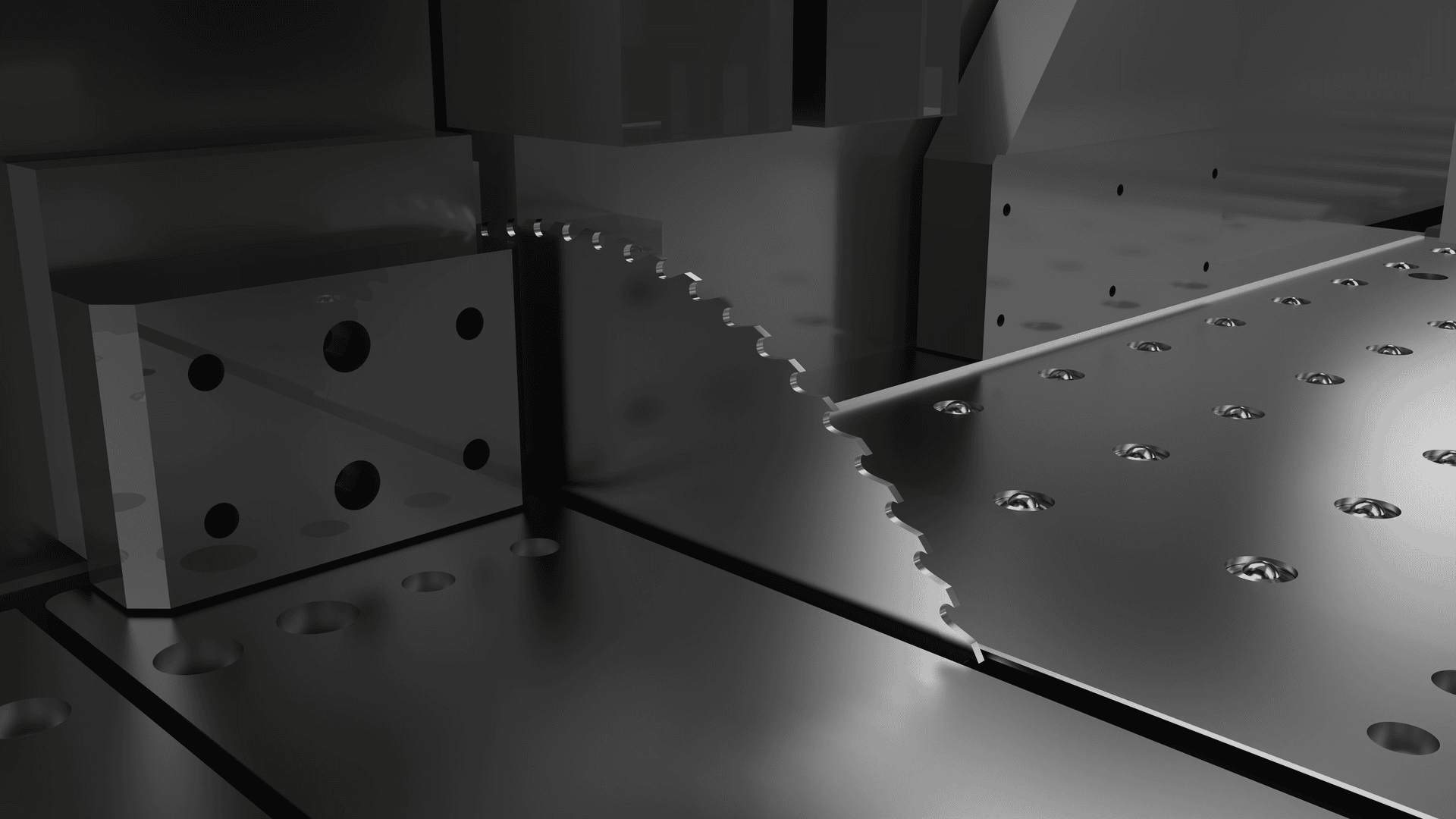
Match the Saw
Band saws, reciprocating saws, jigsaws, and circular saws use different blade designs. Do not apply one tooth chart to every machine.
| Saw | Common work | Main checks |
|---|---|---|
| Band saw | Solid bar, pipe, tube, plate, and structural profiles | Blade length, width, thickness, TPI, tension, and blade speed |
| Reciprocating saw | Installed pipe, bolts, repair work, and demolition | Blade length, TPI, body thickness, and shank |
| Jigsaw | Thin sheet, curves, slots, and panel openings | Recommended sheet thickness, TPI, width, and shank |
| Metal circular saw | Bar, tube, plate, and repeated straight cuts | Diameter, arbor, tooth count, kerf, RPM, and material rating |
Do not put a toothed metal blade on an abrasive chop saw unless the saw manufacturer approves it. Abrasive saws and toothed cold-cut saws can use different spindle speeds, guards, clamps, and motor designs.
For industrial plate and block cutting, the PCS-800NC flat plate circular saw is an example of a machine built for carbide-blade cutting of structural, tool, and alloy steel. Buyers comparing machine types can also read Circular Saws vs Band Saws for Mold Steel Cutting.
Know the Steel
Steel grade and hardness affect cutting speed and blade life. The ASIATOOLS steel guide lists common carbon, mold, tool, alloy, and stainless grades used for plates, blocks, and machined parts.
| Steel type | Common examples | Usual starting choice |
|---|---|---|
| Mild steel | Structural tube, angle, channel, flat bar | General-purpose bi-metal or steel-rated carbide |
| Medium-carbon steel | S45C, AISI 1045, shafts, machine parts | Bi-metal, M42, or carbide depending on hardness |
| Stainless steel | 304 and 316 sheet, pipe, tube, bar | Stainless-rated bi-metal, M42, or carbide |
| Pre-hardened mold steel | P20 and similar mold blocks | M42 bi-metal or a suitable carbide blade |
| Hardened steel | Heat-treated bolts, shafts, wear parts, tool steel | Premium bi-metal, carbide-tipped, or carbide grit within its hardness rating |
Mild Steel
Mild steel is normally easier to cut than stainless or hardened tool steel. A bi-metal blade covers most tube, bar, and profile work.
Check the blade path for weld metal, flame-cut edges, heavy scale, and repaired areas. These parts can be harder than the base steel. When the blade reaches a hard weld, use controlled feed to reduce tooth impact while keeping enough pressure to form chips.
Medium-Carbon Steel
S45C and AISI 1045 are widely used for shafts, fixtures, plates, and machine parts. Their exact chemical limits are not identical, but they are often treated as close equivalents for general purchasing.
Hot-rolled or normalized material can usually be cut with a suitable bi-metal blade. Heat-treated or surface-hardened parts may need M42 or carbide teeth. The article S45C Steel Properties, Applications, and Machining Tips explains common uses and machining conditions.
Stainless Steel
Stainless steel keeps heat near the cutting edge and can work-harden when the teeth rub without removing a proper chip. Use a sharp blade, controlled speed, steady feed, and secure workholding.
For one Starrett band saw reference setup, SAE 316 stainless steel is listed at about 21–24 m/min, or 68–78 ft/min.[5] This is an application example, not a universal setting. Blade type, workpiece size, hardness, coolant, and machine rigidity can change the correct speed.
Signs of rubbing include:
- A sharp squealing sound
- Very slow cutting
- Fine metal powder instead of formed chips
- Fast heat buildup
- Blade or workpiece discoloration
Stop and inspect the blade if it stops forming chips. Adding pressure to a dull blade normally produces more heat and may harden the cut surface further. LENOX confirms that both suitable bi-metal and carbide blades can cut stainless steel when the speed and feed are correct.[7]
Hardened Steel
Hardened steel does not always need the same blade. Check the actual hardness and the blade maker’s approved range.
- Premium M42 bi-metal can cut some moderately hardened steels.
- Carbide-tipped blades suit harder or more abrasive material.
- Carbide-grit blades can handle irregular hard surfaces and some materials that damage normal teeth.
- Very hard steel may need abrasive cutting, wire EDM, or another process.
A surface-hardened shaft may be difficult at the start and easier after the blade reaches the softer core. Use a controlled entry instead of applying full feed against the hard outer layer.
P20 mold steel is commonly supplied in a pre-hardened condition rather than at the high hardness of many finished cold-work tool steels. See P20 Steel Properties and Machining Performance for material and machining details.
Unknown Steel
Do not identify an old shaft, bolt, or frame only from color, magnetism, or sparks. These signs may offer clues, but they do not confirm the grade or hardness.
Check material stamps, part numbers, maintenance records, heat-treatment marks, welds, coatings, and previous blade wear. A file test can give a rough indication of surface hardness, but it cannot replace a proper hardness test.
When the steel is unknown, use a blade approved for hard or mixed metal. Begin with controlled speed and feed, then inspect the chips and teeth before continuing.
Measure the Cut
Choose tooth pitch from the steel inside the blade path, not only from the outside size of the workpiece.
A 60 mm solid bar and a 60 mm pipe with a 2 mm wall need different blades. The solid bar keeps many teeth inside metal throughout the cut. The pipe repeatedly moves the teeth through thin walls and open space.
| Workpiece | Measurement to use |
|---|---|
| Sheet | Sheet thickness |
| Flat bar | Thickness in the cutting direction |
| Solid round bar | Diameter |
| Solid square bar | Width through the blade path |
| Pipe | Wall thickness, outside diameter, and number of walls engaged |
| Square tube | Wall thickness and workpiece position |
| Angle or channel | Material thickness, position, and entry point |
| Bundle | Total blade path and movement between pieces |
A bundle of thin tubes can behave like a much thicker section because the blade passes through several walls. Clamp the pieces so they cannot turn or move.
Saw-cut dimensions also affect later milling and grinding allowance. How to Prepare Steel Blocks Before CNC Machining explains how blank size, kerf, and finishing allowance are connected.
Choose the Blade Material
| Blade material | Useful features | Typical use |
|---|---|---|
| HSS | Hard teeth and good heat resistance | Thin sheet and some jigsaw applications |
| Bi-metal | Hard HSS tooth edge with a flexible backing | General steel, tube, bar, and repair work |
| M42 bi-metal | Better hot hardness than basic HSS teeth | Stainless, alloy steel, and production cutting |
| Carbide-tipped | High wear and heat resistance | Hard steel, large sections, and high-volume cutting |
| Cermet | Clean cuts and good heat resistance | Industrial circular saw production |
| Carbide grit | Abrasive cutting edge without normal teeth | Cast iron and irregular hard material |
Bi-metal is normally the practical choice for mixed workshop work. Carbide costs more and gives the best value when the material is known, the machine is stable, and the cutting volume is high.
Choose Band Saw TPI
Band saw pitch must keep enough teeth in the steel without filling the tooth spaces with chips. Starrett recommends no fewer than three teeth and normally no more than about 10–14 teeth in the material at one time.[1]
| Band saw work | Common starting pitch |
|---|---|
| Thin-wall tube and profiles | 14/18 or 18/24 variable pitch |
| Medium-wall tube and profiles | 10/14 or 14/18 variable pitch |
| Heavy-wall pipe and profiles | 8/12 or 10/14 variable pitch |
| Solid sections around 25–50 mm | 6/10 or 8/12 variable pitch |
| Solid sections around 50–80 mm | 4/6 or 5/8 variable pitch |
| Solid sections around 80–150 mm | 3/4 or 4/6 variable pitch |
| Solid sections above about 150 mm | 2/3 or 3/4, subject to the blade chart |
These are starting points. Soft, chip-forming steel may need a coarser pitch to avoid packed gullets. Harder steel may need a different pitch to control the load on each tooth.
Choose Portable-Saw TPI
Reciprocating and jigsaw blades use a different cutting motion from band saw blades. Follow the thickness range printed on the package.
| Steel thickness | Common starting range |
|---|---|
| Below about 1.5 mm | 24–32 TPI |
| About 1.5–3 mm | 18–24 TPI |
| About 3–6 mm | 14–18 TPI |
| About 6–12 mm | 10–14 TPI |
| Thicker steel | 8–12 TPI or an application-specific carbide blade |
A Bosch T 118 G jigsaw blade uses a very fine 0.7 mm tooth pitch for steel sheet about 0.5–1.5 mm thick.[3] A different Bosch progressive-pitch bi-metal blade uses about 10–21 TPI for steel from 1.5 to 8 mm thick.[4] These examples show why the blade’s stated thickness range is more useful than TPI alone.
Check Tooth Contact
Too few teeth make each tooth carry too much load. Thin steel may catch, vibrate, or strip the tooth tips.
Too many teeth in a thick section leave too little chip space. The blade rubs, heats up, cuts slowly, and may move sideways.
Variable-pitch blades change the tooth spacing along the blade. They are useful for pipe, tube, angle, and channel because the amount of steel inside the cut changes as the blade moves.
Choose a Circular Blade
Do not use band saw or jigsaw TPI tables for circular blades. Select a circular blade by diameter, arbor, total tooth count, kerf, maximum RPM, tooth geometry, material type, and section thickness.
One Evolution 230 mm steel-cutting saw provides a useful real specification example:
- Blade diameter: 230 mm
- Blade bore: 25.4 mm
- Supplied blade: 48 teeth
- Kerf: 2 mm
- No-load speed: 2700 RPM
- Maximum mild-steel plate thickness: 12 mm
- Maximum mild-steel box-section wall thickness: 6 mm
These figures apply to that saw and blade combination, not every 230 mm blade.[6] Another machine with the same blade diameter may use a different RPM, tooth count, kerf, and thickness limit.
For industrial steel-block work, How to Choose a Circular Saw Machine for Steel Blocks covers cutting capacity, blade type, clamping clearance, and material loss.
Count Kerf Loss
Kerf is the width of material removed by the blade. It affects stock length, machining allowance, and the number of parts obtained from a bar or plate.
Simple example: A 2.0 mm kerf removes 200 mm of material across 100 separate cuts. A 1.6 mm kerf removes 160 mm across the same 100 cuts. The difference is 40 mm of stock, before adding facing or squaring allowance.
This does not prove that the thinner blade is always cheaper. A thin blade that deflects, wears quickly, or produces rejected cuts can cost more overall. Kerf must be considered with blade life, cut accuracy, and cycle time.
Check Blade Size
| Blade | Required checks |
|---|---|
| Circular blade | Diameter, bore, RPM, kerf, rotation, and flange fit |
| Band saw blade | Length, width, thickness, TPI, and tension range |
| Reciprocating blade | Shank, length, body thickness, and tooth direction |
| Jigsaw blade | Shank, length, width, tooth direction, and curve capacity |
Never enlarge a circular blade arbor hole or use an improvised washer. The blade must sit flat and centered.
A reciprocating blade must remain longer than the workpiece during the full stroke. If the blade is too short, its tip can enter a pipe and hit the opposite wall.
Set Speed and Feed
There is no single RPM for all steel cutting. Circular saws use RPM, band saws use blade speed, and reciprocating saws and jigsaws use strokes per minute.
Use the blade maker’s range. Stainless steel, hardened steel, and large solid sections normally need lower tooth speed than easy-to-cut carbon steel.
Feed must be high enough to form chips, but not high enough to bend the blade, overload the motor, or move the workpiece.
| Cutting sign | Likely cause |
|---|---|
| Fine powder and little progress | Feed too light, blade dull, or speed too high |
| Thick blue or brown chips | Excessive heat, speed, or feed |
| Strong jumping | Pitch too coarse, work loose, or teeth damaged |
| Cut moves sideways | Dull blade, excessive feed, poor guides, or blade flex |
| Chips packed in the teeth | Pitch too fine or chip removal poor |
When a cut becomes unstable, check blade condition and workholding first. Then check pitch, speed, feed, coolant, and chip removal. Change one setting at a time.
Use Coolant
Coolant removes heat, lubricates the teeth, and carries chips away. On a wet band saw, direct the flow to the point where the teeth enter the steel.
Check coolant concentration, nozzle position, tank condition, and chip contamination. Poor flow can shorten blade life even when the speed and TPI are correct.
Do not pour water or unapproved oil onto a portable electric saw. Use only lubricants or cutting wax approved by the saw and blade manufacturers.
Break In the Blade
Many conventional band saw blades need a controlled break-in. New tooth edges can chip if full feed is used immediately.
Starrett’s general guidance uses normal blade speed with reduced feed during the first cutting area. It starts at about 50% of normal feed for easier material and about 75% for harder material, followed by a gradual increase.[2] The exact process depends on the blade, tooth treatment, and steel.
Practical Examples
| Workpiece | Blade starting point | Reason |
|---|---|---|
| 0.5–1.5 mm steel sheet | Very fine blade around 0.7 mm tooth pitch | Keeps several teeth supported in very thin sheet |
| 2 mm mild-steel sheet | 18–24 TPI bi-metal jigsaw blade | Fine teeth reduce catching and vibration |
| 50 × 50 × 3 mm square tube | 10/14 or 14/18 variable-pitch band saw blade | Blade contact changes as it passes through each wall |
| 75 mm mild-steel round bar | 4/6 variable-pitch band saw blade | Coarse teeth provide chip space in a solid section |
| 3 mm 304 stainless sheet | 18–24 TPI stainless-rated blade | Fine teeth support the sheet; steady feed limits rubbing |
| Heat-treated bolt | Hard-metal-rated M42 or carbide blade | Blade must match the actual hardness |
| Steel frame with a hard weld | Strong bi-metal or suitable carbide blade | Controlled entry reduces tooth impact |
Fix Common Problems
| Problem | What to check first |
|---|---|
| Teeth chip or strip | Pitch, hard spots, feed, and workholding |
| Cut becomes slow | Tooth wear, chip packing, speed, and feed |
| Cut is crooked | Blade condition, guides, tension, and side pressure |
| Strong vibration | Clamping, pitch, damaged teeth, and machine support |
| Blade overheats | Speed, rubbing, coolant, and chip removal |
| Carbide teeth chip | Impact, work movement, machine vibration, and entry feed |
| Reciprocating blade bends | Blade length, shoe contact, and sideways force |
| Jigsaw cut slopes underneath | Blade flex, excessive feed, or worn teeth |
Stop the Saw
Stop cutting immediately if the blade has a crack, several missing teeth in one area, a loose carbide tip, permanent bending, a damaged arbor hole, or strong side-to-side movement.
Also stop if the workpiece cannot be clamped securely, the blade rubs the guard, or the guard does not work correctly. OSHA requires cracked saws to be removed from service and requires suitable upper and lower guards on covered portable circular saws.[8]
Check the Cost
Compare cost per completed cut, not blade price alone. Record blade cost, number of cuts, average cutting time, blade-change downtime, deburring time, rejected cuts, and kerf loss.
Cost example: A ¥600 blade that completes 300 acceptable cuts costs ¥2.00 per cut before labor and downtime. A ¥1,200 blade that completes 900 acceptable cuts costs about ¥1.33 per cut. The more expensive blade is cheaper per cut only if the machine, material, and operating conditions allow it to reach that life.
Blank quality also affects later costs. The Hidden Cost of Buying Rough-Cut Steel Blocks explains how extra milling, grinding, inspection, and material allowance can raise total machining cost.
Safety Checks
- Read the saw and blade instructions.
- Disconnect power before changing the blade.
- Confirm blade size, direction, and speed rating.
- Inspect the blade before cutting.
- Keep guards in place.
- Clamp the steel securely.
- Support long stock and offcuts.
- Wear suitable eye protection.
- Use face and hearing protection when required.
- Keep flammable material away from hot chips.
- Wait for the blade to stop before touching the work.
- Do not clear sharp chips with bare hands.
A toothed metal saw may produce fewer sparks than an abrasive disc, but the chips and cut edges can still be hot.
Buying Checklist
- Saw brand and model
- Blade dimensions and mounting type
- Steel grade or known hardness
- Workpiece shape
- Wall thickness or solid-section size
- Single-piece or bundle cutting
- Expected number of cuts
- Required finish
- Dry or wet cutting
- Welds, scale, or coatings
The official LENOX Blade Selector can also filter band saw blades by width, gauge, TPI, set, and length.[9]
Conclusion
Choose the blade from the saw, steel grade, and effective cutting thickness. For band saws, keep at least about 3 teeth and normally no more than 10–14 teeth in the material. Use fine teeth for sheet and thin tube, and coarse teeth for solid bar. A 2 mm kerf removes 200 mm of stock over 100 cuts, so blade width also affects cost. Bi-metal covers most general work; M42 and carbide suit harder or higher-volume jobs. Stop when the blade produces powder, packs with chips, overheats, or cuts sideways, then check sharpness, clamping, speed, and feed.
Technical References
- Starrett: Sawing Starts With the Material
- Starrett: Why and How to Break In Band Saw Blades
- Bosch T 118 G Basic for Metal Jigsaw Blade
- Bosch PRO Metal Thick and Thin T123XF Jigsaw Blade
- Starrett Band Saw Blade Reference Guide
- Evolution EVO230 Steel Circular Saw Manual
- LENOX: Which Blade Will Cut Stainless Steel?
- OSHA 1910.243: Guarding of Portable Powered Tools
- LENOX Blade Selector