

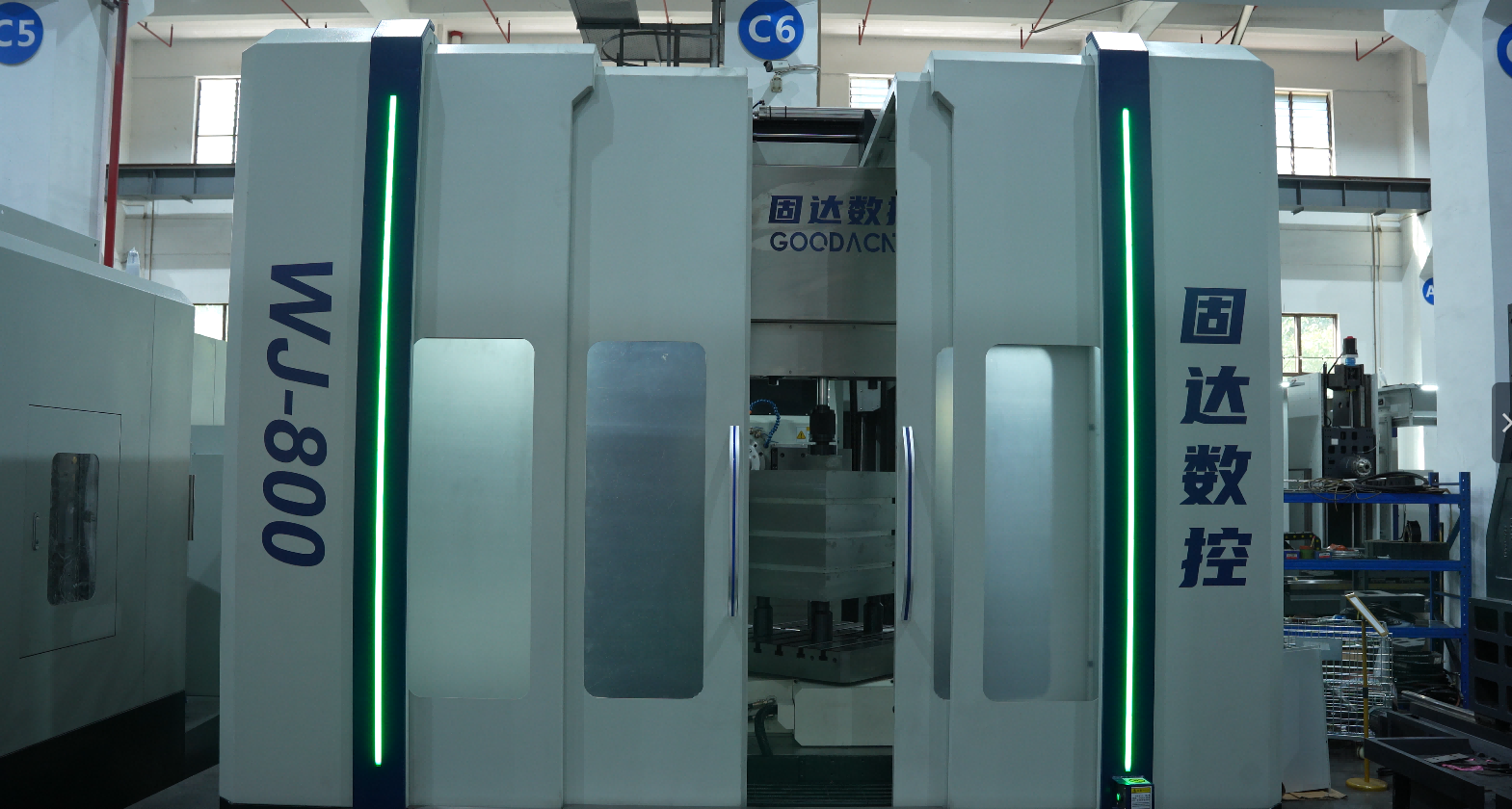
For the WJ-800 HMC, verify table load (800 kg max), swing diameter (~850 mm), and XYZ travel (X800×Y700×Z650 mm) before selecting mold blanks. Exceeding any one makes machining infeasible.
| WJ-800 Key Specifications | |
| Parameter | Specification |
| Table load (max) | 800 kg |
| Swing diameter | ~850–1000 mm |
| X-axis travel | 800 mm |
| Y-axis travel | 700 mm |
| Z-axis travel | 650 mm |
Table Load Capacity
Calculate Maximum Weight
The working table effective travel of the WJ-800 CNC horizontal machining center is X800×Y700×Z650 mm, and the maximum load capacity directly affects the size specifications of the mold that can be machined. The weight of the working table itself is approximately 1200 kg, and the maximum workpiece weight specified in the machine manual needs to subtract the weight of the fixture and pallet to obtain the actual allowance.
The standard configuration weight of the hydraulic fixture is approximately 80-150 kg, the vacuum chuck system is about 30-60 kg, plus the pallet or base plate 50-100 kg, the total weight of auxiliary accessories is usually between 150-300 kg. Taking the WJ-800 full load condition as an example, if the maximum load of the working table is marked as 800 kg, the actual space left for the mold blank is 500-650 kg.
The density of mold blanks is usually 7.8-8.3 g/cm³ (steel), and for a common injection mold blank with dimensions of 300×250×200 mm, the weight of the steel blank is about 117-124 kg, which is still within the safe range. If the mold size exceeds 500×400×300 mm, the blank weight can reach 390-420 kg, plus accessories such as cooling water pipes, normal jacks, and ejector mechanisms, the overall fixture system weight easily exceeds 600 kg, at this time it is necessary to reassess whether the mold of this size can still be accommodated in the full fixture state.
The calculation of the working table load allowance must be accurate to within ±5 kg, otherwise, the micro-deformation of the table during the machining process will cause the tool path to shift by 0.02-0.05 mm, directly affecting the form and position tolerances of the mold.
According to the official specification sheet of the WJ-800[1] horizontal machining center, the maximum load parameter of the working table is the first step in selecting the mold blank. The rigidity index of the machine tool is directly related to the load capacity—the maximum allowable deformation of the working table surface under uniform load is usually not more than 0.02 mm/1000 kg, exceeding this value will lead to the deterioration of the parallelism between the spindle axis and the workpiece surface, thereby affecting the machining accuracy of the mold parting surface.
In actual working conditions, the weight calculation of the mold blank needs to be combined with the material density and geometric dimensions:
· P20 mold steel density: 7.85 g/cm³
· H13 hot work mold steel density: 7.80 g/cm³
· 1.2738 pre-hardened steel density: 7.84 g/cm³
Assuming the size of the mold frame blank of an injection mold is 600×500×350 mm, the net weight of the steel blank is about 816 kg, which has exceeded the load limit of most medium-sized horizontal machining centers. In actual production, the common practice is to split the mold frame for machining—the fixed mold and the moving mold are machined separately, with each piece's weight controlled within 60% of the table's maximum load to ensure machining stability.
The safety factor for the working table load is usually taken as 1.2-1.5, which means that for a working table with a marked load of 800 kg, the actual recommended load limit is 530-670 kg.
Add Fixture Weight
The weight of the fixture system is often underestimated, but in reality, it is the most unstable variable in the calculation of the workbench load. The clamping force of each jaw of a standard hydraulic fixture is approximately 30-50 kN[2], corresponding to a fixture body weight of about 8-15 kg per jaw. The total weight of a 4-axis or 6-axis hydraulic chuck can reach 60-120 kg. Vacuum cup systems are driven by vacuum pumps, with the cups themselves weighing about 15-25 kg, but the accompanying vacuum generator and piping system add an additional 10-20 kg. Precision tooling fixtures, to ensure repeated positioning accuracy, typically use alloy steel materials, which have a density about 10% higher than that of regular steel, resulting in a greater weight for the same volume.
Taking a typical 3+1 layout injection mold as an example, it includes 4-8 positioning pins (each weighing 0.5-2 kg), 4 guide pillars (each weighing 3-8 kg), a set of ejector plates weighing 15-40 kg, and a water pipe connector assembly weighing 5-15 kg, bringing the total fixture system weight to about 80-200 kg. When calculating the total workbench load, it is recommended to use the maximum configuration weight of the fixture as the baseline value, rather than the typical configuration weight, because the fixture may be upgraded or downgraded during product changeover. For example, in the case of the WJ-800 under full load conditions, with a workbench weight capacity of 800 kg, subtracting the maximum fixture configuration of 200 kg, the actual weight space left for the mold is only 600 kg, which must be used as the upper limit during selection.
The weight of the fixture configuration is strongly related to the machining process, with different mold types requiring different fixture solutions. The overlapping areas of these solutions are often blind spots in load calculations.
· Injection molds typically use a combination of hydraulic fixtures and positioning pins, with fixture weights ranging from 80-150 kg.
· Die-casting molds, due to the need to withstand high clamping forces, often use special clamping plates and screw fixation, with fixture weights ranging from 100-200 kg.
· Composite material molds commonly use vacuum bags and honeycomb structures, with relatively lightweight fixtures weighing about 40-80 kg, but the auxiliary support frame may add an additional 50-100 kg.
The WJ-800 workbench comes standard with T-slots spaced 125 mm apart and 18 mm wide, compatible with most international standard fixtures. When calculating the total load, the fixture weight should be based on the maximum configuration value for that particular machine processing that type of mold, not the average value—because in actual production, the fixture may be upgraded when changing products. If the same machine alternately processes injection molds and die-casting molds, the maximum fixture configuration may be as high as 250 kg, leaving only 550 kg of effective load space for the mold blank, which must be determined in the selection stage as the heaviest working condition.
Maintain Balance
The balance state of the workbench directly affects the uniformity of the cutting force on the tool. The workbench of the WJ-800 horizontal machining center has a travel of 800 mm in the X-axis direction. If the center of gravity of the mold deviates from the center of the workbench by more than 100 mm, additional inertial torque will be generated during rapid G00 feed, leading to table shaking and decreased positioning accuracy. The calculation of the mold's center of gravity must consider the uneven distribution of the blank density – the center of gravity of a solid blank is at the geometric center, but the center of gravity of a semi-finished mold with cavities will shift towards the denser material side.
For example, in a typical 400×300×200 mm injection mold blank, if weight-reducing areas such as the sprue bushing, runner, and cooling channels are concentrated on one side, the actual center of gravity may deviate from the geometric center by 15-30 mm, requiring compensation through counterweights or offset installation.
There are usually two methods for adjusting the workbench balance:
1. Use adjustable pads to level the bottom of the mold, adjusting the position of the center of gravity vertical line through the three-point support principle.
2. Use the self-centering function of the CNC vise, achieving automatic balance through the symmetrical distribution of preload.
For molds weighing over 300 kg, it is recommended to measure the workbench tilt angle after clamping – the CNC system of the WJ-800 can measure the flatness of the workbench using a laser interferometer, and if the reading exceeds 0.02 mm/m, the clamping force distribution needs to be readjusted.
Balance correction is a key step before the mold is mounted on the machine, but it is often omitted or simplified in actual production. The correct procedure is:
1. Roughly lift the mold to the vicinity of the workbench using a crane.
2. Measure the weight distribution at the four corners of the mold with an electronic scale, confirm the center of gravity position.
3. Calculate the counterweight scheme based on the offset amount.
The clamping force distribution of the workbench must match the position of the mold's center of gravity – when the center of gravity is biased towards one side, the clamping force on that side should be increased by 15-20%, and the opposite diagonal side should be correspondingly decreased to avoid torsional deformation of the table. The standard arrangement of the T-slots on the WJ-800 workbench is 3 rows longitudinally and 5 columns transversely, totaling 15 standard clamping positions, each with a maximum clamping force of about 15-25 kN. If the mold's center of gravity offset exceeds 150 mm, it is recommended to add auxiliary support – place hardened positioning blocks between the bottom of the mold and the workbench, with a contact area of not less than 50×50 mm and a hardness of not less than HRC 55.
The final verification indicator for balance adjustment is that the difference in Z-axis return-to-zero error of the workbench between no-load and full-load states does not exceed 0.01 mm. If this value is exceeded, it indicates that there is micro-deformation caused by residual stress release, and the clamping distribution must be readjusted.
Swing Diameter
| Swing Diameter Reference Data | |
| Item | Value / Range |
| Swing diameter (standard) | ~850–1000 mm |
| Face milling cutter overhang | 100–150 mm |
| End milling cutter overhang | 75–100 mm |
| Boring tool overhang | 50–80 mm |
| Recommended safety clearance | 15–25 mm |
| Recommended design margin | ≥ 15% |
Measure Diagonal
The swing diameter is one of the most important limiting parameters[3] when selecting a mold for a horizontal machining center. The swing diameter (maximum passage diameter) of the WJ-800 is approximately 850-1000 mm, with the specific value depending on the tool configuration and the minimum distance from the spindle nose to the worktable surface.
The standard method for measuring the swing diameter is as follows:
1. Use a height gauge to determine the center position of the worktable.
2. With the worktable rotation center as the circle center, use an internal micrometer or laser alignment tool to measure the distance from the outermost point of the mold blank to the rotation center.
3. Take the maximum value in the X-axis and Y-axis directions, add them together, and divide by 2 to obtain the equivalent swing radius.
A common mistake in the calculation of the swing diameter for injection molds is ignoring the extension of the runner system and gate area—these auxiliary structures occupy additional passage space during rotation. For molds with side parting mechanisms, the measurement of the swing diameter must include the maximum envelope size of the side core-pulling structure in the fully extended position.
Additionally, protruding parts on the mold, such as cooling water pipe joints and normal jack mounting bases, will also increase the swing envelope, and the calculation should be based on the maximum extended state. In actual measurement, it is recommended to measure the diameter values at several angles and take the maximum value as the basis for verification.
The measurement of the swing diameter must consider the mounting attitude of the mold on the horizontal worktable. The swing diameter of a horizontal machining center refers to the maximum passage space of the mold relative to the spindle centerline when the worktable rotates, and this space is an approximate cylinder with the spindle axis as the axis of symmetry. The typical swing diameter specification of the WJ-800 is 850 mm, which means that under standard tool configuration, the maximum circular cross-section diameter through the space between the spindle and the worktable is 850 mm.
During measurement, it should be noted that the swing envelope of the mold is not a perfect circle, but an approximate ellipse that varies with the angle—the protrusion of structures on the feed side, cooling water outlet side, and ejection side is different, resulting in a difference in the equivalent diameter at different angles of up to 30-50 mm.
The correct measurement steps are:
1. Find the mounting reference surface of the mold on the horizontal worktable and confirm the parting surface orientation (usually placed horizontally, with the parting line parallel to the worktable surface).
2. Measure the maximum envelope size of the mold in the 0°, 90°, 180°, and 270° directions.
3. Calculate the average and maximum of the four readings, with the maximum value used for verification against the swing diameter limit.
If the maximum swing envelope is close to or exceeds the machine specification value, the processing technology must be re-evaluated or consider dividing it into multiple processes.
Allow Clearance
The rotary space margin is a safety clearance that must be reserved when a horizontal machining center processes large molds. The table rotation diameter specification of the WJ-800 is 850 mm, but the actual available rotary space is often limited by the tool length and workpiece clamping height. The standard calculation formula is:
Available rotation diameter = Machine rotation diameter - 2[4] × (Maximum tool overhang + Safety clearance).
Among these, the maximum tool overhang depends on the tool type – face milling cutters can reach 100-150 mm, end milling cutters 75-100 mm, and boring tools 50-80 mm. The safety clearance is usually set at 15-25 mm, used to compensate for tool deflection, thermal expansion, and workpiece deformation.
For example, when machining a circular mold cavity with a diameter of 600 mm, if the maximum tool overhang is 100 mm and the safety clearance is set at 20 mm, the actual available rotation diameter is 850 - 2 × 120 = 610 mm, which barely meets the processing requirements but leaves very little margin.
If the mold diameter exceeds 610 mm, the tool overhang must be shortened (by using a short-edge tool) or the safety clearance reduced to below 10 mm, at which point the processing risk increases significantly. Early signs of insufficient rotary space include: increased spindle vibration, tool life reduced by 30-50%, and chatter marks appearing on the machined surface.
The reservation of rotary space directly affects processing feasibility and quality. When the space margin is insufficient, the tool may collide with the workpiece edge during rotary machining, or due to excessive overhang, rigidity may be insufficient, causing tool deflection.
In the standard configuration of the WJ-800's tool system, the standard overhang length for a 63 mm diameter face milling cutter is 100 mm, at which overhang the sufficient static rigidity can be ensured (spindle mode greater than or equal to 8 kHz). If the overhang is increased to 150 mm, the rigidity of the same diameter tool is reduced by about 40%, and the critical speed drops to 70% of the original, which is still manageable for processing light alloys but prone to chatter when processing P20 mold steel.
The recommended design margin for rotary space is not less than 15% – that is, if the calculated required rotation diameter is 600 mm, a machine with a rotation diameter specification of not less than 690 mm should be selected.
The 850 mm rotation diameter of the WJ-800 is above average among machines of the same specification, but careful calculation is still needed when processing large deep-cavity molds. Another easily overlooked factor is the coolant – the coolant nozzles of horizontal machines also occupy space during rotation, and if the coolant lines interfere with the tool, the coolant path needs to be rearranged or an internal cooling tool used.
Prevent Collision
Collision prevention is the most critical safety risk to address in horizontal mold machining, and the root cause of collisions often lies in the failure to consider dynamic envelopes when calculating rotation space.
The static rotation diameter is the maximum passing dimension measured when the mold and table are stationary and the spindle is not rotating. However, in actual machining, the tool rotates, the table indexes, and the mold rotates with the table, resulting in a dynamic envelope that is significantly larger than the static value due to the superposition of multiple movements.
The WJ-800 has a maximum rotational acceleration of approximately 0.5 rad/s² during rapid G00 movement, and under this acceleration, the centrifugal force of rotating components can cause flexible connecting parts (such as cooling water pipes and hydraulic lines) to swing, occupying an additional 10-20 mm of space compared to the static measurement.
Engineering measures to prevent collisions include:
1. Use the machine simulation module during the CAD/CAM programming phase to perform collision detection, setting the safety factor for the rotation space to 1.15.
2. During tool path planning, reduce the cutting depth in the rotation area by 20% to avoid radial force imbalance during full-blade cutting.
3. Attach anti-collision identification tape around the mold blank, with a tape thickness of about 1 mm, serving as a last line of collision warning.
The WJ-800 CNC system supports real-time monitoring during table rotation, triggering an emergency stop when the feed speed of a certain axis is abnormal, but the emergency stop itself can also damage the tool and workpiece, so proactive prevention is better than passive protection.
Collision prevention requires systematic consideration[5] of three dimensions: process planning, tool selection, and machine parameter settings.
· Process planning: Molds machined horizontally typically place deep cavity areas in the last station to avoid weakening the mold structure after early machining and deformation during subsequent rotations.
· Tool selection: For rough machining of deep cavities, it is recommended to use tools with a diameter 30-40% smaller than the cavity depth to ensure chip evacuation space while reducing radial cutting forces.
· Machine parameters: The WJ-800's rigid tapping mode has high synchronization accuracy between spindle speed and feed, but when using milling cutters with a diameter of 63 mm or larger for G02/G03 arc interpolation, it is recommended to limit the feed speed to F800 or below to avoid excessive centrifugal force causing micro-vibration of the tool.
In actual production, collision accidents most frequently occur during tool change—when the old tool has not fully retracted and the new tool has not fully seated. To address this, the WJ-800's tool magazine is designed with a double safety gap for the tool change position, and programming should make full use of this gap rather than setting the tool change point directly above the cavity. The recommended Z-axis safety height for the tool change area is not less than the safety height corresponding to the maximum rotation diameter of the table + 50 mm.

XYZ Travel
| XYZ Travel Specifications | ||
| Axis | Travel | Description |
| X-axis | 800 mm | Worktable horizontal movement |
| Y-axis | 700 mm | Worktable vertical movement |
| Z-axis | 650 mm | Spindle head feed (depth) |
Check X-Axis Length
The X-axis travel is the most direct parameter affecting mold selection width[6] in horizontal machining centers. The X-axis travel of the WJ-800 is 800 mm, which determines the maximum movement range of the worktable in the X direction (horizontal). When selecting a mold, it is crucial to ensure that the X-direction dimension of the mold blank does not exceed the X-axis travel minus a safety margin of 50 mm on both the front and rear sides, resulting in a maximum machinable mold width of approximately 700 mm.
However, this is only the blank size; in actual machining, the space occupied by the fixture must also be considered. If a 4-axis hydraulic chuck is used, the minimum X-direction space occupied by the fixture is about 100 mm; if a vacuum chuck is used, the chuck frame occupies about 30 mm. Overall, it is recommended to keep the X-direction limit of the mold blank within 600 mm to ensure sufficient clamping and tool retraction space.
Additionally, the X-axis travel must be jointly verified with the turning diameter: if a mold 500 mm wide is mounted on the WJ-800 worktable and its turning envelope exceeds the machine's turning diameter limit, the overall machining is not feasible even if the X-axis travel is sufficient.
Another hidden limitation of the X-axis travel is the machine bed length – when the worktable of the horizontal machining center is at the extreme positions of the X-axis, the lubrication state and rigidity of the guide rails differ from those at the middle position. Long-term machining at extreme positions will accelerate guide rail wear, so it is recommended to keep the X-axis travel utilization rate within 90%.
The X-axis travel of 800 mm for the WJ-800 is considered a medium specification in CNC horizontal machining centers and can cover the machining needs of most medium-sized injection molds and die-casting molds. The utilization rate of the travel is directly related to machining efficiency: the higher the X-axis travel utilization rate, the more frequent the direction changes of the cutting force, and the faster the wear of the screw pair will be. Industry experience data shows that when the X-axis travel utilization rate exceeds 85% for a long time, the expected life of the ball screw will decrease from 20,000 hours to about 12,000 hours. Therefore, in the mold process planning stage, if the X-direction size of the blank exceeds 650 mm, it is preferable to consider changing the mold from horizontal to vertical placement (if the mold structure allows) or splitting the mold into two sequences for machining.
The X-axis travel must also match the mold's machining process route – a typical horizontal machining process sequence is to first rough mill most of the cavity, then semi-finish each parting surface, and finally finish the detailed areas. The required X-axis travel for these three sequences decreases sequentially.
If all three sequences require near full travel machining, it indicates an unreasonable process route design and should be re-zoned or use a machine with a larger travel. The rigidity characteristics of the X-axis travel have boundary effects at both ends of the travel range, manifesting as a slight overshoot of the worktable due to the inertial force during acceleration and deceleration during idle movement (usually 0.01-0.03 mm). In precision machining, this needs to be corrected through the reverse clearance compensation function of the CNC system.
Check Y-Axis Height
The Y-axis travel is an indicator in the travel parameters of a horizontal machining center[7] that determines the machining height of the mold. The Y-axis travel of the WJ-800 is 700 mm, and the Y-axis controls the vertical (up and down) movement of the worktable. The core criterion for Y-axis selection is whether the total height of the mold, plus the fixture height and tool length, remains within the Y-axis travel range.
Taking a 350 mm high injection mold as an example, with a fixture height of about 50 mm and a tool length of about 150 mm (considering end mills and drills), plus the minimum distance from the spindle nose to the worktable surface of about 100 mm, the required Y-axis travel is 350 + 50 + 150 + 100 = 650 mm, which is close to the Y-axis upper limit of 700 mm for the WJ-800.
The Y-axis travel also needs to consider the Z-direction tool deflection during machining of deep cavities—the axial force on the tool during deep cavity mold machining will cause the tool to deflect, leading to deviations in machining depth.
The axial rigidity index of the WJ-800 is about 0.03 mm/kN, and under full blade cutting of P20 mold steel, if the milling force is 2 kN, the deflection is about 0.06 mm, which needs to be included in the Y-axis travel margin calculation. Excessive utilization of the Y-axis travel will also affect the dynamic performance of the machine—the worktable and workpiece's center of gravity are at their highest when the Y-axis is at the upper end of its travel, and both the machine's pitching rigidity and the Y-axis response bandwidth will decrease.
The planning of the Y-axis travel needs to be combined with the mold's parting surface height and the machine worktable height position. The worktable height of a horizontal machining center is usually fixed, and the distance between the spindle centerline and the worktable surface is a fixed value.
After the mold is clamped on the worktable, the height of its highest machining point is determined by the blank height and the clamping method. The minimum distance from the spindle nose to the worktable surface of the WJ-800 is about 100 mm, and the maximum distance is about 750 mm (Y-axis travel of 700 mm), which determines the height range of the mold that can be machined.
During clamping planning, the parting surface height of the mold should be set in the middle range of the Y-axis travel (about 350 mm at the middle position of the Y-axis) as much as possible, as this is when the machine's dynamic rigidity and thermal stability are at their best. If the parting surface must be near the upper or lower limit of the Y-axis travel, it should be noted in the process document and the corresponding tool inspection frequency should be increased.
Another practical limitation of the Y-axis travel is the chip evacuation problem during deep cavity milling—when the cavity depth exceeds 4 times the tool diameter (aspect ratio greater than 4:1), chips are difficult to naturally evacuate, and internal cooling tools or ultrasonic-assisted chip evacuation need to be configured, otherwise, chip accumulation in the cavity will lead to secondary cutting, damaging the cavity surface and tool edge.
Determine Z-Axis Depth
The Z-axis travel is the parameter that most directly determines the cavity depth[8] machining capability among the three-axis travels of a horizontal machining center. The Z-axis travel of the WJ-800 is 650 mm, with the Z-axis controlling the feed of the spindle head in the vertical direction. The criterion for selecting the Z-axis is whether the maximum cutting depth of the mold cavity is within the Z-axis travel range, but this judgment is much more complex than that for the X/Y axes—because the Z-axis machining depth is also related to multiple dimensional chain factors such as fixture height, tool length, and the distance from the spindle nose to the worktable surface.
The standard calculation formula is:
Available Z-axis depth = Z-axis travel - Minimum distance from worktable surface to spindle nose - Fixture height - Minimum overhang of the tool beyond the top surface of the workpiece.
For example, with a Z-axis travel of 650 mm, a minimum distance from the worktable surface to the spindle nose of 100 mm, a fixture height of 50 mm, and a tool overhang of 50 mm, the actual Z-axis depth available for machining the cavity is 450 mm.
If the cavity depth exceeds this value, it needs to be milled in two or three layers, with each layer's depth recommended to be controlled within 100-150 mm to ensure the axial rigidity of the tool and smooth chip evacuation. Another key point in Z-axis depth planning is the control of residual height during layered cutting—if the total cavity depth of 450 mm is milled in 3 layers, with each layer's cutting depth at 150 mm and a finishing allowance of 0.5 mm, then the finishing depth of the last layer is only 0.5 mm, and the axial force on the tool is close to a pure friction state, which will significantly reduce the tool life.
The planning of Z-axis travel needs to be linked with the machining strategy. For deep cavity molds (such as barrel-shaped molds with a depth exceeding 300 mm), Z-axis machining usually adopts a layered spiral milling strategy, with each layer's depth determined by the tool diameter and material hardness: when machining P20 mold steel with a 20 mm diameter end mill, each layer's depth is recommended to be 80-120 mm; when using a 30 mm diameter end mill to machine the same material, each layer's depth can be increased to 100-150 mm.
The rapid feed speed of the Z-axis of the WJ-800 is 8 m/min, and the cutting feed speed is 1-4 m/min. When layering the Z-axis, setting the tool lift height and G00 rapid retraction height reasonably can significantly save non-cutting time.
The Z-axis travel also needs to check the maximum overhang of the tool—the greater the Z-axis depth, the longer the required tool, and the worse the static rigidity of the tool. For example, for a 20 mm diameter carbide end mill, when the overhang length is 100 mm, the natural frequency is about 3.2 kHz; when the overhang is increased to 200 mm, the natural frequency drops to about 1.8 kHz, which is close to or lower than the typical working speed of the machine spindle (3000-8000 rpm), and is very likely to cause resonance.
When the WJ-800 is processing deep cavities, it is recommended to configure extended shank tools or two sets of tool systems for rough and finish machining—rough machining uses extended tools to quickly remove the allowance, while finish machining uses standard length tools to ensure dimensional accuracy and surface quality.
Key rules: apply 1.2 safety factor to table load; maintain 15% clearance on swing diameter; limit XYZ travel to 90%. Feasible mold size is the intersection of all three constraints.