

45 steel offers excellent machinability.
It is commonly supplied in the form of hot-rolled round bar or steel plate, with an annealed hardness of around HB197.
When coated carbide tools are used at a cutting speed of 120 m/min, tool wear remains minimal and tool life is long.
Combined with high-pressure emulsion coolant, chips can be flushed away quickly, making it easy to achieve a surface finish of Ra 1.6 μm and highly efficient machining.
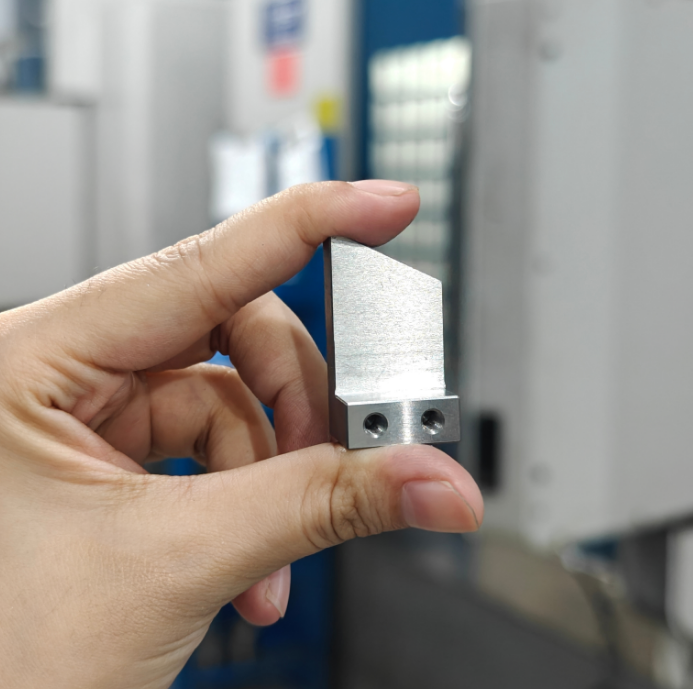
Tool Life
Tool Material Selection
When machinists receive a standard 45 steel blank with a hardness of around HRC20, they typically reach for inserts in blue packaging. The blue label usually indicates P-grade carbide. Traditional W18Cr4V high-speed steel tools would soften like clay once cutting temperatures exceeded 600°C. On modern CNC lathes, however, the temperature at the tool tip can easily rise above 800°C, and only carbide can withstand that kind of heat.
The insert substrate is made by sintering tungsten carbide particles with metallic cobalt powder in a furnace at around 1400°C. For machining 45 steel, the most practical grades are P20 to P30, where cobalt content is tightly controlled between 6% and 9%. If cobalt content is too high, the insert becomes tougher but wears much faster at higher cutting speeds. If cobalt drops below 5%, hardness can jump to HRA92, but the edge will chip immediately when it encounters mill scale on the blank surface.
When selecting uncoated inserts, plant technicians focus on several key specifications:
· Tungsten carbide grain size should be 1.0 to 2.5 μm
· Transverse rupture strength should exceed 2000 MPa
· Fracture toughness should be around 10 MPa·m^0.5
· Vickers hardness at room temperature should reach at least HV1400
· Cobalt distribution must appear uniform and dense under a microscope
The substrate alone cannot withstand the extreme heat generated during continuous cutting of 45 steel. What really takes the punishment is the 7 to 15 μm coating on the outside. Manufacturers place the inserts in a reactor at 850°C to 1000°C and apply a three-layer composite coating through a chemical deposition process. The outermost layer is golden titanium carbonitride, which mainly helps operators judge wear visually.
The middle dark brown alumina layer is highly heat resistant, with a thermal conductivity of only 29 W/(m·K). Thanks to this layer, more than 90% of the intense cutting heat is kept away from the substrate. The innermost layer, bonded directly to the substrate, can reach HV3000 in hardness and remains firmly anchored even under a rough-turning cutting force of 800 N.
When machining 45 steel thin-wall parts with a wall thickness of only 2 mm, or when a surface finish of Ra 1.6 is required, a thick coating becomes too blunt. In those cases, a PVD insert is the better choice. Its coating is deposited at only 500°C and kept extremely thin, just 2 to 5 μm, giving the edge a razor-like sharpness.
In the shop, process sheets clearly distinguish when each insert type should be used:
· Use a thick coating when the depth of cut exceeds 2.5 mm
· Use a thick coating when feed rate is above 0.25 mm/rev
· Switch to a thin coating when dimensional tolerance is tighter than 0.01 mm
· Switch to a thin coating when cutting speed falls below 150 m/min
To decide whether an insert can still be used, machinists typically measure flank wear with a caliper. During rough turning of 45 steel, once flank wear reaches the 0.3 mm limit, the insert must be replaced immediately. Some operators try to save a few yuan by pushing worn inserts too far, but spindle motor current can instantly rise by 15% to 20%.
A dull edge rubbing forcefully against 45 steel will create a 0.1 to 0.2 mm hardened layer on the workpiece surface. When a fresh tool is used in the next finishing pass, it has to cut directly into that abnormally hard skin, and tool life is cut in half on the spot. In reality, the material and labor lost on one scrapped part are worth far more than dozens of inserts.
For bright-finish 45 steel parts, some finishing operations use cermet inserts. These contain around 15% nickel or molybdenum. Because cermet has low affinity with steel, it can produce a mirror-like surface when cutting speed is raised to 250 to 300 m/min.
However, cermet is extremely brittle. If the 45 steel bar has a keyway, or if blank eccentricity exceeds 1 mm, and feed rate rises above 0.15 mm/rev, the cutting edge will most likely fracture immediately. For rougher applications, the process sheet should still specify coated micro-grain carbide.
Frontline technicians diagnose worn inserts every day by looking at failed tools:
· A large crater on the rake face means the alumina coating was too thin
· A collapsed nose indicates excessive cobalt in the substrate
· Large-scale coating flaking at the start of cutting means poor coating adhesion
· Tiny visible edge chips usually mean an overly hard P10 grade was used by mistake
Coolant can also completely change tool behavior. With an 8% emulsion delivered at 20 L/min, high heat is removed rapidly, but thick coatings will also contract violently. Repeated heating and cooling hundreds of times per minute can create comb-like thermal cracks across the coating surface.
Cutting Parameters
When roughing 45 steel at around HRC20, spindle speed is chosen largely based on how long the insert is expected to last. Manufacturer recommendations usually fall between 150 and 250 m/min.
Experienced lathe operators often limit cutting speed to around 160 m/min. Once speed exceeds 200 m/min, the tool tip can reach 850°C within seconds, and the coating simply cannot handle it. At a steadier speed, a P20 insert costing about 25 RMB can cut reliably for 40 minutes and finish around 60 standard shaft sleeves.
Apprentices trying to increase output sometimes turn the speed dial up to 120%. Cutting speed then jumps beyond 220 m/min, and the tool tip approaches 1000°C. In less than 10 minutes, the bright yellow insert turns dark from heat, and after fewer than 15 parts, flank wear exceeds the 0.3 mm discard limit.
Once spindle speed is set, feed rate determines how fast the machine advances. When rough-turning the outside diameter of a 45 steel blank, feed is typically 0.2 to 0.35 mm/rev. Thick chips peel off and curl into C-shaped forms about 10 to 15 mm wide.
If feed is pushed beyond 0.45 mm/rev, the reaction force is transmitted back through a 25 mm tool shank into the machine. Even a 2-ton lathe bed will begin vibrating at around 50 Hz, leaving wave marks on the surface. Once tool-edge stress exceeds 2500 MPa, the insert will fail instantly.
For fine work requiring Ra 1.6, feed must be controlled to 0.1 to 0.15 mm/rev. Too little feed is also a problem. Below 0.08 mm/rev, the edge rubs rather than cuts. The resulting chip is as thin as paper and can wear a shallow groove about 0.1 mm deep into the flank face.
When roughing an 80 mm diameter 45 steel bar, experienced machinists may take a depth of cut of 3 to 4 mm in one pass. As long as the machine has an 11 kW motor, the thick chips carry away nearly 80% of the heat, making cutting surprisingly stable.
The finishing allowance is generally kept between 0.2 and 0.5 mm. If the roughing pass leaves less than 0.1 mm, the new finishing insert ends up grinding against a hardened surface layer at around HRC35.
Some practical rules from the shop floor:
· When depth of cut exceeds 2 mm and speed is held at 120 m/min, chip flow is smooth and tool breakage is least likely
· At 0.25 mm/rev and 200 m/min, the tool tip can glow red within 3 minutes
· Leaving 0.3 mm for finishing and cutting at 180 m/min can produce a surface as bright as a Ra 1.6 mirror
· When the depth of cut is below 0.05 mm, switching to a ceramic insert helps prevent chip adhesion
| Machining Stage | Cutting Speed (m/min) | Feed (mm/rev) | Depth of Cut (mm) | Tool Life (min) |
| Rough turning, removing scale | 120 - 150 | 0.25 - 0.35 | 2.5 - 4.0 | 45 - 60 |
| Semi-finishing for alignment | 160 - 180 | 0.15 - 0.20 | 0.8 - 1.5 | 40 - 50 |
| Finishing with minimal stock | 180 - 220 | 0.08 - 0.12 | 0.2 - 0.5 | 25 - 35 |
When machining a stepped shaft that changes from 80 mm down to 20 mm, programmers often use G96 constant surface speed mode. Machine speed automatically rises from about 600 rpm to 3100 rpm, keeping cutting speed constant at 150 m/min and making insert wear far more uniform.
If the workpiece is a hexagonal 45 steel bar, or a shaft with a 12 mm-wide keyway, those parameters no longer apply. The insert may take more than 300 impacts per minute, so cutting speed should be cut by about 30%, down to roughly 100 m/min, and feed should be reduced to 0.15 mm/rev to absorb the impact load.
In large factories, dry cutting of 45 steel is becoming more common. If 5% coolant is sprayed on a tool running at 160 m/min, the thermal shock can reach 600°C between hot and cold cycles. The coating develops spider-web cracks in less than 20 minutes.
Built-Up Edge & Chip Control
Built-up edge tends to appear when cutting speed drops into the 15 to 50 m/min range. At that point, cutting-zone temperature stays between 300°C and 500°C, and the chip becomes soft and sticky like pulled nougat. Under compressive stress as high as 1500 MPa, metal from the bottom of the chip welds directly to the cutting edge of the carbide insert.
Even though the blank itself is only around HRC20, the built-up edge can harden to over HV800. It then plows across the workpiece surface, leaving ugly grooves up to 0.05 mm deep. Once it grows to around 0.2 mm, it breaks off and often tears away part of the coating with it.
Once the protective coating is ripped off and the gray-white substrate is exposed, the next cut at 0.2 mm/rev can knock a large chunk out of a tool tip that would otherwise withstand 800 N of cutting force.
If spindle speed is raised so that cutting speed exceeds 100 m/min, temperature at the cutting zone rises above 800°C. The chip root softens into a near-fluid state and slides smoothly off the rake face before it has any chance to stick.
In thread turning or drilling, where speed cannot be increased much, machinists often add more extreme-pressure additives to the coolant. A 10% sulfurized cutting oil can form a nanometer-thick iron sulfide film between the tool face and the chip, reducing cutting resistance by 15%.
Even when built-up edge is eliminated, poor chip control can still cause major trouble. 45 steel is quite tough. At a feed of 0.15 mm/rev, a plain insert without a chipbreaker can produce long, spring-like continuous chips.
Once those long stringy chips wrap around a chuck running at 2000 rpm, or wind into the lead screw under the tool post, spindle load can spike to 150%, triggering an overload shutdown. Torn chips can also scratch the freshly machined Ra 1.6 surface with bright scars as deep as 0.1 mm.
To solve this, insert manufacturers form dedicated chipbreaker grooves on the rake face:
· For roughing at 3 mm depth of cut, use a 2.5 mm-wide deep single-sided groove so chips curl into a C-shape
· For finishing with 0.3 mm stock remaining, switch to a shallow groove only 1 mm wide to force the thin chip to curl and break
· At 0.35 mm/rev, use a textured groove with a raised land to produce 15 mm-long 6-shaped chips
A difference of just 0.1 mm in groove width or depth can completely change performance. Actual chip thickness is usually about one-third of the feed. At 0.3 mm/rev, the chip itself is only about 0.1 mm thick. That thin strip of steel must slam into the groove wall at about 2.5 m/s and break within a fraction of a second.
The impact angle is usually set between 15° and 20°. As the chip is forced upward, it develops intense shear stress that exceeds the material’s yield strength. Once the bending radius is compressed to 4 to 6 mm, the chip snaps cleanly at its root.
When the chips hit the machine guard with a crisp rattling sound like rainfall, the sweepings at the end of the shift should consist of neatly curled pieces only 10 to 25 mm long.
The trickle coolant on a standard manual lathe is not enough. High-end machines use a 70 bar internal high-pressure coolant system. At 7 MPa, the emulsion is forced through the tool shank and aimed precisely about 2 mm behind the cutting edge.
The jet hits the red-hot chip at around 30 m/s. A chip that would otherwise form a 50 mm ring is suddenly cooled by 400°C in one-tenth of a second. The combined effect of quenching and hydraulic impact makes the chip brittle, and it breaks into pieces shorter than 10 mm.
Experienced shift leaders do not even look at the G-code on the screen. They judge the cut by watching the pile of chips under the machine:
· If the chips form tightly packed spring coils, the feed is too low and must be raised above 0.1
· If the chips turn black-purple with 0.05 mm burrs at the edges, flank wear has likely exceeded 0.2 mm
· If the chips become powdery or break into 3 to 4 mm fragments, spindle speed is too high and tool breakage is imminent
When machining ordinary 45 steel, success comes down to keeping the tool tip in the right temperature range and watching chip curl carefully. With the right parameters and chipbreaker geometry, a box of carbide inserts costing around 200 RMB can machine 400 to 500 qualified shaft sleeves within a tolerance of 0.02 mm.
Surface Finish
Increasing Cutting Speed
When working with 45 steel, experienced machinists often run the spindle at 600 rpm with a feed of 0.2 mm. Chips smoke heavily as they come off. That may be acceptable for roughing, but a finished surface produced that way feels like an old file. Even with a new insert, raising speed slightly to 800 rpm still leaves fine hairline marks on the part. If spindle speed stays too low, built-up edge clings stubbornly to the tool tip and tears the unfinished metal surface.
In reality, cutting speed can often be raised much more aggressively. On a standard C6140 lathe or a FANUC CNC lathe, as long as hydraulic chuck force is set to 2.5 MPa and workpiece overhang does not exceed three times the diameter, running the spindle at 1500 rpm is entirely workable. Cutting speed then exceeds 180 m/min, and the contact zone between the insert and the built-up metal can shoot to 600°C to 800°C within 0.01 second.
At that temperature:
· The chip root softens immediately
· Chip color changes from silver-white to dark blue
· Chip thickness is visibly reduced
· The metal stuck to the tool tip burns away under heat
Once the chips turn dark blue or purple-red and break off like fragments of a spring, surface roughness drops below Ra 1.6 μm almost immediately. The high temperature softens the 45 steel at the cutting point, which actually makes the cut easier. Modern coated inserts are designed to perform under heat. A commonly used CNMG120408 dual-color coated insert has an alumina layer only 10 to 15 μm thick.
That black-and-gold outer layer is specifically built to resist temperatures around 800°C. If it were replaced with an uncoated high-speed steel tool, the edge would collapse in no more than 3 seconds at 150 m/min. In CNC programming, G96 constant surface speed mode is far more effective than fixed spindle speed. When turning a 100 mm diameter 45 steel disc from the outer edge toward the center, spindle speed rises automatically from about 480 rpm.
The spindle continues accelerating until it approaches the machine’s set limit, often 3000 rpm. When checked with a roughness tester, the needle remains stable, and surface finish stays consistent across the entire face. The whole disc can maintain an Ra of around 1.2 μm, with visible reflection under light. At those high speeds, insert geometry becomes extremely important:
· Nose radius should be 0.4 mm
· Feed should be held at 0.1 to 0.15 mm/rev
· Finishing depth of cut should remain 0.3 to 0.5 mm
· Use a 15° positive rake
· Select a 93° or 95° lead angle
The chipbreaker groove is only 0.2 to 0.5 mm from the cutting edge. As blue chips pass through at high speed, they are forced to curl and fracture. If they do not break, long strips of scrap can wrap around the spinning chuck. At up to 5 meters per second, they become dangerous, capable of cutting hands and gouging the freshly machined surface with scratches 0.1 mm deep.
Coolant delivery matters as well. A low-pressure plastic hose dribbling coolant is useless; pressure below 0.1 MPa cannot reach the cutting zone before it vaporizes on contact with 700°C heat. The machine needs high-pressure coolant, ideally 2 to 5 MPa. With 8% emulsion, the jet can punch straight through the vapor barrier.
The high-pressure stream must be aimed precisely into the gap between the chip and the insert. That instantly lowers chip temperature, making the chip brittle enough to snap with a sound like popping beans. The resulting 45 steel surface stays bright and clean, without yellow burn marks, and retains a natural metallic luster. If the machine sounds wrong, parameters need to be adjusted immediately.
· If the surface shows wave-like lines, reduce speed by 15% to avoid resonance
· If some areas are bright and others dull, check whether the nozzle is misaligned by 3° to 5°
· If there are burrs or tearing, inspect the insert under 10x magnification for edge chipping
· If dimensions keep cutting undersize, the tool post may be deflecting—reduce depth of cut by 0.1 mm
Shops with larger budgets sometimes use cermet inserts for 45 steel finishing. With hardness above HRA92, cermet can withstand more than 100°C higher temperature than ordinary carbide. At 250 m/min and a feed of 0.08 mm/rev, it can produce a cylindrical surface as fine as Ra 0.8 μm, approaching a mirror finish.
That can eliminate a grinding step altogether and save significant production time. However, the machine spindle motor must be strong enough. On an 11 kW CNC lathe, running at 200 m/min with a 2 mm depth of cut typically uses around 60% of motor capacity. If spindle speed drops by even 50 rpm, the balance required for high-speed turning disappears.
Soft chips then start sticking to the hot tool tip again, leaving a 0.05 mm deep dark rough mark on the workpiece surface. Trying to remove that later with 320-grit sandpaper is time-consuming and often ineffective.

Heat Treatment
Fresh hot-rolled 45 steel bar from the steel market usually measures around HB170 to HB200. If a standard WNMG080408 carbide insert is used directly, the chips tend to stick and drag like chewed gum. Long strips of swarf wind around the tool post, and the machined surface is filled with tiny torn pits. Measured roughness can easily exceed Ra 6.3 μm, and the surface feels very poor to the touch.
Experienced machinists never take as-rolled material straight into finishing. They rough-turn it first, leaving around 2 mm per side, then send it into a pit furnace. Temperature is raised to 840°C, held for 2 to 3 hours, then the parts are removed by crane and dropped into water or quenching oil.
Rapid cooling pushes surface hardness above HRC45, making the outer layer brittle like glass. The parts are then reheated to 500 to 600°C and tempered gently for 4 hours. The brittle structure transforms into tempered sorbite, and hardness stabilizes at HRC28 to 32.
Once the material has been properly quenched and tempered, it goes back to the lathe for finishing. At a feed of 0.15 mm/rev and a spindle speed of 1200 rpm, blue chips break off in neat thumbnail-sized C-shapes. Under shop lighting, the cylindrical surface looks smooth and bright, and even dragging a fingernail across the turning marks produces almost no resistance. Surface roughness drops easily below Ra 1.6 μm.
If the drawing specifies a shaft journal with a tolerance of 0.02 mm and also requires wear resistance, the part must go to an induction hardening machine. A copper coil is placed around the journal and energized with high-frequency current. In just 2 to 3 seconds, the outer 1 to 2 mm heats red hot. Water is sprayed simultaneously, and surface hardness jumps to about HRC50.
At that hardness, an ordinary file will skid across the surface, and a coated carbide insert will be worn flat after only 10 mm of cutting. At that point, the tool must be changed to CBN (cubic boron nitride). Spindle speed is set at 800 rpm, and depth of cut is limited to just 0.1 mm. The chips come off glowing red like burnt matchsticks, and the surface can be brought down to a near-mirror Ra 0.4.
The measured relationship between heat treatment and surface finish is shown below:
| Heat Treatment Condition | Measured Hardness | Recommended Cutting Speed (m/min) | Chip Form | Measured Roughness Ra (μm) |
| As-rolled raw stock | HB 185 | 80 - 120 | Continuous long strip | 3.2 - 6.3 |
| Normalized | HB 210 | 120 - 150 | Long spiral | 2.5 - 3.2 |
| Quenched and tempered | HRC 30 | 150 - 200 | C-shaped or 6-shaped | 0.8 - 1.6 |
| Induction hardened | HRC 52 | 80 - 100 (with CBN) | Fine matchstick-like chips | 0.4 - 0.8 |
Normalizing is the economical option in many shops. Steel is heated to 850°C and then air-cooled on a cold steel plate instead of being quenched. Hardness increases by 20 to 30 HB over the as-rolled condition, making it suitable for lower-requirement parts such as flanges or thick washers. At a feed of 0.25 mm/rev, the surface can still come out reasonably well, around Ra 3.2.
But normalizing does not solve the problem of sticky cutting behavior. Once depth of cut drops below 0.5 mm, rubbing and squeezing dominate again. The surface immediately develops a pale, cloudy finish, and under magnification it is covered with tiny tears. Only material tempered at around 550°C, with the grain refined to grade 7 or 8, allows the tool edge to cut smoothly through the metal.
Even quenched-and-tempered material can cause problems if hardness is not uniform. If the furnace is overloaded, workpieces in the middle may not cool properly during quenching. Surface hardness may measure HRC28, but at 3 mm below the surface it can suddenly fall to HB180. The cutting sound becomes dull, and the previously bright surface develops a dark rough patch about 20 mm wide.
If the two ends of a shaft differ by 5 HRC, maintaining dimensional tolerance becomes nearly impossible. The diameter can vary by 0.03 mm from one end to the other, and the part is effectively scrap. Machining always comes down to matching the right tool and process to the right material condition.
Quench water temperature also affects how 45 steel cuts. In winter, when workshop temperature drops to -5°C, quench water can become so cold that the steel develops fine network cracks. During cutting, metal flakes off along the crack edges, leaving dense pits up to 0.05 mm deep.
In summer, if water temperature is controlled between 20 and 30°C, or 5% industrial salt is added, cooling becomes more moderate. Cracking is avoided, ferrite becomes more evenly dispersed in the microstructure, and the next day’s machining runs far more smoothly. At a 1.5 mm depth of cut, the finish is visibly better than what is usually achieved in winter.
Even shortening tempering time by just half an hour changes tool wear significantly. A drawing may specify HRC25. If holding time is reduced from 4 hours to 2.5 hours, hardness may still measure as qualified, but internal stress remains.
Tooling & Coolant
If a cheap no-name carbide insert from a hardware store is used to cut 45 steel, the golden coating on the edge may wear away in less than 200 mm of travel. The gray-black tungsten-cobalt substrate underneath is exposed, and at 150 m/min, the chips quickly wear a crescent-shaped crater into it. The finished cylindrical surface deteriorates from a bright Ra 1.6 to a rough Ra 3.2.
For finishing, a 0.8 mm nose radius roughing insert should not be used. The standard choice is a 0.4 mm finishing insert, with feed locked at 0.1 mm/rev. A 0.4 mm nose radius leaves turning marks less than half the height of those left by an R0.8 tool.
If the drawing requires a finish below Ra 0.8 μm, then even a standard R0.4 insert is not enough. A wiper insert is needed. It has a flat section about 1.2 mm long behind the main cutting edge. The front edge removes the metal, and the trailing flat section irons down the microscopic peaks. Even at 0.2 mm/rev, the surface can still be held at Ra 0.8.
There are several strict rules for selecting this type of insert:
· The cutting edge should have a large positive rake, ideally 15° to 18°
· The outer coating should be PVD, with a thickness of only 3 to 5 μm
· The edge must not be honed blunt; it should be sharp enough to slice A4 paper
· Finishing depth of cut must never be less than the physical nose radius
If the coating is too thick, the edge becomes too blunt. CVD coatings can easily reach 15 μm, and when cutting sticky 45 steel, that thick coating tends to tear the metal instead of slicing it cleanly, making a bright mirror-like finish impossible.
Even the best insert is useless if coolant delivery is poor. In small workshops, a 40 to 50 W pump may drip coolant down through a plastic hose. Pressure is often below 0.05 MPa, far too weak to cool the cutting zone effectively. The moment the insert enters 45 steel, local temperature can shoot to 700°C to 800°C.
In less than 10 seconds, the tool tip can burn a crater 0.2 mm deep. Hot chips then fall onto the freshly machined bright surface and leave yellow-brown burn marks. To achieve a proper finish, shops need a high-pressure internal coolant pump, starting at 2 MPa and ideally going up to 7 MPa.
A through-coolant toolholder connected to a high-pressure line can deliver as much as 40 L/min. The coolant jet comes out like a steel needle and strikes directly into the separation zone between the chip and the insert. It penetrates the thick vapor barrier and forces tool-tip temperature below 300°C. The blue chips cool rapidly, become hard and brittle, and snap with a crisp sound under the force of the coolant.
Coolant quality matters just as much. Plain water is not enough. For turning 45 steel, emulsion concentration must be checked with a refractometer and kept between 8% and 10%. Once concentration drops below 5%, lubrication is no longer sufficient. Friction between the tool and the steel rises sharply, and the surface immediately develops pale marks about 0.02 mm deep.
The machine tank must also be large enough. A single lathe should have at least a 200 L tank. If the pump is drawing 40 L/min, the returning coolant needs enough volume and residence time to let chips settle and heat dissipate.
If tank capacity is only 50 L, coolant can become hot to the touch in less than 10 minutes, easily rising above 50°C. Warm coolant on a 45 steel shaft causes thermal expansion issues. Over a 200 mm shaft, the diameter can vary by 0.015 mm from one end to the other.
A cloth bag filter with 20 μm mesh should also be installed in the return system. Without filtration, fine metal particles are pumped back onto the machined surface, like washing a car with sand in the water. The bright steel finish ends up covered with tiny impact pits.
At the end of the day, floating way oil should also be skimmed off. If a 0.5 cm thick layer of oil is left on the coolant surface overnight, anaerobic bacteria multiply rapidly. The next morning, when the machine starts, the coolant gives off a rotten-egg smell. Its pH has dropped below 7, making it acidic. On freshly cut 45 steel, surface rust can begin in less than 30 minutes. Once that red-brown oxidation forms, even 320-grit abrasive cloth cannot remove the trace completely, and the carefully controlled Ra value is ruined.
Delivery Forms
Surface & Processing Characteristics
Fresh hot-rolled 45 steel has a rough, harsh surface because it reacts violently with air at around 1050°C, forming a dark oxide scale. This outer layer is usually 0.2 to 0.5 mm thick and consists mainly of hard Fe₃O₄.
Machinists dislike cutting through this black skin because its local microhardness can exceed HV800, close to quenched bearing steel. Even with a CVD-coated carbide insert running at 150 m/min, microscopic edge chipping can appear within 3 seconds.
To protect expensive inserts, the material usually goes through several prep steps before it ever reaches the machine:
· Steel shot of 0.8 mm is blasted onto the surface to remove about 70% of the oxide scale
· The end face is ground with an angle grinder to remove the hardest edge skin
· The stock is immersed in 15% hydrochloric acid for 20 minutes to remove rust
· The first pass is set to 0.3 mm/rev so the machine’s cutting force can break the chip cleanly
High-temperature exposure not only creates an outer hard skin, but also leaves a decarburized layer about 0.15 to 0.3 mm deep around the outside of the round bar. In this barely visible region, the original carbon content of 0.45% may drop to less than 0.2%.
If too little stock is removed during turning and part of that decarburized layer remains on the workpiece, induction hardening later can fail completely. The drawing may require HRC45+, but Rockwell testing will show only HRC35, and an entire batch of parts may be scrapped.
Experienced workers usually solve this by leaving a full 2 mm machining allowance per side on the outside diameter. Once that waste layer is fully removed, the tool cuts into normal material at around HB180, where the ferrite-pearlite structure machines much more smoothly.
To avoid heavy scale removal altogether, many workshops buy pickled and cold-drawn bright bar. A 20 mm hot-rolled bar is forcibly drawn through a die at room temperature to 19.8 mm.
Bright bar has a smooth surface, with roughness around Ra 3.2, and dimensional tolerance typically held to h10 or h9. On Swiss-type lathes producing slender pins, the tool often does not even need to touch the outside diameter for the part to meet assembly requirements.
However, cold drawing introduces 10% to 15% plastic deformation, which hardens the material internally. Yield strength rises from about 355 MPa to nearly 500 MPa, and the material feels noticeably more brittle in machining.
The residual stress from drawing can also lead to part distortion:
· Milling a 5 mm deep keyway into the side can bend the shaft by 0.2 mm
· In wire EDM, the remaining stress can pinch the molybdenum wire and snap it halfway through the cut
· Drilling deeper than 50 mm can easily break the drill under internal stress
· Even if left in storage for 3 months, microscopic lattice changes can still affect dimensions
To relieve this stress, the entire bundle of steel must be put into a furnace, heated to 550°C, and soaked for 2 hours. After cooling, the elongated grains recover, and the material can be milled aggressively without bending.
If you look closely at the surface of bright bar, you may sometimes find hairline cracks about 0.05 mm deep. These are hydrogen embrittlement microcracks, caused when pickling residue is not fully rinsed away and hydrogen atoms enter the metal.
When receiving cold-drawn material, inspectors often examine the surface under 10x magnification with a flashlight. Even a drawing scratch only 0.1 mm deep can be grounds for rejection, because on parts vibrating 3000 times per minute, such scratches become the origin of fatigue failure.
With a fresh PVD-coated insert, a 0.15 mm depth of cut, and spindle speed at 2500 rpm, the machine enclosure fills with purple-blue C-shaped chips, and the machined surface can reflect like a mirror, reaching Ra 0.8.
But during those few seconds of cutting, local temperature at the tool-workpiece interface can exceed 600°C. If water-soluble coolant is not aimed correctly into the cutting zone, the bright silver surface can turn pale yellow within 5 seconds.
A roughness of around Ra 1.6 is ideal. The 140°C sodium nitrite blackening solution can then penetrate the fine tool marks and form a dense 1 μm anti-corrosion film.
For final pre-assembly polishing, 45 steel at around 190HB is very belt-friendly. With an 80-grit alumina belt, about 15 g of steel can be removed per minute, and unlike soft annealed material, it does not smear and clog the abrasive.
A quick inspection before material goes on the machine can eliminate 90% of downstream rework:
· Measure the outside diameter with a caliper and check whether the difference between the two ends and the middle exceeds 0.15 mm
· Touch it on a grinder and observe the spark pattern; bright, branching sparks indicate the correct material
· Hold a 0.5 m steel ruler against the side and check whether bow is less than 3 mm per meter
· Scrape the surface lightly with a file to check for localized hard spots within the same batch
Internal Structure
When tons of red-hot steel coil are laid on a cooling bed, the outer layer cools quickly in air while the center still holds nearly 800°C. A hardness test may show 220HB at the surface and only 160HB at the center.
If such uneven material is machined on a CNC lathe at 1200 rpm, the tool first meets the harder outer zone with a crisp cutting sound. About 30 mm deeper toward the core, the sound turns dull immediately.
A carbide insert rated for 45 minutes on the box may wear out in less than 15 minutes when faced with alternating soft and hard material. The chips may break into short C-shapes one moment and then turn into 0.5 m springs the next, wrapping tightly around the three-jaw chuck.
Before shipping, steel mills often reheat this material to 850°C, soak it for 1.5 hours, and then let it cool in still air. The ferrite and pearlite inside reorganize into a fine, uniform grain structure of around grade 6 to 8.
After this 850°C normalizing treatment, hardness across the entire section of 45 steel can be held consistently between 170 and 210HB. Even at a 4 mm depth of cut and a feed of 0.25 mm/rev, spindle load remains in the safe green zone at around 45%.
In this uniform condition, pearlite lamellar spacing is around 0.2 to 0.3 μm, and cutting force remains stable at about 1200 N. The surface is far less likely to tear, and roughness can be held comfortably around Ra 3.2.
Some workshops, hoping to reduce cutting force, order fully annealed material from the mill. The steel is slowly cooled from 750°C down below 500°C over about 10 hours, giving carbon atoms time to cluster and spheroidize the pearlite. Hardness drops to around 150HB.
But for a 0.45% carbon medium-carbon steel, that softness becomes a machining problem. A high-speed steel twist drill running at 800 rpm and drilling 50 mm deep produces gummy chips that pack into the flutes. Within seconds, trapped heat turns the drill tip blue-purple.
Understanding the difference between normalizing and annealing is essential for batch production. The following table is commonly used in shops when scheduling lathe work:
| Internal Condition | Average Hardness Range | Chip Evacuation in 50 mm Drilling | Expected Turned Surface Finish | Recommended Cutting Speed |
| Hot-rolled, untreated | 160-220HB (high variation) | Chips wrap, repeated pecking needed | Ra6.3 - Ra12.5 | 120-150 m/min |
| Normalized at 850°C | 170-210HB (very uniform) | C-shaped chips, smooth evacuation | Ra1.6 - Ra3.2 | 180-220 m/min |
| Annealed at 750°C | 140-160HB (too soft) | Severe sticking, grooves clog easily | Ra3.2 - Ra6.3 | 100-130 m/min |
That difference of just a few dozen meters per minute becomes a major productivity factor on a line producing 2000 parts per day. On slender shafts with a length more than 10 times the diameter, a uniform internal lattice also helps conduct away the 600°C heat generated during cutting.
Untreated stock can build up thermal stress above 150 MPa in localized hot zones. After a single turning pass, once the tailstock center is released, a previously straight bar may show 0.3 mm runout on a dial indicator. By that point, even the grinding department will not want to touch it.
Under 500x magnification, normalized 45 steel shows white ferrite surrounding black pearlite like a net. When carbon content stays between 0.42% and 0.50%, that interlocked black-and-white microstructure does an excellent job of absorbing high-frequency vibration from the machine.
When face milling a 100 × 100 mm surface with a six-insert face mill at 800 mm/min, a uniform internal structure keeps the impact load variation between inserts below 50 N. Vibration is so low that a coin standing on the machine guard will not fall over.
In deep-bore applications, where the boring bar extends more than 150 mm, chatter becomes a serious risk. Uniform grain structure acts like a natural damper, holding bore cylindricity error within 0.02 mm and cutting the scrap rate from 5% to just 0.2%.
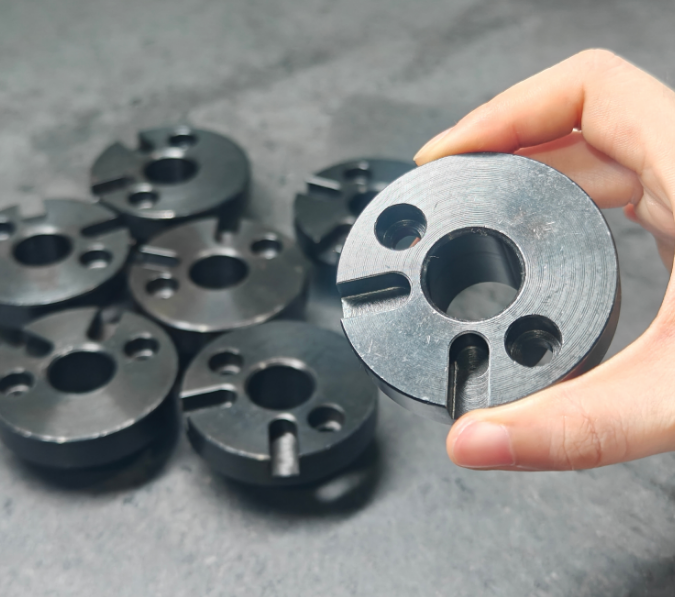
Common Forms
In any machining shop’s stock area, the most common sight is bundles of 6-meter round bar. They are usually coated with a 20 μm anti-rust oil film, and machinists work with them every day.
If a drawing specifies a 48 mm transmission shaft, purchasing will usually order 50 mm round bar. Leaving 1 mm of stock per side is just enough to remove the 0.5 mm black scale layer cleanly.
At about 15.4 kg per meter, a 6-meter length of 50 mm bar weighs close to 100 kg and must be moved by crane. On the saw, with a feed rate of 25 mm/min, a bi-metal blade takes about 2.5 minutes to cut through it.
The cut face will usually show about 0.3 mm of taper and a rough burr. One facing pass on a conventional lathe cleans it up immediately. As long as bar straightness is within 2 mm per meter, the spindle can run at 1500 rpm without noticeable vibration.
When making M24 large hex nuts in volume, using round bar and milling six flats is a waste of time. Smart shop managers order cold-drawn hex bar instead.
· For a size such as S36 across flats, dimensional tolerance is often held within 0.05 mm
· A simple 1 × 45° chamfer is enough before loading it into a collet
· The mill-bright Ra 3.2 surface usually needs no additional milling
· On a CNC lathe with an automatic feeder, a finished nut can be turned, threaded, and cut off in just 30 seconds
· Eliminating the milling operation can reduce unit processing cost by about 2.5 RMB
A 20 mm-thick, 150 mm-wide 45 steel plate often has hard black slag along the edges from flame cutting.
The operator needs a 36-grit resin wheel on an angle grinder to remove that 1 mm thick burnt layer. Otherwise the milling cutter will chip within 10 seconds of touching the workpiece.
Once the plate is clamped on a machining center with an 80 mm face mill, spindle speed can be set to 600 rpm and feed to 300 mm/min. The flying chips may reach 400°C.
A water-soluble coolant flow of 5 L/min is enough for cooling. If 2 mm is removed from each face of a palm-sized plate, flatness can be held within 0.02 mm.
Because steel plate is repeatedly compressed by upper and lower rollers in the mill, the grains are elongated into a fiber-like structure. Cutting along that rolling direction can extend carbide tool life by about 20%.
If the job involves 100 × 100 mm square sliders, starting from solid round bar and milling it into blocks wastes enormous amounts of material and machining time. Cutting 10 pieces of cold-drawn square bar at once on a band saw can increase daily output by 200 parts.
Cold-drawn square bar has a true square section, and the corners are usually controlled to within R1.5 to prevent cracking during drawing. Once clamped in a vise, a single pass with a face mill can reduce machining time by 12 minutes per part.
If the drawing calls for a massive gear blank with an 800 mm outside diameter weighing 2 tons, starting from a solid round bar would mean boring out the center, turning large steps, and generating more than 500 kg of useless chips.
A conventional lathe would have to run for 3 full days, and insert consumption would be extremely high. For heavy-duty parts like this, experienced machinists rely on forged blanks.
At the steel plant, a red-hot steel block heated to 1100°C is moved under an 8000-ton hydraulic press. After repeated hammering, the ingot is shaped into a stepped gear blank close to final form.
The forged blank leaves only 20 mm of stock per side for machining. It is then cooled slowly in sand for 48 hours to prevent cracking. Internal shrinkage cavities and pores are compressed tightly shut during forging.
The internal grain flow follows the contour of the gear blank. Ultrasonic inspection will not find cracks larger than 2 mm, and the continuous flow lines can increase gear tooth impact resistance by 1.5 times.
For hollow thick-wall parts such as hydraulic cylinder sleeves, shops prefer to start with 45 steel seamless pipe. Since the tube already has a bore, there is no need to remove large amounts of material from solid stock.
· A pipe with 100 mm OD and 60 mm ID saves about 35 kg of steel per meter
· A rough boring bar can enter the bore, take a 1.5 mm depth of cut, and brighten the inside in just two passes
· This completely avoids the risk of spindle seizure caused by chip blockage when trying to drill a 60 mm hole through solid bar
· Compared with machining the bore out of solid stock, it can save around 15 RMB per part in electricity and internal turning insert wear
However, during tube piercing, the wall is subjected to extreme deformation. Uneven wall thickness is normal. Measuring around the circumference with a caliper, a difference of 1.5 mm between the thickest and thinnest points is very common.
When setting the part on the lathe, a four-jaw chuck must be used to distribute eccentric stock evenly. The boring bar overhang should be kept within 240 mm so that wall-thickness tolerance stays within 0.05 mm.
If cutting allowance is calculated properly and the blank form is chosen wisely, spending one extra yuan on stock that is closer to final shape can easily save three yuan in machining time, labor, and electricity.