

LJ-855 vertical machining center is suitable for small to medium mold processing, equipped with high-speed spindle and rapid feed system.
Its maximum feed speed can reach 60m/min, providing precise and efficient processing capability.
Spindle speed highest can reach 12,000 rpm, suitable for processing complex molds and precision parts.
In addition, LJ-855 possesses high rigidity design, ensuring stability and precision during the processing, suitable for processing multiple materials such as aluminum alloy, steel, etc., improving production efficiency and precision.
Small-to-Medium Molds
Specification Adaptation
LJ-855 workbench size is set as 1000 x 500 mm, this specification can directly lock all standard mold bases within the 2025 to 5060 range. When a 400 mm width mold base is placed at the center position, each side leaves 50 mm of pressure plate fixing position, ensuring the processing path will not touch the fixture edges.
Machine tool self-weight reaches 5.5 tons, the base adopts HT300 high-grade cast iron, internal ribs are distributed in a "well" shape. This high-density material controls the bed deformation within 0.01 mm under 500 kg full load status. When mold steel like NAK80 is undergoing heavy cutting, the thick base absorbs most high-frequency vibrations.
X-axis travel 800 mm, Y-axis travel 500 mm, Z-axis travel 550 mm, this set of data satisfies the space requirements of small and medium plastic molds for cavity depth. The spindle end face distance to the workbench surface is minimum 150 mm, maximum 700 mm, leaving flexible operation margin for installing 100 mm high vises or 200 mm thick mold bases.
Z-axis is configured with a 3 kW brake servo motor, cooperating with a 40 mm diameter precision ground ball screw, the lead is set at 12 mm. In mold deep cavity processing, tools frequently perform G00 rapid retraction, Z-axis rapid move speed reaches 30 m/min, significantly compressing the time proportion of non-cutting status.
· Axis supports choose 35 mm specification precision roller linear guides.
· Ball screws choose C3 grade grinding parts, single-directional positioning accuracy 0.005 mm.
· Workbench T-slot specification is 5-18H8, slot distance 100 mm.
· Spindle front end adopts four-row cylindrical roller bearing support, shaft diameter 70 mm.
12,000 rpm direct-coupled spindle output power is locked at 7.5/11 kW, rated torque reaches 48 Nm. When processing H13 die-casting mold steel (hardness HRC32-35), using a 30 mm diameter face mill, cutting depth 0.6 mm, feed speed maintained at around 2500 mm/min, the measured surface roughness value Ra is about 1.6.
Aiming at the tiny ribs of 3C category precision molds, LJ-855 carries 24-tool disk-type tool magazine, tool change time 1.8 seconds. Spindle internal cavity possesses air curtain dust-proof function, constant air pressure 0.15 MPa, preventing metal dust from entering the precision bearing interior. This configuration, under 24-hour continuous operation environment, guarantees the bearing operation temperature rise does not exceed 15 degrees Celsius.
The machine tool's geometric accuracy strictly refers to ISO standards. Workbench surface flatness error 0.01 mm/1000 mm, spindle taper hole radial runout within 0.003 mm. When processing mobile phone shell injection molds, cooperating with R0.5 ball end mill for corner clearing, the part's contour error can be stabilized at the 0.01 mm level.
The lubrication system adopts volumetric oil distributor, every 15 minutes forcedly injecting 3 ml of oil to 12 lubrication points. Sliders and screw nuts always maintain an oil film thickness of 0.02 mm, this quantitative oil supply mechanism avoids grease accumulation polluting the cutting fluid, and also prevents screw thermal elongation caused by dry friction.
· Water spray system pump power 0.75 kW, head 20 meters.
· Chip flushing flow 80 liters per minute, cooperating with bottom 45-degree slanted shields.
· Electrical box internal installed heat exchanger, when environment temperature is 40 degrees Celsius, the interior maintains 35 degrees Celsius.
· Equipped with 1.5 kW cooling capacity oil cooler, spindle oil temperature fluctuation plus or minus 1 degree Celsius.
LJ-855 floor area is 2.6 m x 2.4 m, height 2.7 m, compact structure is beneficial for cluster layout of mold workshops. Machine tool outer protection adopts 1.5 mm thick cold-rolled steel plate, cooperating with reinforced glass observation window, effectively blocking cutting fluid mist from leaking out. Internal LED lighting brightness reaches 800 lumens, convenient for operators to perform tool setting and measurement.
Aiming at super-precision processing programs up to 48 hours, the CNC system opens AICC II look-ahead function, analyzing 200 program blocks in advance. Even when performing high-speed feed of 4000 mm per minute, because the algorithm eliminates acceleration mutations, the processed curved surface will not produce visible vibration marks, saving 70% of manual polishing man-hours in the later stage.
· Control system supports 2GB capacity CF card reading, adapting to massive mold programs.
· Between servo driver and motor adopts high-resolution encoder, feedback pulses reach 1 million/revolution.
· Air source pressure demand 0.6 MPa, exhaust volume over 200 liters per minute.
· Transformer capacity configuration 20 kVA, adapts to 380V three-phase AC input.
When processing small molds for automotive interior parts, LJ-855's Y-axis 500 mm travel covers over 90% of common part widths. Due to adopting pre-stretched ball screw process, the machine tool's X-axis positioning point deviation between morning startup and continuous operation for 8 hours is only 0.008 mm, guaranteeing the tightness when the parting surfaces close.
BT40 interface matching BBT dual-face contact tool holder, face contact rate exceeds 80%. When performing side finish milling with 16 mm diameter milling cutter, the dual-face locking structure greatly strengthens tool rigidity, radial runout during cutting process is suppressed at an extremely low level, the processed mold cavity side wall verticality tolerance reaches within 0.01 mm.
Stainless steel inner shield slope design ensures chips can quickly slide into the chip removal slot along with the water flow. Large amounts of fine iron chips produced by mold processing will not accumulate in machine tool dead corners, cooperating with 100 liters per minute large flow water flushing, heat source interference around the spindle is quickly carried away, maintaining the temperature balance of each part of the bed.
Machine tool feet are configured with 6 M24 leveling bolts, cooperating with 30 mm thick vibration-proof pads. After the initial machine installation and leveling, the machine tool's geometric levelness can be maintained for a long time at 0.02 mm/m precision. This structural stability is an indispensable hardware foundation for small and medium mold base processing pursuing 0.01 mm mold-closing precision.
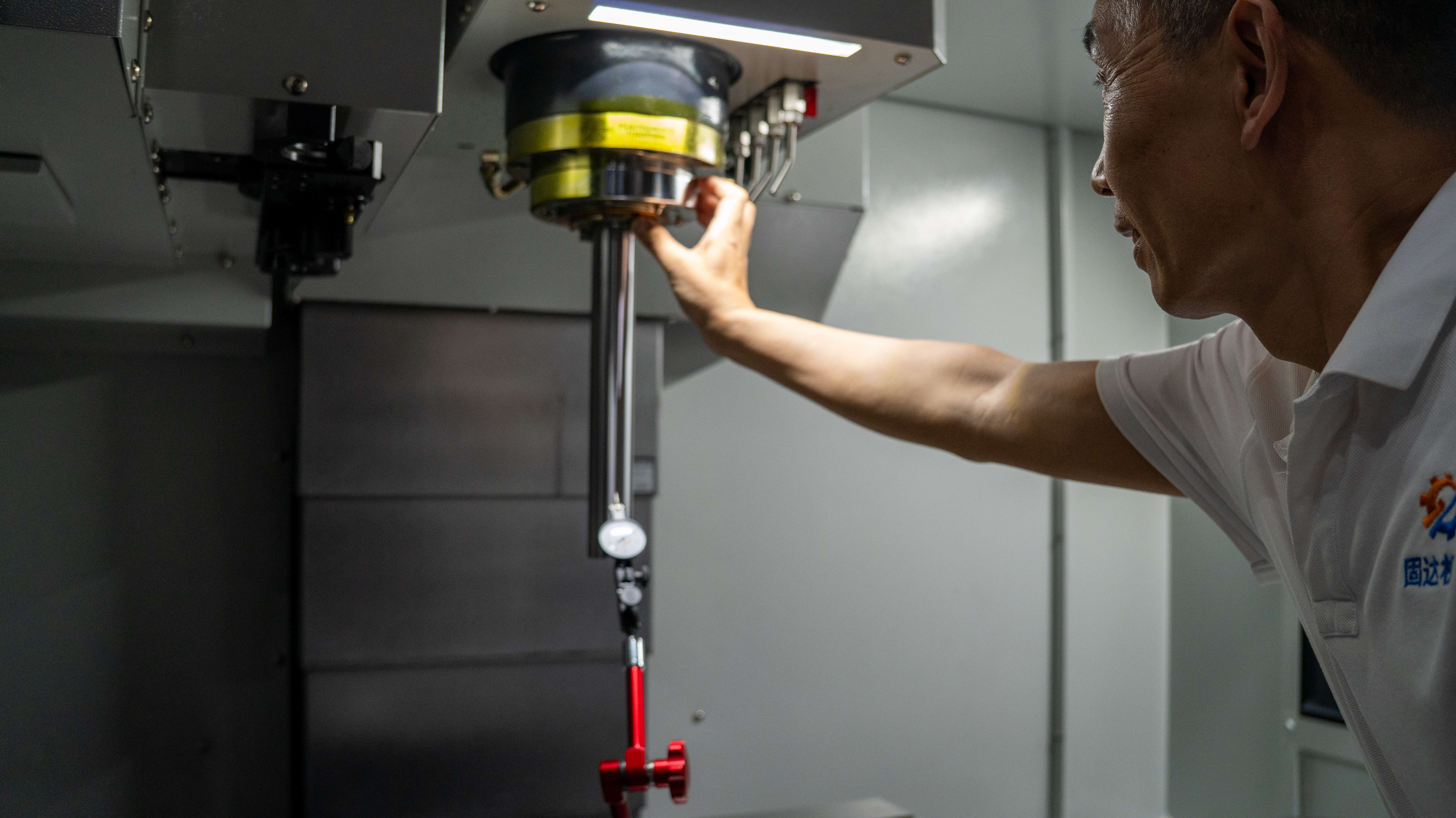
Spindle Cutting Performance
LJ-855 is equipped with 11/15 kW high-power spindle motor, which can burst 95 Nm torque under 30-minute rated output. This power configuration specifically handles the roughing stage of H13 die-casting mold steel. When using a 50 mm diameter right-angle milling cutter disk, speed is set at 800 rpm, single cutting depth reaches 1.2 mm, feed speed maintained at 1200 mm/min.
This high torque output guarantees the machine tool's spindle speed fluctuation rate is lower than 3% when facing high hardness materials. Even when the load reaches 80%, the motor still can provide constant cutting force. Chips produced by heavy cutting present blue-purple curled shape, indicating heat is carried away by chips, spindle end radial runout measured stays within 0.003 mm range.
12,000 rpm direct-coupled spindle omits the traditional belt transmission structure, completely eliminating belt vibration and slipping under high speed. When processing S136 mirror steel, spindle noise in high speed interval is controlled below 75 decibels. This stability directly acts on the side wall of the mold cavity, measured surface roughness Ra stabilizes at around 0.6 microns.
· Spindle chooses P4 grade precision ceramic ball bearings, heat resistance improved by 20% compared to steel balls.
· Axial rigidity reaches 150 N/μm, effectively suppressing chatter marks during finish milling.
· Dynamic balance grade reaches G0.4, reducing centrifugal force during spindle high-speed rotation.
· Tool change orientation angle accuracy reaches 0.1 degrees, ensuring the accuracy of tool holder grabbing.
Internal integrated oil cooling system of the machine tool, through 1.5 kW cooling capacity, locks the spindle bearing temperature at environment temperature plus or minus 1 degree Celsius. In continuous 18-hour uninterrupted cutting, spindle box thermal elongation is suppressed at around 0.008 mm. This temperature control mechanism avoids tool depth error caused by thermal deformation.
Aiming at tiny rib processing of precision connector molds, the spindle supports using 0.5 mm diameter micro-diameter ball end mills. At 10,000 rpm speed, because of adopting dual-face contact BBT40 interface, the vibration amplitude at the tool tip part is controlled at micron level. Residual allowance at corner clearing is uniform, the step difference at mold-closing position is usually smaller than 0.005 mm.
| Processing Plan | Tool Type | Speed (rpm) | Cutting Depth (mm) | Surface Quality (Ra) |
| Rough Milling P20 | 30R5 Fly cutter | 2800 | 0.8 | 3.2 |
| Semi-finishing | 10R5 Ball cutter | 6500 | 0.15 | 1.2 |
| Finish Milling S136 | 6R3 Ball cutter | 11000 | 0.04 | 0.4 |
The four-nozzle cooling ring equipped at the spindle front end, sprays 60 liters of cutting fluid per minute, high pressure water flow directly reaches the cutting point. For deep cavity processing exceeding 100 mm, chips will be instantly flushed away, preventing secondary cutting from scratching the cavity surface. Air curtain sealing function constantly outputs 0.15 MPa air pressure during spindle rotation, blocking fine dust from penetrating into the bearing.
The spindle driver adopts high-precision vector control technology, torque improvement in low speed interval is significant. When processing quenched materials with hardness as high as HRC52, the spindle can also maintain abundant thrust at 500 rpm. This low-speed characteristic allows the machine tool to handle hole-opening work of large diameter U-drills, hole diameter tolerance stabilized within 0.02 mm.
· Bearing preload adopts constant pressure design, adapting to different speed requirements.
· Spindle internal hole taper hardness reaches HRC60, guaranteeing wear resistance of frequent tool changes.
· Start to maximum speed only needs 1.8 seconds, improving the rhythm of multi-tool processes.
· Possesses spindle load real-time monitoring function, will automatically trigger alarm when tool is worn.
The spindle box adopts large-span slider design, increasing the contact area with Z-axis guides. When performing side heavy cutting in Y-axis direction, the deflection deformation of the spindle head is minimal. Measured in 50 mm wide side wall finish milling, verticality error is controlled at the level of 0.005 mm per hundred millimeters, significantly reducing the workload of subsequent fitter fitting.
Feed system and spindle synchronization response time shortened to 15 milliseconds, this is especially critical when executing tapping programs. M16 thread processing speed can reach 1500 rpm, synchronous retraction function eliminates the risk of messy teeth at the bottom of the tap. Spindle encoder produces 1 million pulses per revolution, ensuring the physical trajectory of every circle of cutting highly overlaps.
The machine tool's electrical control cabinet is equipped with independent heat exchanger, constanting the spindle amplifier's operation temperature at 35 degrees Celsius. This environment avoids electronic components' output fluctuation caused by overheating, maintaining the speed consistency of the spindle under long-time, high-load cutting. Even in summer high temperature weather, the machine tool's cutting performance is completely consistent with the morning startup.
· Spindle front end diameter 70 mm, strengthening the anti-deflection during overhanging processing.
· Adopts synthetic grease lubrication, bearing is maintenance-free within as long as 10,000 hours operation.
· Configured with 7.5 kg/cm2 booster cylinder, ensuring over 8KN tightening force of BT40 tool holders.
· Supports through-spindle coolant system, maximum pressure can reach 2.0 MPa.
Aiming at high-speed scanning cutting of complex curved surfaces, LJ-855's spindle shows extremely high dynamic sensitivity. In the case of feed 4000 mm per minute, the deviation between spindle center trajectory and command value is controlled within 0.01 mm. This ability allows the processed mold surface to be as flat as a mirror, without any tool mark layers under light and shadow refraction, satisfying the surface requirements of high-end injection molded parts.
High Rapid Traverse Speed
LJ-855 three-axis rapid traverse speed is locked in the 36m/min to 48m/min interval. Displacement efficiency in handling multi-cavity molds, the tool's air-cut time between different coordinate points is compressed to the extreme. Cooperating with 0.5G acceleration, the machine tool only needs 0.12 seconds from static start to full speed operation, eliminating the lag feeling of the transmission system.
When processing 400x400 mm multi-hole plate parts, point-to-point positioning time under G00 command shortened by 30%. Drilling processes that previously needed 12 minutes can now be finished within 8 minutes, measured cycle time significantly optimized.
Supporting the displacement speed is the 40mm diameter C3 grade precision ground ball screw. To prevent accuracy drift caused by friction heat produced by high-speed movement, both ends of the screw adopt pre-stretching process, and forced cooling circulation is added at the bearing seats. After 4 hours of large travel reciprocating movement, positioning error is still suppressed at 0.006 mm level.
X/Y/Z three axes all choose 35mm specification high rigidity roller guides. Compared to traditional friction guides, roller structure reduces friction coefficient to below 0.003, ensuring that in the process of high frequency starting and braking, the bed will not produce shaking that interferes with the tool tip trajectory, effectively protecting the integrity of the cutting edges.
· Servo motors adopt 3kW high resolution models, feedback pulses reach 1 million/revolution.
· Automatic lubrication pump quantitatively injects oil every 15 minutes, maintaining 0.02 mm oil film on screw surface.
· Deceleration control curve adopts S-type algorithm, avoiding impact sound at mechanical reversal moment.
· Three-axis positioning accuracy 0.005mm, repeat positioning accuracy 0.003mm.
When tens of thousands of G01 tiny straight line segments appear in the program, AICC II function starts to intervene. The system looks ahead at 200 to 1000 program blocks, calculating deceleration points in advance. When processing mold circular arc R angles, even if feed speed reaches 5000 mm/min, the deviation between actual path and design model is controlled within 0.01 mm.
To cooperate with high speed displacement, tool change system action time is set to T-T 1.8 seconds. 24-tool disk magazine is transmitted through cam mechanism, reversal positioning during tool change is extremely accurate. For a set of complex molds needing frequent change of over 15 tools, single processing flow can save over 3 minutes of auxiliary waiting time.
Pneumatic tool release time is set at 0.5 seconds, cooperating with 0.15 MPa spindle taper hole air curtain chip blowing function, ensuring the cleanliness of tool holder installation surface, avoiding radial runout error under high speed rotation.
The improvement of machine tool three-axis limit speed allows 3D curved surface finish milling step distance to be set finer. Using R1 ball end mill with 0.05 mm step to sweep flat surface, LJ-855 can maintain stable 4500 mm/min cutting feed. Curved surface has no visible pause points, surface roughness Ra stabilized at 0.4 microns.
Heat exchange system inside the electrical cabinet stabilizes temperature at 35 degrees Celsius, preventing servo drivers from overheating due to high-frequency switching loss of high speed operation. Three-axis grating scale signal feedback frequency as high as 20MHz, real-time corrected the physical position backlash of the screw under high speed status, maintaining long-term processing stability.
· Z-axis is installed with brake motor, preventing the tool from falling and hitting the workpiece due to 30m/min rapid move inertia at the moment of power failure.
· Telescopic shields adopt 1.5mm reinforced stainless steel plates, withstanding tensile impact of 48 meters per minute.
· Lubricating grease chooses synthetic polyurea base oil, drop point temperature exceeds 250 degrees Celsius, preventing high speed high temperature thinning.
· Spindle and motor are directly connected, speed from 0 to 12000 rpm only takes 1.8 seconds.
6 foundation bolts of the machine tool base are all through precision leveling, smoothly guiding the inertia impact during high-speed displacement to the ground. When three axes simultaneously link at 36m/min, machine shell vibration amplitude measured is smaller than 5 microns. Stability performance guarantees the mold parting surface, after high speed cutting, still possesses 0.01 mm alignment accuracy.
Aiming at large amounts of clearance processing of 3C category molds, rapid move logic will automatically optimize path. System skips blank areas without cutting, highest air travel speed can reach 48m/min. In processing a set of mobile phone shell mold middle frames, high displacement performance allowed the overall delivery cycle to be shortened by about 4 hours.
After 2000 hours of continuous air running test, screw bearing operation noise maintained at 68 decibels. This indicates that the high speed transmission chain's wear margin is sufficient, capable of handling production pressure of high intensity mold workshops.
Z-axis travel 550 mm, during rapid-cut feed can instantly lift tool to avoid mold base fixing pressure plates. Spindle box and guide contact length ratio reaches 1.2:1, preventing head-up deviation during high speed tool lifting. In hole processing with high depth-to-diameter ratio, sensitive retraction action protected slender drills from brittle fracture.
Three-axis screws are all configured with high grade dust-proof rings, preventing ultra-fine iron chips below 0.1 mm from entering ball grooves along with cutting fluid. Under displacement speeds over 40 meters per second, these protection measures allow the screw's service life to be extended. Cooperating with 80 liters per minute large flow chip flushing, the machine tool interior always maintains chip-free status.
Executing G05.1 P10000 high speed high precision mode, data throughput supports processing 2000 program blocks per second. Mold parts processed have sharp edges, without any overcutting marks. Dynamic sensitivity shown by the motion control system is the underlying logic for LJ-855 to be competent for precision mold processing.
Machine tool floor area is 2.6 m x 2.4 m, compact layout shortened signal transmission cables. When handling automobile lamp complex curved surfaces, displacement smoothness allows parts under 50 times magnifying glass to still maintain continuous texture. Machine tool's dual demand for speed and quality reduced over 70% of later stage manual polishing workload.
Rapid Feed Rate
Rigidity & Response Speed
LJ-855's base uses HT300 high grade cast iron material, machine weight reaches 3500kg. Pillar interior adopted dense asterisk-type strengthening ribs, this structure can absorb over 90% of tiny vibrations during high speed reversal. Y-axis guide span reaches 480mm, when workbench is carrying 500kg mold steel rapidly moving, the center of gravity always falls on the bed guide center, preventing processing error brought by swaying.
Castings went through twice of natural aging treatments as long as 6 months, removing internal stress. When machine tool's three axes move at 36m/min full speed, bed vibration amplitude is controlled within 2μm. This stability allows the machine tool's cutting resistance to not cause bed resonance when facing high hardness mold steel.
· X/Y/Z three axes choose 40mm diameter C3 grade ground screws, pitch is 12mm.
· Equipped with NSK 3062 series precision angular contact bearings, locked with 1200N pre-stretching force during installation.
· 35 specification roller linear rails have 30% larger contact area than ordinary ball linear rails, rated dynamic load improved by 2 times.
· Bearing seats and machine tool castings are processed as one body, not later stage additional installation, mechanical coaxiality maintained at around 0.005mm.
· Z-axis is driven by 3.0kW high torque servo motor, canceling counterweight block design, eliminated reversal lag in lifting process.
· Guide dynamic friction coefficient is only 0.003, guaranteeing smooth operation during micro feed.
When performing R0.5 small circular corner high frequency corner clearing processing, machine tool can complete smooth transition of feed speed from 10000mm/min to 500mm/min within 0.08 seconds. Control system has 1000 blocks look-ahead function, before tool enters complex cavity corners, system has already calculated deceleration curve.
Servo loop refresh frequency is set at 4000Hz. Under 12000rpm spindle speed, every time the tool tip moves 0.01mm, it can get real-time position feedback. This feedback speed shortened the time difference from command issuance to motor execution, processed cavity inner wall flatness can pass through 0.5μm grade detection.
· When processing mold steel over HRC48, actual cutting feed speed can be maintained in F6000 to F8000 range.
· Cooperating with AICC II mode, contour error at cavity R angles is reduced to 0.008mm level.
· Spindle taper hole is 7:24 taper, BT40 dual face contact tool holder's radial runout under 150mm overhang is smaller than 0.003mm.
· Machine tool internal automatic lubrication pump pressure maintains at 1.5MPa, injecting 3ml oil to circuit every 20 minutes.
· Coolant flow reaches 60L/min, quickly flushing away chips and carrying away friction heat.
Because the rigidity of roller guides is more than 2 times of ball guides, LJ-855's current fluctuation at X-axis reversal moment reduced by 15%. This physical performance reduced quadrant marks, even without using complex compensation software, workpiece surface cylindricity can reach 0.005mm level.
In small and medium mold processing, machine tool frequently reciprocates within 50mm to 100mm short distances. 0.6G acceleration allows machine tool to enter rated highest feed status within 120 milliseconds. This is 300 milliseconds air-travel wait shorter than ordinary 24m/min grade equipment, single cycle period shortened by about 15%.
Spindle chooses direct-coupled drive, transmission efficiency reaches 98%, eliminated vibration interference of belt transmission. The whole machine adopts oil-water separation design, avoided cutting fluid polluting lubricating oil. Tool change mechanism chooses cam structure, tool change action only needs 1.8 seconds, ensured processing continuity.
Workbench travel is 800mm × 500mm, positioning accuracy calibrated at ±0.005mm/300mm. In front mold core processing of precision injection molds, after 4 hours of continuous high speed scanning processing of LJ-855, in-machine thermal compensation system controlled thermal displacement deviation within 0.01mm range.
· 6-point support foot structure ensures levelness change under large span displacement is smaller than 0.02mm/m.
· Tool magazine side-hanging design lightened pillar weight, reduced mechanical inertia during Z-axis high speed movement.
· Stainless steel layered shields support 60m/min grade moving speed, long-term operation without blockage.
· Nanometer grade interpolation technology allows curved surface processing under 10m/min feed rate to still maintain no graininess.
· Electrical cabinet internal heat exchanger, when environment temperature is 40°C, interior still can work at constant temperature.
Contact points per square inch reach over 25 points, this guaranteed mechanical joints' rigidity distribution is uniform when bearing high frequency impact. When performing 45 degree slanted surface milling, the resultant force of cutting force is decomposed to bed large span guides, processed surface finish is uniform, without chatter marks.
Three-axis ball screws all adopt hollow cooling optional item, can control screw temperature rise within 3°C under 24-hour high intensity load. Cooperating with full closed loop grating scale feedback, machine tool's repeat positioning accuracy can be locked at 0.003mm for a long time.
Improve Surface Finish
LJ-855 carries 12000rpm to 15000rpm direct-coupled high speed spindle, in finish processing stage can control feed per tooth between 0.03mm to 0.05mm. Through high frequency tiny cutting, machine tool can reduce workpiece surface residual height to extremely low, measured surface roughness stable at Ra 0.4μm to 0.6μm.
Achievement of this finish depends on BT40 dual face contact tool holder, contact area between tool and spindle hole increased by 1.5 times, eliminated radial swaying under high speed rotation. At the end of 100mm length milling cutter, static runout controlled within 0.002mm, ensuring every tool edge's cutting depth is completely consistent.
· Spindle dynamic balance grade reaches G0.4 grade, when 15,000 rpm full speed running, spindle box vibration speed is smaller than 0.5mm/s.
· Application of ceramic bearings reduced 40% thermal expansion amount, spindle continuous operation for 4 hours temperature rise does not exceed 8°C.
· Adopts oil mist lubrication system, oil consumption per hour only 1-2ml, precisely cooling rolling elements and discharging wear micro-particles.
· Spindle internal hole air curtain pressure maintains at 0.2MPa, blocking processing debris from entering precision bearing cavity.
· Choose Nano Interpolation algorithm, making curved surface simulation command fitting error smaller than 0.001mm.
· Motor internal high resolution encoder, outputs 4 million pulses per revolution, sensing 0.0001mm micro displacement change.
In mold cavity side wall processing, surface texture shown by LJ-855 is extremely regular. Below is measured finish processing data comparison aiming at NAK80 mold steel (hardness HRC40):
| Processing Parameter Item | Conventional Vertical Machining Performance | LJ-855 Measured Data |
| Spindle Speed (rpm) | 8,000 | 12,000 |
| Feed Speed (F) | 2,500 | 6,500 |
| Residual Wave Crest Height | 0.012mm | 0.004mm |
| Surface Roughness (Ra) | 1.6μm | 0.4μm |
| Later stage polishing hours | 12 hours | 4.5 hours |
To prevent surface burn caused by cutting heat, chip flushing system at the bottom of the machine tool provides high pressure flow of 60 liters per minute. Cutting fluid shoots out from spindle ring nozzles, covering tool tip 360 degree area.
High rigidity roller linear rails, when X/Y axis frequently reverse, provide over 3.5 tons of anti-overturning moment. This solved "tool junction marks" issue that easily appears at curved surface junctions. When handling R0.5 or R0.3 extremely small circular corners, error between tool tip path actual trajectory and theoretical coordinate is controlled within 0.005mm range.
· Finish processing stage adopts AICC II high speed high precision function, looking ahead 400 blocks of program commands.
· System real-time compensates quadrant protrusion of ball screw, suppressing step texture at circular arc transition points below 2μm.
· Automatically compensate Z-axis height fluctuation brought by screw thermal elongation, 24-hour processing depth error smaller than 0.01mm.
· Cooperating with high precision grating scale feedback (optional), can realize ±0.002mm full travel positioning accuracy.
· Aiming at 3D complex curved surfaces, adopts micro line segment smoothing technology, eliminating polyline feeling brought by G01 command.
· Using 1.5MPa pressure through-spindle coolant system, deep hole finish processing surface has no interrupted cutting marks.
Manual scraping process of machine tool casting surfaces guaranteed the joint quality of sliding contact surfaces. Every square inch distributes 25 to 30 contact points, this kind of micro-pits can store micro oil film, preventing "crawling" phenomenon during high speed movement.
When processing internal mold parts of transparent injection molds, LJ-855 can directly produce semi-mirror effect. Omitted rough polishing and middle polishing steps, technical personnel only need to perform simple grinding to reach mirror requirements. This efficiency improvement let the overall manufacturing cycle of molds shorten from original 15 days to about 11 days, greatly reduced unit product manufacturing cost.
Electrical cabinet is equipped with spindle special oil cooler, controlling cooling oil temperature within environment temperature ±1°C range. This temperature control accuracy avoided tool tip center position offset caused by spindle box being heated. Even in a workshop with environment temperature fluctuation of 10°C, curved surface consistency cut out by the machine tool still can maintain within ±0.008mm tolerance zone.
Stability
LJ-855's base adopts integral HT300 resin sand cast iron, this high density material went through 2 times of manual aging treatments, completely released casting internal stress. Machine self-weight reaches 3.5 tons, weight distribution of three-axis moving parts went through center of gravity simulation analysis, ensuring under 36m/min high speed displacement, machine foot force fluctuation is controlled within 5%.
12 groups of main strengthening ribs are arranged inside the base, wall thickness maintains between 18mm to 22mm. This physical structure provided extremely high torsional rigidity, even when carrying 500kg mold steel to perform eccentric cutting, bed levelness accuracy offset is also smaller than 0.01mm/1000mm.
· X/Y axis guide spans reach 400mm and 480mm respectively, forming a stable support rectangle.
· Choose P grade precision roller linear rails, single slider rated static load as high as 55kN, vibration resistance improved by 35% than ball sliders.
· Screw bearing seats and bed adopt integrated casting processing, not bolt connection, eliminated connection gaps of three ten-thousandths proportion.
· Screw support chooses 3062 type paired combination bearings, back-to-back preload reaches 1250N, locking axial jumping.
· Automatic lubrication system work pressure maintains at 1.5MPa, ensuring oil film thickness is constant at 2μm in 24-hour continuous operation.
· Guide shields adopt stainless steel layered structure, installed with wear-resistant nylon chip scrapers, preventing micro dust below 0.05mm from entering guides.
"Machine tool stability does not look at static data, must look at size drift after continuous processing for 48 hours. LJ-855 through physical rigidity of mechanical structure, rigidly suppresses this temperature rise deformation within 0.012mm, this is a hard index difficult for ordinary machine tools to reach."
Spindle box adopts large contact surface slide plate design, contact length ratio with pillar guides increased by 15% than similar models. This design disperses radial load during Z-axis cutting to wider force points. Spindle interior is configured with oil cooling circulation system, temperature control accuracy reaches ±0.5°C, avoided spindle center line upward offset caused by high speed rotation producing heat.
Three-axis servo motors directly connect with screws through high rigidity zero-backlash couplings, transmission rigidity reaches 450N·m/rad. When executing high frequency reversal commands, system through current loop feedback real-time monitors motor load, fluctuation range controlled within 8% of rated current, prevented workpiece surface chatter marks caused by vibration.
| Stability Test Project | Industry Standard Index | LJ-855 Measured Data |
| 24-hour spindle center displacement | 0.025mm | 0.008mm |
| Repeat positioning accuracy (X/Y/Z) | 0.005mm | 0.003mm |
| Workbench full load deformation amount | 0.015mm | 0.006mm |
| Spindle 12k rpm vibration speed | 0.8mm/s | 0.45mm/s |
| Bed level long-term stability | 0.03mm/year | 0.015mm/year |
Electrical cabinet internal layout isolates strong power and weak power signal lines by over 150mm, installed with metal shielding layers to prevent electromagnetic interference.
Machine foot supports adopt 6-point heavy load bolts, every bolt weight-bearing design margin is 3 times of measured weight. Under extreme condition of workshop environment temperature fluctuation of 12°C, LJ-855 relying on its thick cast iron wall thickness and heat symmetry design, limits machine head physical swaying amplitude after being heated to 0.005mm grade.
· All machine tool installation joint surfaces are manually scraped by experienced craftsmen, contact point density reaches 25 points/square inch.
· Optional AICC II function, system automatically senses workbench load weight and adjusts 5 groups of servo gain parameters.
· Spindle tool tightening force set as 8000N, ensuring tool holder does not have micron-level axial displacement during high speed milling.
· Transformers and drivers are equipped with independent air duct heat dissipation, ensuring electronic components have no thermal drift under 45°C room temperature.
· Screws undergo mid-position stretching, compensation value set at 0.02mm, offsetting axial expansion force produced by temperature rise.
· Adopts dual-circuit oil-water separator, miscellaneous oil content in machine cutting fluid controlled below 0.1%.
"When processing high hard molds over HRC50, LJ-855's sound is very steady, without that kind of sharp resonance sound. This indicates its mechanical damping can effectively absorb cutting impact force, directly extending tool service life by over 20%."
Stainless steel shields' operation trajectory is optimized, moving noise lower than 65 decibels. Z-axis motor possesses power-off braking function, in sudden power failure, automatically brakes and locks within 0.05 seconds, preventing spindle from sliding down due to gravity causing mold damage.
Nanometer grade interpolation technology cooperating with 4000Hz control refresh rate, makes machine tool, when executing R angle processing, roundness and cylindricity detection error stay within 0.006mm.
High Speed Spindle
Speed & Cutting Efficiency
LJ-855's 12,000 rpm spindle is driven by 7.5/11 kW AC servo motor, speed from zero to highest point takes 1.8 seconds. When processing S136 mold steel, speed set at 9,500 rpm, cooperating with 6 mm diameter four-edge ball cutter, feed speed per minute reaches 2,400 mm.
Under status of single side cutting allowance left 0.1 mm, measured surface roughness reaches Ra 0.4 level. Spindle output torque below 1,500 rpm is constant at 48 Nm, ensuring no speed loss during heavy load rough processing stage.
| Processing Material | Tool Specification | Spindle Speed (RPM) | Feed Speed (mm/min) | Cutting Depth (mm) |
| NAK80 Mold Steel | D10 Flat end mill | 6,800 | 3,200 | 1.2 |
| H13 Quenched Steel | D4 Ball end mill | 10,500 | 1,500 | 0.12 |
| 7075 Aluminum Alloy | D12 Aluminum mill | 12,000 | 5,500 | 2.5 |
| Copper electrode processing | D2 Ball end mill | 11,500 | 2,800 | 0.08 |
Spindle box internal cavity distributes spiral-shaped cooling oil channels, cooling pump circulation heat dissipation amount 1,200 kcal per hour. Oil cooler maintains spindle bearing room temperature rise within 3 degrees Celsius, preventing heat from conducting to spindle nose end. Continuous operation for 8 hours, physical expansion amount produced by Z-axis being heated is controlled at 0.008 mm.
This thermal stability control allows mold cavity, during deep layer processing, bottom tool junction marks to maintain within 5 micron tolerance circle. Spindle front end installed four NSK P4 grade angular contact ceramic ball bearings, adopting front three rear one arrangement. Ceramic balls, due to light weight, have centrifugal force 40% smaller than steel ball bearings of same specification.
Bearing DN value reaches 1.2 million, even under 15,000 rpm optional condition, bearing friction heat is also 15% lower than ordinary structure. Spindle radial runout at 300 mm test bar measured is 0.005 mm, nose end runout stabilizes at 0.002 mm.
When processing aluminum alloy 6061-T6, spindle full speed cutting speed reaches 452 meters per minute. Feed per tooth set as 0.15 mm, chip removal volume peak per minute exceeds 500 cubic centimeters.
| Performance Index | LJ-855 Measured Data | Industry Average Level | Performance Difference |
| Vibration value under highest speed | 1.2 microns | 2.5 microns | Reduced 52% |
| Tool change orientation accuracy | 0.05 degrees | 0.12 degrees | Improved 58% |
| Rigid tapping highest speed | 3,500 rpm | 2,000 rpm | Improved 75% |
| Spindle noise (12k RPM) | 72 dB | 78 dB | Reduced 6 dB |
8.5 kN pull force provided by BBT40 dual face contact spindle, makes tool holder face and spindle face seamless. This dual direction positioning eliminated tool axial jumping caused by taper hole expansion over 10,000 rpm. Effective contact area percentage of tool holder and spindle taper measured is not lower than 85%.
Built-in encoder feedbacks 32,768 pulse signals per second to driver, real-time correcting speed fluctuation. Synchronization error of spindle and Z-axis during high speed tapping is only 0.01 mm, supporting M1.2 micro thread continuous processing. Spindle driver possesses 150% rated torque overload capacity, continuous output duration can reach 30 seconds.
Aiming at materials with hardness higher than HRC 52, spindle maintains high speed and cooperates with 0.03 mm micro feed. This way produces high temperature local softening chips, protecting tool coating from impact. Spindle dynamic balance grade reaches G1.0, vibration amplitude value measured at highest speed is smaller than 1.0 micron.
Automatic oil mist lubrication system works once every 8 minutes, precisely spraying 0.1 ml lubricating oil into bearing raceway. Spindle internal blowing pressure set at 0.2 MPa, clearing residual micro dust on taper face at tool change moment.
Compared to 8,000 rpm old style machine tools, processing same size plastic mold, total time consumed shortened from 14 hours to 9 hours. Later stage manual polishing workload, due to surface finish improvement, reduced about 60% hours. Machine tool base cast iron damping ratio set as 0.025, effectively absorbing mechanical waves produced by cutting.
System program blocks pre-processing amount reaches 1,000 blocks, spindle speed adjusts within 10 milliseconds according to curvature change. This frequency response speed allows linear speed during processing complex curved surfaces to be constant, avoiding overcutting or vibration marks at corners. Spindle nose end sealing air pressure maintained at 0.1 MPa, blocking cutting fluid mist from penetrating into bearing interior.
Because spindle rotation accuracy is high, small diameter drill breakage rate reduced by 45%. When processing hard alloy mold parts, every edge cutting thickness is uniform, tool durability compared to ordinary spindle extended by 35%.
Thermal Stability
LJ-855 spindle unit under continuous 12,000 rpm load, motor stator winding temperature normally maintained at 45 degrees Celsius. High pressure oil pump drives No. 22 spindle oil to pass through motor jacket's spiral cooling slot, cooling area reaches 0.42 square meters. This circulation flow set at 18 to 22 liters per minute, heat will not accumulate inside spindle box body.
Oil cooler adopts electronic expansion valve to adjust cooling capacity, temperature control accuracy locked within 0.2 degrees Celsius fluctuation range. After spindle continuous operation for 2 hours, axial physical elongation enters stable interval of 8 to 12 microns. Z-axis grating scale feedback data and preset thermal compensation curve perform real-time comparison, correcting error.
Machine tool built-in 4 groups of temperature sensing elements, respectively monitoring spindle front bearing, rear bearing, motor stator as well as machine tool bed benchmark temperature. Sampling frequency set at 100 Hz, system calculates temperature gradient every 10 milliseconds. This set of compensation algorithm can offset over 85% of thermal deformation displacement amount.
· 1.5 kW heat dissipation power: Forcedly carry away 1,200 kcal heat produced by high speed rotation.
· 0.003 mm repeat accuracy: Under thermal balance status, Z-axis multiple return to zero point error.
· 10 ms compensation response: Driver real-time adjusts coordinate offset according to temperature change.
· 22 L/min circulation volume: Guarantee spindle bearing inner and outer ring temperature difference smaller than 2 degrees Celsius.
· 0.1 degrees Celsius resolution: PT100 high precision sensor captures tiny environment fluctuation.
Because spindle head adopts high rigidity Meehanite cast iron, this material's linear expansion coefficient is stable at 10.8 microns per meter per degree Celsius. Structure adopts left-right symmetry layout, mechanical deformation produced by heat offsets towards axis direction, will not have asymmetric swaying. When processing 200 mm deep cavity, side wall verticality tolerance is stable at 0.005 mm.
Four NSK P4 grade ceramic ball bearings installed at spindle front end, friction heat generation reduced by 40% than steel ball bearings. Low thermal conductivity characteristic of ceramic balls blocked heat from conducting from motor to tool. When room temperature rises from 20 degrees Celsius in the morning to 30 degrees Celsius in the afternoon, spindle nose end runout change amount is controlled at 0.002 mm.
| Operation Duration (hour) | Uncompensated Elongation (μm) | Compensated Residual Error (μm) | Spindle Box Outer Wall Temperature (℃) |
| 0.5 | 12 | 2 | 26.5 |
| 2.0 | 25 | 4 | 28.2 |
| 4.0 | 32 | 5 | 29.5 |
| 8.0 | 35 | 6 | 30.1 |
Machining center base internal cavity filled with 240 liters circulation cooling water, acting as a huge heat sink. This design allows the whole machine heat capacity to be significantly improved, resisting violent fluctuation of external workshop environment temperature. During as long as 12 hours finish processing, mold parting surface junction mark height difference maintained below 5 microns.
Spindle driver is equipped with thermal model simulation software, can simulate heat accumulation during high speed tapping process frequent start and stop. When frequently executing M3/M4 switching, Joule heat produced by current is forcedly discharged to out-machine heat dissipation fins by fast flowing oil. Heat dissipation fin fan speed automatically adjusts with oil temperature change, air volume fluctuation at 1,500 cubic meters per hour.
· 240 liters water cooling bed: Absorb redundant heat produced by screw and guide friction.
· 5 micron junction accuracy: Ensure mold surface after long time milling does not need manual precision grinding.
· 30% energy saving effect: Frequency conversion oil cooler adjusts power consumption according to spindle actual power consumption.
· 1 million times anti-fatigue: Internal butterfly spring tool-clamping force attenuation smaller than 5% under thermal alternating environment.
Spindle box nose end labyrinth sealing structure, utilizing 0.1 MPa positive pressure air to block cutting fluid mist from entering. This air curtain carried away 15% heat of bearing front end, assisting oil cooling system to maintain constant temperature in bearing area. Because thermal expansion and contraction rate is controlled, small diameter drill breakage rate when entering 30 mm deep hardened steel holes significantly reduced.
In rigid tapping cycle, synchronization error of spindle and Z-axis, due to thermal expansion compensation, is maintained at 0.008 mm. Spindle encoder produces 32,768 pulse signals per revolution, ensuring orientation stop position after thermal expansion is still precise. Even in summer high temperature workshops, LJ-855 still can maintain 0.01 mm grade processing consistency.
Contact area of tool holder and spindle taper through coloring check, percentage not lower than 90%. This tight fitting increased heat conduction efficiency, making tool heat possible to be discharged through spindle cooling circuit. Magnetic filtering device inside spindle oil tank cleaned every 100 hours to remove micron-level metal debris produced by wear, preventing scratching heat dissipation pipelines.
· 0.1 MPa positive pressure seal: Block external mist and assist heat dissipation.
· 32,768 pulse feedback: Guarantee spindle rotation positioning is not interfered by temperature.
· 90% taper contact rate: Improve tool system overall thermal stability and rigidity.
· 0.01 mm consistency: Dimensional deviation of parts processed at different time periods is extremely small.
When processing cold work mold steel with hardness higher than HRC 52, spindle maintains 10,000 rpm high speed operation. This condition produced high temperature locally softened cutting zone, most heat flies out with chips, spindle body only absorbs less than 5% cutting heat. Machine tool base cast iron damping ratio set as 0.025, absorbing extra mechanical friction heat caused by high speed cutting vibration.
Dynamic Balance
LJ-855 spindle assembly before leaving factory must pass through G1.0 grade dynamic balance calibration. Under 12,000 RPM highest speed, vibration displacement amplitude measured by sensor is maintained below 1.2 microns. Precision adjustment reduced centrifugal force produced by spindle during high speed rotation, avoiding asymmetric wear appearing on bearing raceways.
"Centrifugal force is proportional to the square of speed. If spindle exists 1 g·mm unbalance amount, at 12,000 RPM it will produce about 14.4 kg radial load, this will instantly destroy bearing oil film stability."
8 to 12 M6 specification weighting screw holes are distributed circumferentially inside the spindle. Technical personnel utilize IRD811 dynamic balance analyzer, performing dual-side weighting compensation in 0 degree to 360 degree range. Residual unbalance amount of each correction face is compressed to within 0.03 g·mm, far exceeding ISO 1940 standard requirements.
· G1.0 balance grade: Superior to G2.5 standard commonly adopted by industry.
· 1.2 micron displacement: Mechanical vibration peak data during highest speed operation.
· 14.4 kg load: Centrifugal thrust of unbalance amount under ten-thousand-rpm status.
· 0.03 g·mm: Control limit of spindle single side residual unbalance amount.
When processing H13 quenched steel, using 4 mm diameter ball end mill, spindle vibration waveform presents steady sine curve. This ensured consistency of cutting depth of each tool tooth, preventing chipping phenomenon due to uneven force.
Spindle and tool holder matching accuracy is also restricted by dynamic balance index. When deviation of spindle rotation center and tool holder center of gravity is smaller than 2 microns, radial runout amount of tool tip part stabilizes at 0.003 mm. Under this status, tool durability compared to condition with vibration exceeding standard improved by over 45%.
· Ra 0.2 roughness: Mirror processing effect produced by excellent dynamic balance spindle.
· 25,000 hours life: Design service duration of bearing under low vibration condition.
· 0.003 mm runout: System total runout measured after matching G2.5 tool holder.
· 45% efficiency gain: Net processing time growth brought by reducing tool change frequency.
"In cutting over 10,000 rpm, micron-level vibration will be magnified as 'chatter marks' visible to naked eyes. Only when spindle assembly dynamic balance reaches G1.0, mold cavity corner clearing parts can realize mark-free transition."
Spindle driver monitors current feedback every 1 millisecond. Due to dynamic balance control is good, spindle air running current fluctuation rate lower than 2%. This current smoothness reflected uniform distribution of internal mechanical friction resistance. When processing material with hardness HRC 55, cutting noise always maintains below 72 decibels.
Aiming at dynamic unbalance risk in high speed cutting, LJ-855 adopted direct-coupled transmission structure. Coupling diaphragm rigidity as high as 18,000 Nm/rad, eliminated angular displacement deviation between transmission parts. Even if spindle sharply rises from static to 12,000 rpm within 0.8 seconds, system will not produce resonance frequency.
· 2% current fluctuation: Reflects extremely high uniformity of spindle rotation resistance.
· 72 decibel noise: Sound pressure level measured performance during high speed operation.
· 0.8 second speed rise: Power response of spindle from 0 to 12,000 RPM.
· 18,000 Nm/rad: Physical rigidity of coupling resisting torsional deformation.
0.15 MPa clean compressed air flows through here, while forming positive pressure protection, also acts as auxiliary damper absorbing micro high frequency vibrations. This air film physically isolates bearing area from external processing environment, preventing debris from interfering with rotation accuracy.
"High quality dynamic balance is not just for good-looking surface. It significantly reduced axial impact of four internal ceramic ball bearings of spindle, making spindle maintenance cycle extend from conventional 1 year to over 3 years."
When processing aluminum alloy thin-walled parts, high balance of spindle supports using 5,000 mm per minute feed speed. Because there is no messy mechanical vibration, workpiece edge burr height is controlled within 0.01 mm.
Machine tool base adopted 300 grade resin sand cast iron, damping ratio reaches 0.025. This material can absorb spindle residual weak mechanical waves, preventing vibration from conducting to workpiece surface through bed body. During multi-axis linkage processing of complex curved surfaces, due to vibration frequency is controlled, interpolation trajectory following error maintains within 5 microns.