

To calculate a rectangular mold steel block’s weight, multiply its length, width, and thickness by the material density. When dimensions are in millimeters and density is in g/cm³, divide the result by 1,000,000 to get kilograms. A 500 × 300 × 80 mm steel block at 7.85 g/cm³ weighs 94.2 kg.
Use ordered or measured block dimensions for material purchasing, finished dimensions for the machined part, and packed dimensions only for freight calculations. Add pallet and crate weight separately when calculating gross shipping weight.
For made-to-order material, sizes, and surface conditions, see our custom mold steel blocks for CNC machining.
Weight Formula
For a solid rectangular block measured in millimeters:
Weight in kg = Length × Width × Thickness × Density ÷ 1,000,000
- Length, width, and thickness must all be in millimeters.
- Density must be in g/cm³.
- The result is the theoretical net weight of the material.
Example: A 500 × 300 × 80 mm steel block at 7.85 g/cm³ weighs:
500 × 300 × 80 × 7.85 ÷ 1,000,000 = 94.2 kg
Quick Weight Reference
The table below uses a density of 7.85 g/cm³.
| Block Size | Estimated Weight |
|---|---|
| 200 × 150 × 30 mm | 7.07 kg |
| 300 × 200 × 50 mm | 23.55 kg |
| 400 × 300 × 60 mm | 56.52 kg |
| 500 × 300 × 80 mm | 94.20 kg |
| 600 × 400 × 100 mm | 188.40 kg |
| 800 × 500 × 150 mm | 471.00 kg |
| 1,000 × 600 × 200 mm | 942.00 kg |
| 1,200 × 800 × 300 mm | 2,260.80 kg |
Unit Formulas
| Dimensions | Density | Formula |
|---|---|---|
| Millimeters | g/cm³ | Length × Width × Thickness × Density ÷ 1,000,000 |
| Meters | kg/m³ | Length × Width × Thickness × Density |
| Inches | lb/in³ | Length × Width × Thickness × Density |
General steel is approximately 7,850 kg/m³ or 0.283 lb/in³. Do not mix millimeters with lb/in³ or inches with g/cm³ unless the values are converted first.
Material Density
Density depends on the actual material. Use the steel producer’s data sheet when available. The figures below are suitable for estimates, but they are not guaranteed values for every producer or heat.
Available grades and supply forms can be reviewed in the ASIATOOLS mold steel range.
| Material | Planning Density | Common Use |
|---|---|---|
| General carbon or alloy steel | 7.85 g/cm³ | Early estimate when the exact grade is unknown |
| P20 / 1.2311 | About 7.80 g/cm³ | Plastic mold cavities, cores, and mold plates |
| P20+S / 1.2312 | About 7.80 g/cm³ | Prehardened mold parts requiring easier machining |
| P20+Ni / 1.2738 | About 7.80 g/cm³ | Large plastic mold sections |
| H13 / 1.2344 | About 7.80 g/cm³ | Hot-work and die-casting tooling |
| D2 / 1.2379 | About 7.70 g/cm³ | Wear-resistant inserts, punches, and dies |
| 420 / 1.2083 | About 7.80 g/cm³ | Corrosion-resistant mold parts |
| High-speed tool steel | About 8.00–8.20 g/cm³ | High-alloy cutting and tooling parts |
| Copper-alloy mold insert | About 8.30–8.90 g/cm³ | High-heat-transfer mold inserts |
| Aluminum tooling plate | About 2.66–2.85 g/cm³ | Fixtures, prototype molds, and lightweight tooling |
Use density information in this order: exact producer data sheet, supplier-confirmed density, recognized equivalent-grade value, and then the general steel value of 7.85 g/cm³.
Same Size, Different Materials
The following comparison uses the same 500 × 300 × 80 mm block size.
| Material | Density | Estimated Weight |
|---|---|---|
| Aluminum tooling plate | 2.70 g/cm³ | 32.40 kg |
| D2-type tool steel | 7.70 g/cm³ | 92.40 kg |
| P20/H13-type steel | 7.80 g/cm³ | 93.60 kg |
| General steel | 7.85 g/cm³ | 94.20 kg |
| Copper alloy | 8.35 g/cm³ | 100.20 kg |
Why Density Matters
A 1,200 × 800 × 300 mm block weighs 2,260.8 kg at 7.85 g/cm³ and 2,217.6 kg at 7.70 g/cm³. The difference is 43.2 kg. On large blocks or batch orders, this can affect cost, vehicle payload, and lifting capacity.
Which Dimensions to Use
| Dimension Type | Meaning | Use |
|---|---|---|
| Finished size | Size after machining | Finished-part weight |
| Ordered size | Purchase-order size with machining allowance | Material budget |
| Supplied size | Actual delivered dimensions | Invoice and incoming inspection |
| Packed size | Outside pallet or crate dimensions | Shipping space and dimensional weight |
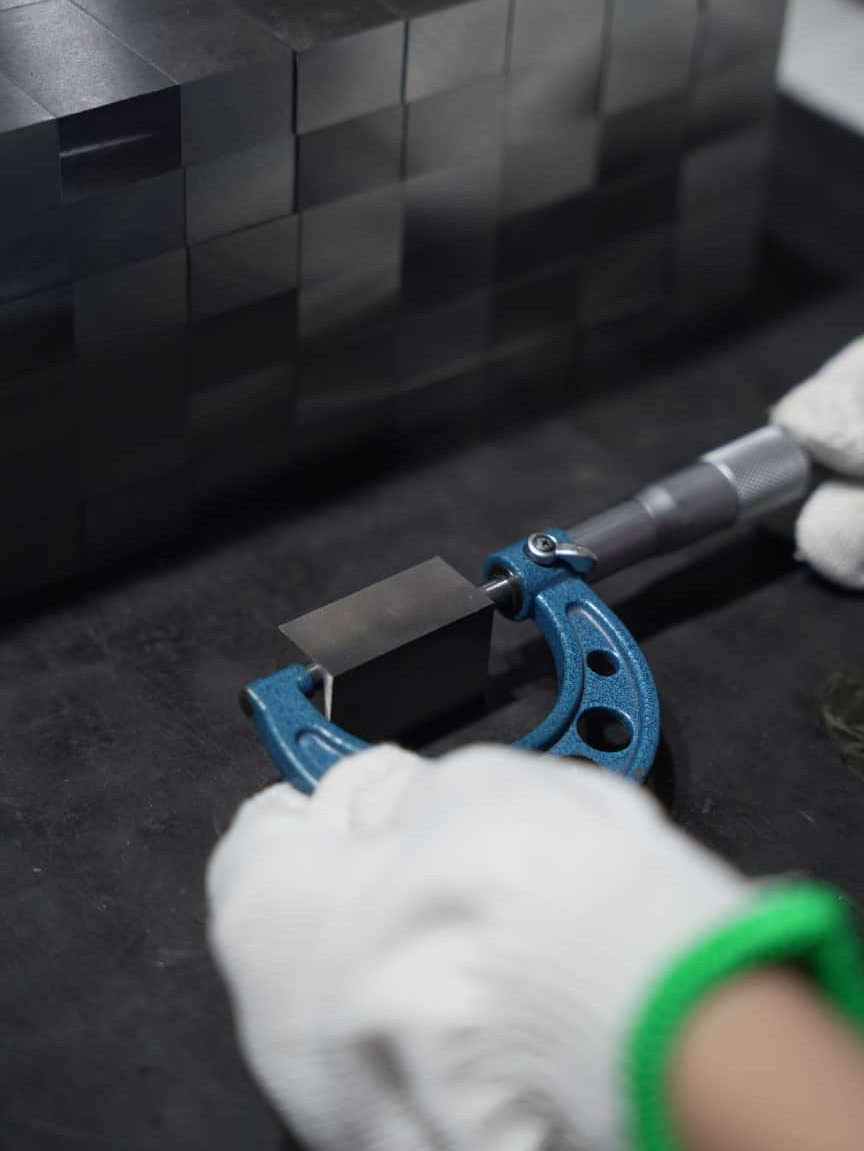
Do not calculate raw-material cost from the finished drawing size. Sawing, milling, grinding, clamping, and stress-relief work may require extra material. The article on calculating mold block size before CNC machining explains how these allowances are separated.
Allowance Changes Weight
The table below uses 7.80 g/cm³ and compares several supplied sizes with a 500 × 300 × 80 mm finished block.
| Supplied Size | Estimated Weight | Increase |
|---|---|---|
| 500 × 300 × 80 mm | 93.60 kg | — |
| 503 × 303 × 82 mm | 97.55 kg | 3.95 kg |
| 506 × 306 × 83 mm | 100.24 kg | 6.64 kg |
| 510 × 310 × 85 mm | 104.04 kg | 10.44 kg |
Surface condition also affects the required allowance. A rough black-surface block may need more cleanup stock than a milled block. See the practical comparison of black-surface and six-side-milled steel blocks.
Batch Order Weight
A 500 × 300 × 80 mm P20-type block at 7.80 g/cm³ weighs 93.60 kg per piece.
| Quantity | Total Steel Weight |
|---|---|
| 1 | 93.60 kg |
| 5 | 468.00 kg |
| 10 | 936.00 kg |
| 20 | 1,872.00 kg |
Dimension Tolerance
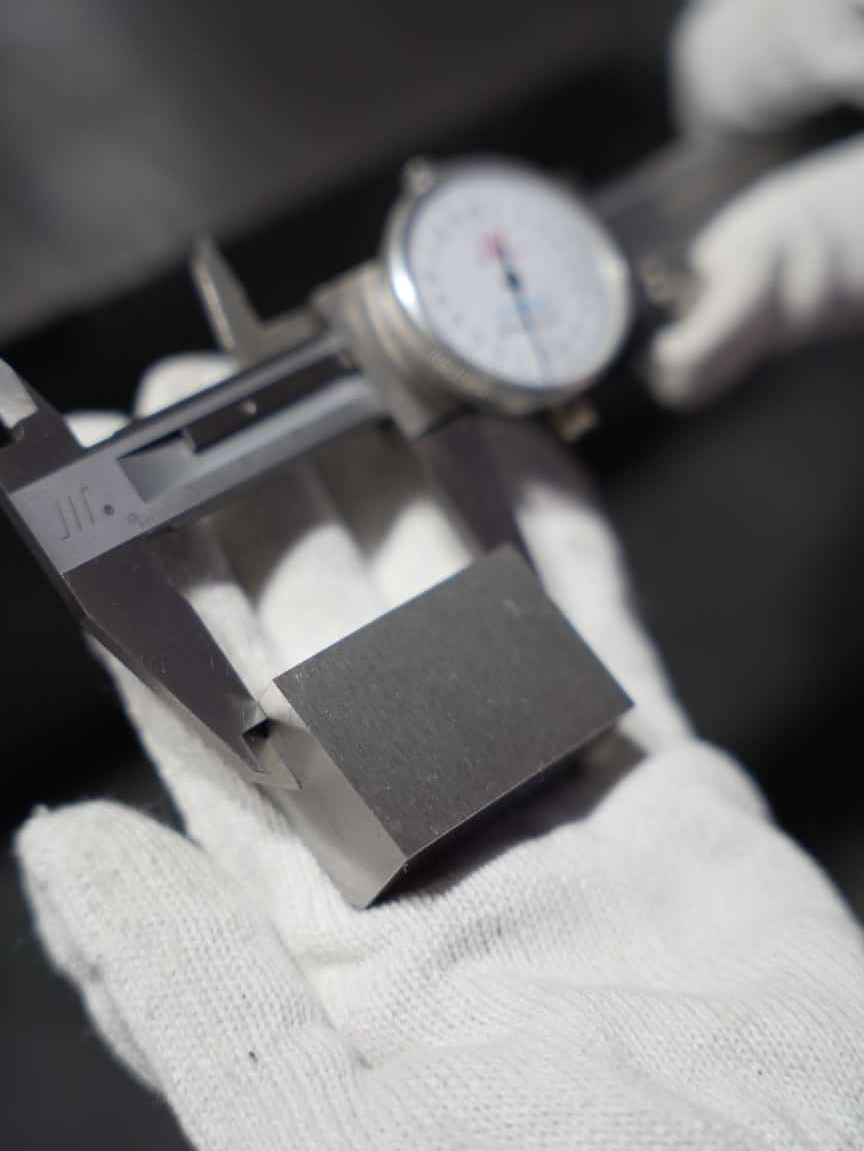
A nominal 1,000 × 600 × 200 mm block at 7.85 g/cm³ weighs 942 kg. If the measured size is 1,005 × 605 × 203 mm, the theoretical weight is 968.92 kg. The difference is 26.92 kg, or about 2.9%.
Other Stock Shapes
| Shape | Metric Formula |
|---|---|
| Round bar or disc | π × Diameter² × Length or Thickness × Density ÷ 4,000,000 |
| Ring | π × (Outside diameter² − Inside diameter²) × Thickness × Density ÷ 4,000,000 |
Holes and Cavities
Calculate the full outside block first, then subtract the removed material.
Net volume = Outside volume − Removed volume
Net weight = Net volume × Density
For a round hole: Removed volume = π × Hole diameter² ÷ 4 × Hole depth
For a rectangular pocket: Removed volume = Pocket length × Pocket width × Pocket depth
Through-Hole Weight Removal
The table below uses a 100 mm hole depth and a density of 7.80 g/cm³.
| Through-Hole Diameter | Removed Weight |
|---|---|
| 50 mm | 1.53 kg |
| 75 mm | 3.45 kg |
| 100 mm | 6.13 kg |
| 150 mm | 13.78 kg |
| 200 mm | 24.50 kg |
Using CAD
- Confirm that the model is a closed solid.
- Check whether the model uses millimeters or inches.
- Confirm whether it represents raw stock or the finished part.
- Include all large holes, cavities, and channels.
- Check hidden or suppressed bodies.
- Assign the correct density to each material.
Shipping Weight
| Weight Type | Meaning |
|---|---|
| Block net weight | One steel block without packaging |
| Total net weight | All steel blocks or finished parts in the shipment |
| Tare weight | Empty pallet, crate, supports, restraints, and protective materials |
| Gross weight | Total net weight plus tare weight |
| Dimensional weight | A space-based value used by some parcel and air services |
Gross weight = Total net weight + Tare weight
| Item | Weight |
|---|---|
| Steel block | 820 kg |
| Pallet or skid | 38 kg |
| Supports | 16 kg |
| Brackets and bolts | 7 kg |
| Straps and protection | 4 kg |
| Gross weight | 885 kg |
In this example, packing adds 65 kg, equal to about 7.9% of the steel weight. This percentage applies only to this packing design and should not be used as a general rule.
Dimensional Weight
Dimensional weight in kg = Package length × Package width × Package height ÷ Divisor
An 80 × 60 × 50 cm crate with a divisor of 5,000 gives 48 kg. If the packed actual weight is 220 kg, the actual weight is higher. This comparison is useful only when the chosen service uses dimensional weight.
Packing Heavy Steel
- Use timber or steel supports to spread the load.
- Prevent the block from sliding in every direction.
- Protect sharp edges where straps touch the steel.
- Keep forklift openings clear.
- Mark the gross weight and lifting position.
- Confirm that the receiver can unload the shipment.
Machine and Lifting Checks
Total machine load = Block + Fixture + Clamps + Support parts
A 2,800 kg block with a 420 kg fixture and 80 kg of clamps creates a total setup load of 3,300 kg.
Material Cost
Material cost = Invoiced material weight × Price per kg
Extra Material Cost
The table below uses a steel price of $4.20/kg.
| Extra Material | Extra Cost |
|---|---|
| 5 kg | $21.00 |
| 10 kg | $42.00 |
| 20 kg | $84.00 |
| 50 kg | $210.00 |
| 100 kg | $420.00 |
For an 800 × 500 × 150 mm block at 7.80 g/cm³, the nominal weight is 468 kg. At $4.20/kg, the material cost is $1,965.60. If the supplied size is 806 × 506 × 153 mm, the weight becomes 486.71 kg and the cost becomes $2,044.19. The added stock costs $78.59 before machining.
For large P20 parts, see the comparison of rolled and forged P20 mold steel blocks.
Machining Yield
Machining yield = Finished weight ÷ Purchased weight × 100%
The table below assumes a purchased blank weight of 500 kg.
| Finished Weight | Material Removed | Machining Yield |
|---|---|---|
| 450 kg | 50 kg | 90% |
| 400 kg | 100 kg | 80% |
| 350 kg | 150 kg | 70% |
| 300 kg | 200 kg | 60% |
| 250 kg | 250 kg | 50% |
Checking Supplier Weight
If the quoted weight differs from your calculation, check the grade, density, actual dimensions, quantity, machining allowance, surface condition, packaging weight, and billing method.
Difference percentage = (Supplier weight − Calculated weight) ÷ Calculated weight × 100%
See the guide on evaluating a mold steel supplier before ordering.
Complete Example
- Block size: 806 × 506 × 153 mm
- Density: 7.80 g/cm³
- Quantity: 2
- Packaging weight: 62 kg
- Packed size: 110 × 80 × 60 cm
- Example dimensional divisor: 5,000
Single-block weight = 486.71 kg
Total net weight = 973.42 kg
Gross weight = 1,035.42 kg
Dimensional weight = 105.6 kg
Common Errors
- Using finished dimensions for purchasing: raw stock normally includes extra material.
- Entering 7,800 instead of 7.80: the calculator requires g/cm³.
- Mixing inches and metric density: keep all inputs in one unit system.
- Ignoring quantity: multiply the single-block weight by the number of pieces.
- Ignoring large cavities: finished molds can be much lighter than solid blanks.
- Ignoring packaging: freight and forklift planning require gross weight.
- Using too many decimal places: 486.7 kg is more realistic than 486.711482 kg for a theoretical calculation.
- Using calculated weight as final proof: use actual weighing for shipping documents and safety-related handling.
Summary
For a rectangular mold steel block, use length × width × thickness × density ÷ 1,000,000 when dimensions are in millimeters. A 500 × 300 × 80 mm block at 7.85 g/cm³ weighs 94.2 kg. Use supplied dimensions for material cost, finished dimensions for the machined part, and packed dimensions for freight. Extra stock can change the result quickly: increasing a 1,000 × 600 × 200 mm block to 1,005 × 605 × 203 mm adds about 26.9 kg. Add pallet and crate weight separately, and confirm final shipping or lifting weight by actual weighing.