

A mold used for ordinary polypropylene may run for years with standard prehardened steel. The same steel can develop rust, pits, worn gates, blocked cooling channels, and damaged polished surfaces when it processes PVC or a glass-filled flame-retardant compound.
The term “corrosive plastic” can be misleading. The plastic pellet does not always attack the steel directly. Damage may come from hot decomposition gases, additives, deposits, moisture, cooling water, or several of these factors acting together.
Two risks must be checked separately:
- Corrosion: Metal is attacked by gases, water, deposits, humidity, or chemicals.
- Wear: Metal is removed or deformed by glass fiber, mineral filler, high pressure, and fast plastic flow.
A steel that resists rust may still wear quickly. A very hard steel may resist glass fiber but still corrode. Mold-surface damage can also change the roughness and appearance of the molded part.[1]
Steel selection must also consider mold life, part appearance, block thickness, heat treatment, repair, cooling-water quality, and downtime cost. The main factors used to select plastic mold steel should be checked together.
Quick Choice
The table below gives a starting point. It is not a final steel or heat-treatment specification.
| Mold condition | Steel family to evaluate | What to confirm |
|---|---|---|
| Mild corrosion and a short or medium production run | Prehardened corrosion-resistant mold steel | Delivery hardness, machining cost, and maintenance needs |
| Unfilled PVC or frequent exposure to humidity | 420-modified or 1.2083-type stainless steel | Corrosion resistance, working hardness, and block size |
| Large cavity with a high surface requirement | Clean remelted stainless steel that can harden through the full block | Center hardness, steel cleanliness, and maximum block thickness |
| Transparent or mirror-finished part | Clean ESR stainless mold steel | Low inclusion content and stable polishing |
| Corrosive plastic with glass fiber | Hard corrosion- and wear-resistant steel | Gate wear, toughness, and expected shot count |
| Severe corrosion and abrasion over a long run | Powder-metallurgy stainless steel in high-wear areas | Machining ability and total lifetime cost |
| Complex insert with a high distortion risk | Precipitation-hardening stainless steel | Aging condition, toughness, and dimensional movement |
| Corrosion mainly affects mold plates or the mold base | Prehardened stainless holder steel | Machinability, plate size, and corrosion exposure |
The exact resin grade still matters. An unfilled PVC pipe fitting and a 35% glass-filled flame-retardant connector should not use the same steel-selection rule.
Main Risks
Damage usually starts in small areas where hot gas, deposits, water, or fast-moving plastic are concentrated.
| Area | Main risk | Why it fails |
|---|---|---|
| Vents | Corrosion and deposits | Hot gases repeatedly pass through a narrow groove. |
| End-of-fill areas | Burning and corrosion | Trapped air is compressed and heated. |
| Gates | Wear, deformation, and corrosion | Plastic moves through a small opening at high speed. |
| Runner turns | Abrasion | Fibers strike the steel when the flow changes direction. |
| Deep ribs | Gas trapping | Narrow spaces are difficult to vent, polish, and clean. |
| Thin shutoffs | Wear and chipping | The edge carries pressure and repeated contact loads. |
| Hot-runner dead zones | Material degradation | Trapped resin remains hot longer than the main melt stream. |
| Slides and ejector gaps | Crevice corrosion and wear | Moisture, cleaner, dust, and residue collect in small gaps. |
| Cooling channels | Rust and scale | Internal damage can grow without being visible from outside. |
If pitting always appears beside one vent, do not replace the whole cavity immediately. First check the vent, resin burning, end-of-fill position, and cleaning interval.
Corrosion
Corrosion removes metal through a chemical reaction. It can begin as a stain, but true pitting leaves small holes in the steel.
Common signs include:
- Red or brown rust
- Black or gray staining
- Small holes in a polished cavity
- Rough steel around vents
- Rust around water fittings
- Cloudy or uneven gloss on molded parts
- Rust particles in return water
- Falling cooling-water flow
A stain may disappear after cleaning. A pit is missing metal. On a mirror-polished cavity, even a small pit may appear on every molded part.
Not every dark mark is corrosion. Burnt resin, oil, cleaner, polishing compound, and oxide stains can look similar. Clean the area and inspect it under magnification before polishing away steel.
| Problem | Likely cause | What to check |
|---|---|---|
| Small pits beside a vent | Gas deposits, moisture, or poor cleaning | Burnt resin, vent position, residue, and cleaning frequency |
| Red rust around a fitting | Leakage or water-side corrosion | Seals, threads, water pressure, and water quality |
| Polished surface becomes cloudy | Light corrosion, cleaner damage, or polishing error | Surface condition before and after cleaning |
| Corrosion follows an insert edge | Water or cleaner trapped in the joint | Insert fit, drainage, sealing, and drying |
| Rust appears in return water | Cooling-channel rust or contamination from plant pipes | Mold channels, filters, manifolds, and external piping |
Corrosion usually falls into four groups:
- Process-side corrosion: Degraded resin, hot gases, additives, and deposits attack the molding surface.
- Water-side corrosion: Cooling water, chlorides, oxygen, or poor treatment attack the channels.
- Atmospheric corrosion: Humidity and condensation attack the mold during shutdown or storage.
- Crevice corrosion: Moisture or cleaner remains between inserts, plates, threads, or moving parts.
The correct repair depends on the cause. Stainless cavity steel will not stop rust coming from untreated plant piping. Better water treatment will not stop PVC from burning in a hot-runner dead zone.
Wear
Wear is the physical removal or deformation of steel. Hard fibers and fillers scrape or strike the mold as the plastic passes through runners, gates, and cavities.
Common signs include:
- An enlarged gate
- Rounded corners
- Scratches in the flow direction
- Loss of texture
- Flash at shutoffs
- Changing part dimensions
- Worn slides
- Loss of sharp cavity details
Glass fiber is a major cause, but mineral filler, ceramic particles, metal contamination, and some pigments can also increase wear.
A stainless steel at 32–38 HRC may resist rust but may not last at a small gate processing 30% or 40% glass-filled resin. In that case, hardness, toughness, and wear resistance matter as much as corrosion resistance.
Judge wear by its effect on production:
- A worn gate can change filling speed, pressure, part weight, and gate appearance.
- A worn shutoff can create flash even when the molding pressure has not changed.
- A worn core can make holes too large or walls too thin.
- A worn texture can create gloss differences.
- A worn slide can create mismatch lines.
Record the new mold’s gate size, important core dimensions, part weight, and visible surface condition. These records make slow wear easier to find.
PVC
PVC is the plastic most often linked with mold corrosion. When it is overheated or held at temperature for too long, thermal breakdown can release hydrogen chloride.[2]
Hydrogen chloride can attack metals in the presence of moisture and can irritate the eyes, skin, and respiratory system.[3]
PVC-related damage often appears near:
- Vents
- Small gates
- End-of-fill areas
- Hot-runner pockets
- Dead corners
- Burnt resin deposits
- Surfaces left dirty after shutdown
For regular PVC production, a corrosion-resistant stainless mold steel is usually safer than ordinary P20. A properly selected 420 or 1.2083 stainless mold steel is a common starting point when the mold also needs good polishing and useful working hardness.
Steel alone will not solve a PVC problem. The process must also control:
- Melt temperature
- Residence time
- Shear heating
- Runner dead zones
- Vent condition
- Shutdown and purging
Injection-molding equipment should have suitable exhaust ventilation when harmful gases or vapors may be released. Operators should also follow the resin supplier’s safety data and processing instructions.[4]
Rigid PVC, flexible PVC, CPVC, clear PVC, and filled PVC can behave differently. Select steel from the exact commercial resin grade, not from the word “PVC” alone.
Flame Retardants
A resin description such as ABS, PC/ABS, PA66, or PBT is not enough. A flame-retardant grade may also contain glass fiber, minerals, pigments, stabilizers, and other additives.
Before selecting steel, request:
- The full commercial resin name
- The flame-retardant classification
- Glass-fiber percentage
- Mineral-filler percentage
- Recommended melt and mold temperatures
- Residence-time limits
- Drying instructions
- Approved regrind percentage
The flame-retardant rating does not show the full mold risk. Two materials with the same rating may use different additives. A halogen-free material can still produce deposits or contain abrasive fillers.
Glass Fiber
Glass fiber mainly causes abrasion. The hardest condition for the mold is a material that combines glass fiber with corrosive additives.
Wear is usually highest at:
- Small gates
- Runner turns
- Thin flow restrictions
- Core tips
- Sharp cavity details
- Surfaces hit directly by fast-moving plastic
- Thin shutoffs
Fiber percentage is not the only factor. Fiber length, injection speed, gate size, melt thickness, pressure, recycled fiber, and part shape also change the wear rate.
Peer-reviewed testing confirms that glass-fiber-reinforced plastics create strong abrasive wear in molds and that correctly selected PVD coatings can improve wear resistance in some applications.[5]
The whole mold does not need the most expensive steel. A practical design may use:
- Main cavity: Corrosion-resistant steel with good polishing.
- Gate insert: Harder corrosion- and wear-resistant steel.
- Thin core: Tougher steel or a tougher heat-treatment condition.
- Vent insert: Corrosion-resistant steel that is easy to remove and clean.
- Slides and lifters: Steel and hardness combinations that reduce wear and sticking.
- Mold base: A machinable steel selected for size, exposure, and budget.
Recycled Resin
Recycled resin creates more uncertainty when its source or composition is not controlled. Clean post-industrial material may be stable, while mixed material can change from batch to batch.
Useful incoming checks include:
- Moisture
- Melt flow or viscosity
- Ash or filler level
- Glass-fiber level
- Metal contamination
- Black spots
- Odor or visible degradation
- Color difference
When feedstock quality changes often, gates and vents should be easy to reach. Replaceable gate and vent inserts can reduce repair time.
Water Damage
Many mold-corrosion problems are caused by cooling water rather than plastic.
Common causes include:
- Untreated plant water
- Chlorides
- Dissolved oxygen
- Hard-water scale
- Rust from external pipes
- Mixed-metal fittings
- Leaking seals
- Water left inside the mold
- Microbial growth
- Condensation
A published mold-cooling failure analysis found that the wrong material combination caused galvanic corrosion and that an unsuitable antibacterial agent released chloride ions that increased the damage.[6]
Rust narrows the channel. Scale adds an insulating layer. Both reduce heat transfer and can cause longer cycles, hot spots, warpage, and unstable part dimensions.
One injection-molding study found that a 2 mm scale layer reduced the heat-removal advantage of a conformal cooling system until it performed only as well as a less efficient conventional system.[7]
Useful water checks include:
- pH
- Conductivity
- Chloride level
- Water hardness
- Corrosion-inhibitor level
- Microbial growth
- Filter condition
- Make-up water rate
EPA guidance for recirculating cooling systems notes that dissolved solids, scale, corrosion, and biological growth must be controlled through monitoring, treatment, filtration, and blowdown.[8]
There is no single water-quality limit for every mold. A cooling tower, closed treated loop, chilled-water system, and temporary tap-water line have different risks.
P20 Steel
P20 or 1.2311 mold steel is widely used because it is prehardened, economical, available in large blocks, and easier to machine than high-hardness stainless steel.
P20 may be suitable when:
- The resin is not strongly corrosive.
- The planned mold life is limited.
- The surface is not sensitive to small rust marks.
- The factory and storage area are dry.
- Cooling water is controlled.
- Maintenance downtime is acceptable.
P20 becomes less suitable when:
- The mold regularly processes PVC or aggressive additives.
- Chilled water causes condensation.
- Cooling channels are small and difficult to clean.
- The cavity needs a mirror finish.
- One small pit would reject the part.
- The mold runs continuously with little maintenance time.
P20 is a steel family, not one identical material. P20, 1.2311, 1.2312, modified P20, and nickel-modified P20 can have different hardness, sulfur content, toughness, and polishing quality.
For a large non-corrosive mold, a nickel-modified grade such as 1.2738 mold steel may give more even hardness through a thick block. It is not a direct replacement for stainless steel in a strongly corrosive mold.
P20 can be repair welded, but the weld procedure may require suitable filler, preheating, controlled cooling, and post-weld treatment. It should not be welded like ordinary low-carbon steel.
Prehardened Stainless
Prehardened stainless mold steel is supplied at a usable hardness. The mold maker can machine it without completing a full hardening and quenching cycle.
This can reduce:
- Heat-treatment distortion
- Final grinding
- Dimensional correction
- Lead time
- Risk on large plates
Many prehardened corrosion-resistant grades are supplied from the low-30s to around 40 HRC. The exact hardness depends on the grade and block size.
For example, 1.2085 prehardened stainless mold steel balances corrosion resistance with easier machining. Its sulfur improves cutting, but the sulfur-containing inclusions make it less suitable for the highest mirror-polish requirements.
Prehardened stainless steel is useful for large mold plates, large cavities with moderate wear, humid production, and projects where final hardening would create too much distortion risk.
A through-hardened stainless steel is usually better when the gate, shutoff, or cavity needs higher hardness and longer wear life.
420 and 1.2083
AISI 420-modified and 1.2083-type steels are hardenable stainless mold steels. They commonly contain about 13% chromium, although the exact chemistry varies by supplier.
After correct heat treatment, a clean 420-modified or 1.2083-type steel can provide:
- Good corrosion resistance
- Useful wear resistance
- High working hardness
- Good polishing
- Better resistance to humid production and storage
Some premium 420-modified grades are used at about 45–52 HRC. This range belongs to specific grades and should not be used automatically for every steel sold as 420 or 1.2083.
Chromium helps stainless steel form a thin protective film. Corrosion can begin when that film breaks down. Chlorides, inclusions, surface damage, and the steel’s heat-treatment condition can all affect the film.[9]
Recent research on 4Cr13 corrosion-resistant plastic mold steel also shows that alloy changes can alter carbide structure, hardness, and wear resistance. Steel chemistry must therefore be considered together with heat treatment.[10]
Do not assume that 420, 1.2083, S136, 4Cr13 ESR, or an “equivalent” grade are identical. They may differ in:
- Carbon and chromium content
- Non-metallic inclusions
- Sulfur content
- Carbide size and distribution
- Remelting process
- Hardening response
- Toughness
- Block uniformity
1.2316 Steel
1.2316-type steel is also used for corrosive plastic molds. Different suppliers may adjust chromium, molybdenum, nickel, and other elements to improve corrosion resistance, toughness, or performance in thick blocks.
It is often evaluated for:
- Large cavity blocks
- PVC molds
- Extrusion tooling
- Corrosive compounds
- Mold plates
- Applications needing better performance through a thick section
1.2316 is not automatically better or worse than 1.2083. A clean ESR 1.2083-type steel may suit a small mirror-polished insert, while a modified 1.2316-type grade may suit a larger corrosion-resistant block.
Before ordering, confirm:
- The exact supplier grade
- Delivery hardness
- Maximum block thickness
- Center hardness
- Heat-treatment instructions
- Polishing quality
- Repair-welding method
- Texture and coating suitability
ESR Steel
ESR means electroslag remelting. It is a refining process, not a separate steel grade. It also does not guarantee that a thick block will harden evenly.
ESR can improve:
- Steel cleanliness
- Control of non-metallic particles
- Structure uniformity
- Polishing consistency
- Performance from one area of the block to another
The main purpose of ESR is to produce cleaner steel and a more controlled solidified structure.[11]
These benefits matter for lenses, clear covers, light guides, high-gloss trim, cosmetic packaging, and other parts where a tiny cavity defect is visible.
For a large cavity, the steel must also be able to harden through the full thickness. A clean ESR steel designed for small inserts may still be unsuitable for a very thick block.
ESR is easiest to justify when polishing defects could reject the cavity or when repeated repolishing would change the cavity dimensions. A short-life textured mold may not need the extra cost.
Precipitation Hardening
Precipitation-hardening stainless steel gains strength during an aging treatment. It does not need the same full hardening and quenching route used by many traditional tool steels.
This can reduce dimensional movement in:
- Complex inserts
- Thin parts
- Conformal-cooling inserts
- Parts that may need welding
- Additively manufactured inserts
Aging temperature changes hardness, strength, ductility, and toughness. The condition with the highest hardness is not always the condition with the best crack resistance.[12]
A thick, well-supported insert may use a harder condition. A thin core with sharp corners may last longer in a tougher condition.
For a 3D-printed insert, performance also depends on porosity, build direction, heat treatment, channel cleaning, and final machining.
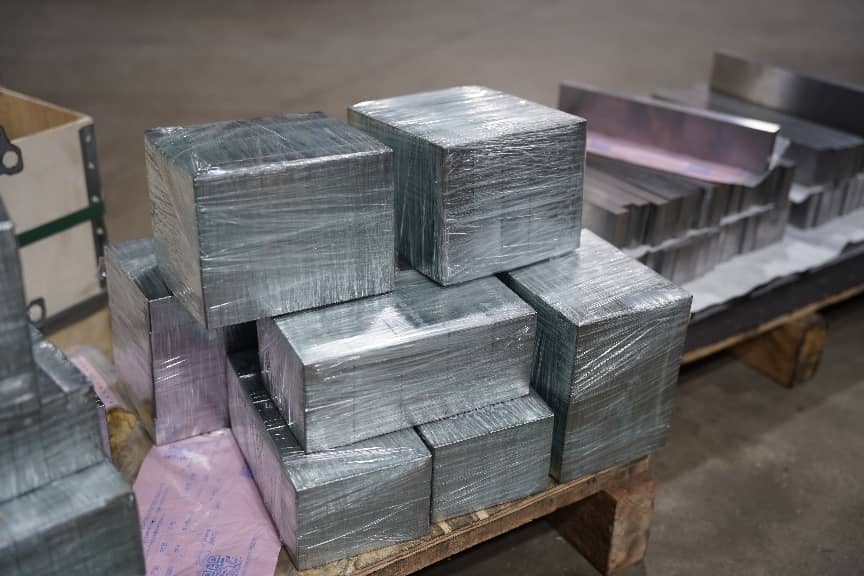
Powder Steel
Powder-metallurgy stainless tool steel is considered when ordinary stainless mold steel does not provide enough wear resistance.
The process can create a finer and more even distribution of hard particles in the steel. This can improve the balance of:
- Abrasive-wear resistance
- Corrosion resistance
- Compressive strength
- Dimensional stability
- Structure uniformity
It may be justified for:
- Long production runs
- Small gates
- High glass-fiber content
- Corrosive flame-retardant compounds
- Thin shutoffs
- Hot-runner components
- Repeated gate-insert failure
Powder steel is more expensive and usually harder to machine, grind, weld, and heat treat. It should not be used automatically for every corrosive plastic.
When wear is limited to the gate or shutoff, a small premium insert is usually more economical than a full powder-steel cavity.
Hardness
Higher hardness usually improves resistance to indentation, deformation, and abrasive wear. It can also reduce toughness and make welding or repair more difficult.
| Steel condition | Common example | Main limit |
|---|---|---|
| Prehardened P20-type steel | About 28–34 HRC for many grades | Limited corrosion resistance |
| Prehardened stainless mold steel | Low-30s to around 40 HRC | May be too soft for severe glass-fiber wear |
| Through-hardened 420-modified stainless steel | About 45–52 HRC for some grades | Sharp or thin parts may need more toughness |
| Precipitation-hardening stainless steel | Grade- and aging-dependent | Hardness and toughness change with aging condition |
| High-wear corrosion-resistant steel | Some grades operate above 52 HRC | Higher cost and harder machining |
These are general examples, not heat-treatment instructions.
Different mold parts may need different hardness:
- The gate may need high wear resistance.
- A thin core may need more toughness.
- The cavity may need a balance of polishing, corrosion resistance, and hardness.
- The mold base does not need the same hardness as the gate.
For a thick block, check hardness near the center. A surface reading does not prove that the full block has the same hardness.
Heat Treatment
Poor heat treatment can ruin good steel before the mold enters production.
Possible problems include:
- Low or uneven hardness
- Too much retained austenite
- Distortion
- Cracking
- Reduced corrosion resistance
- Poor polishing
- Decarburized surfaces
- Soft surface layers
For stainless mold steel, heat treatment affects hardness, toughness, carbides, corrosion behavior, and dimensional stability. Reaching the requested HRC number does not prove that the full heat treatment was correct.
Send the heat treater:
- Exact steel grade and supplier
- Material certificate and heat number
- Block dimensions
- Rough-machined dimensions
- Target hardness
- Surface-finish requirement
- Maximum allowed distortion
- Areas that cannot be straightened
- Planned welding or coating
If a PVD coating will be added, its processing temperature must be compatible with the steel’s original tempering or aging condition.
Machining
Stainless mold steel can work-harden when a worn cutting edge rubs instead of cutting. Heat and vibration can then shorten tool life and damage the surface.
Useful controls include:
- Use a rigid setup and sharp carbide tools.
- Avoid very light rubbing cuts.
- Rough-machine large blocks evenly on both sides.
- Control heat and remove chips during deep-hole drilling.
- Leave enough material for grinding, correction, and polishing.
Deep cooling holes need special attention. Rough walls, trapped chips, and badly aligned intersections can increase scale buildup and local corrosion.
A professional mold and die machining service can complete cutting, milling, drilling, rough pockets, and semi-finishing before final precision work.
EDM
Electrical discharge machining can leave a melted and resolidified surface layer. This layer may contain pores, high stress, cracks, or material transferred from the electrode.
Research reviews show that EDM can create a recast layer and heat-affected zone, while the amount of damage depends on discharge energy, pulse settings, dielectric fluid, and finishing cuts.[13]
After EDM:
- Use fine finishing settings where possible.
- Remove the affected layer when the steel supplier requires it.
- Inspect sharp corners and thin shutoffs.
- Check critical areas for cracks.
- Stress relieve the part when required.
- Measure the part again after final surface finishing.
Different steels respond differently to EDM. Follow the exact material datasheet rather than using one removal depth for every grade.
Polishing
Polishing quality depends on steel cleanliness, heat treatment, carbide distribution, and polishing method.
Common defects include:
- Orange peel
- Pinholes
- Streaks
- Wavy surfaces
- Rounded edges
- Embedded abrasive
- Contamination from carbon-steel polishing tools
Good practice includes:
- Use polishing tools reserved for stainless mold steel.
- Remove the old scratch pattern before using a finer abrasive.
- Change polishing direction between stages.
- Clean the surface between stages.
- Use less pressure during fine polishing.
- Protect sharp edges and shutoffs.
- Stop when the required finish is reached.
Mirror polishing does not mean polishing for as long as possible. Too much pressure or time can create orange peel or pull inclusions from the surface.
A mirror surface shows very small corrosion pits. A deep texture can trap residue and cleaner. Repeated repolishing can also change cavity size and edge shape.
Coatings
A coating can improve wear resistance, release, or surface hardness, but it cannot correct unsuitable base steel.
Before coating, confirm:
- Base-steel hardness
- Coating temperature
- Tempering or aging temperature
- Surface roughness
- Dimensional allowance
- Edge shape
- Future welding and repair needs
Common treatments include:
- PVD coating: Used to improve surface hardness, wear resistance, and release.
- Electroless nickel: Can cover complex shapes, but thickness, pores, and adhesion must be controlled.
- Hard chrome: Can improve surface performance, but damaged edges and later welding need care.
- Nitriding: Can increase surface hardness, but it is not suitable for every stainless mold steel.
A hard coating still needs strong steel underneath it. If the base steel bends or dents, the coating can crack.
Cooling holes, damaged edges, and repaired areas are usually not protected by a cavity coating. Severe corrosion therefore needs a suitable base steel first.
Vents
Vents are often the first areas to corrode because hot gas and deposits repeatedly pass through them.
Poor venting can cause:
- Burn marks
- Short shots
- High injection pressure
- Deposit buildup
- Local overheating
- Corrosion
- Diesel effect
A complete vent has three parts:
- Vent depth: Lets gas escape without allowing plastic to flash.
- Vent land: The short controlled section beside the cavity.
- Relief channel: Carries gas away from the mold cavity.
A shallow groove that does not lead outside the mold may not vent properly. Vent dimensions should follow the resin supplier’s advice and be confirmed during mold trials.
Vents should be easy to reach and clean. Replaceable vent inserts are useful when one area repeatedly corrodes.
Gates
Gates face high speed, pressure, shear, and repeated fiber contact. They often need more wear resistance than the main cavity.
A separate gate insert offers:
- Easier replacement
- Better size control
- Lower repair cost
- Less welding on the main cavity
- Freedom to use a different steel and hardness
The insert needs enough support. A very hard insert can still chip if it has sharp corners, poor backing, or the wrong fit.
Also check:
- Thermal expansion between the insert and cavity
- Water entering the joint
- Repeat positioning after replacement
- Hot-runner or cold-runner conditions
- Access for polishing and inspection
If only the gate is wearing, upgrading the entire cavity to powder steel is usually unnecessary.
Cooling
Cooling channels should be designed for flow testing, cleaning, drainage, and leak testing.
Useful features include:
- Separate circuits
- Marked inlets and outlets
- Drain points
- Accessible plugs
- Corrosion-resistant fittings
- Filters
- Flow records
- Leak-test access
Record these values when the mold is new:
- Flow rate in each circuit
- Inlet and outlet temperature
- Pressure difference
- Mold-surface temperature
- Cooling time
- Part dimensions and warpage
Inspect the circuit when flow falls, pressure difference rises, cycle time increases, one area becomes hotter, or a stable part begins to warp.
Do not judge cooling from pressure alone. A partly blocked channel may show pressure while carrying very little water.
Storage
Condensation begins when the mold surface reaches the dew-point temperature of the surrounding air.[14]
Before storage:
- Remove resin and deposits.
- Clean vents and gates.
- Dry the cavity and moving parts.
- Drain cooling channels.
- Blow out trapped water.
- Apply a compatible rust preventive when needed.
- Seal open water fittings.
- Record the mold condition and storage date.
Water can remain in low points, baffles, bubblers, spiral channels, plugs, and conformal-cooling passages after the main circuit has been drained.
A cold mold moved into warm, humid air should be allowed to warm before it is closed or covered.
More general upkeep information is available in this mold steel selection and maintenance guide.
Cost
Do not compare mold steel only by price per kilogram.
Total mold cost = steel + machining + heat treatment + coating + maintenance + downtime + rejected parts + cooling loss + replacement inserts
A cheaper steel can become more expensive if it causes:
- Frequent vent polishing
- Rusted cooling channels
- Repeated gate repair
- Visible part defects
- Emergency welding
- Unplanned mold disassembly
- Missed production dates
- Longer cycle time
Premium corrosion-resistant steel is easier to justify when the mold has many cavities, the part has a sensitive visible surface, production runs continuously, or downtime is expensive.
If corrosion is spread across the cavity, a full material upgrade may be justified. If damage is limited to the gate or vent, a local insert may cost less over the mold’s life.
Buying Checklist
Resin
- Exact commercial grade and supplier
- Glass-fiber percentage
- Mineral content
- Flame-retardant system
- Regrind percentage
- Pigment and color
- Drying conditions
- Processing-temperature limits
The same base polymer can create very different mold conditions when its additives change.
Mold
- Number of cavities
- Insert dimensions
- Largest block thickness
- Gate and runner type
- Hot-runner or cold-runner system
- Cooling-channel size
- Required surface finish
- Texture requirement
Block thickness affects hardness through the steel. Gate design affects local wear.
Production
- Expected total shots
- Annual quantity
- Cycle time
- Injection pressure
- Mold temperature
- Factory humidity
- Cooling-water system
- Planned maintenance interval
Production volume helps decide whether premium steel will reduce lifetime cost.
Manufacturing
- Required delivery hardness
- Heat-treatment ability
- EDM use
- Repair-welding requirement
- Coating requirement
- Dimensional tolerance
- Maximum acceptable distortion
Material Verification
- Exact supplier grade
- Heat number
- Chemical composition
- Delivery hardness
- Block dimensions
- Ultrasonic test result when required
- Heat-treatment result
- Trial polishing for critical optical molds
A mold steel mill test certificate should connect the delivered steel to its heat number, chemistry, hardness, and test results.
Available material families and supply forms can be reviewed through the ASIATOOLS mold steel range.
Final Choice
- Confirm the exact resin and additive package.
- Decide whether the main problem is corrosion, wear, or both.
- Mark the high-risk gates, vents, cores, shutoffs, and cooling channels.
- Select the steel and hardness for each important mold part.
- Check machining, heat treatment, maintenance, and lifetime cost before ordering.
For unfilled PVC and a moderate insert size, clean 420-modified or 1.2083-type stainless steel is often a practical starting point.
For a large polished cavity, choose a clean remelted stainless grade that can reach suitable hardness through the full block.
For glass-filled flame-retardant plastic, select for corrosion and abrasion together. Premium steel may be needed only at the gate, shutoff, or another high-flow area.
For a complex insert with a high distortion risk, precipitation-hardening stainless steel may be useful. For severe wear and a long production run, powder-metallurgy stainless steel may provide better lifetime value in critical inserts.
Names such as P20, 420, 1.2083, 1.2316, S136, “modified,” and “equivalent” do not guarantee the same chemistry, cleanliness, hardness, or performance. Always check the exact supplier datasheet and material certificate.
Choosing stainless mold steel does not by itself make a mold or molded part suitable for food contact. FDA guidance states that the complete food-contact material depends on the regulatory status and intended use of all of its components.[15]
For medical products, steel choice is also only one part of the process. Resin, coatings, lubricants, cleaning, traceability, and production controls must be checked separately.
The right mold steel protects more than the cavity from rust. It also protects gate size, cooling flow, part quality, cycle time, and production stability.