

Use pre-hardened steel when roughly 28–38 HRC is enough for the mold and you want to machine the block without full hardening afterward. Use soft-annealed hardenable steel when the finished mold needs roughly 45–60 HRC, stronger wear resistance, or a heat-treated property that the selected pre-hardened grade cannot provide.
| Requirement | Pre-Hardened | Annealed + Hardened |
|---|---|---|
| Typical hardness during machining | About 28–38 HRC for common P20-type grades | Usually below about 230–250 HB before hardening |
| Final working hardness | Usually close to supplied hardness | Often about 45–60 HRC, depending on grade |
| Machining | Higher cutting load and tool wear | Easier while soft |
| Full hardening after machining | Usually avoided | Required |
| Heat-treatment movement | No final quenching if used as supplied | Allowance and final correction are normally needed |
| Best fit | Large molds, moderate wear, short lead time | High wear, hard inserts, demanding service |
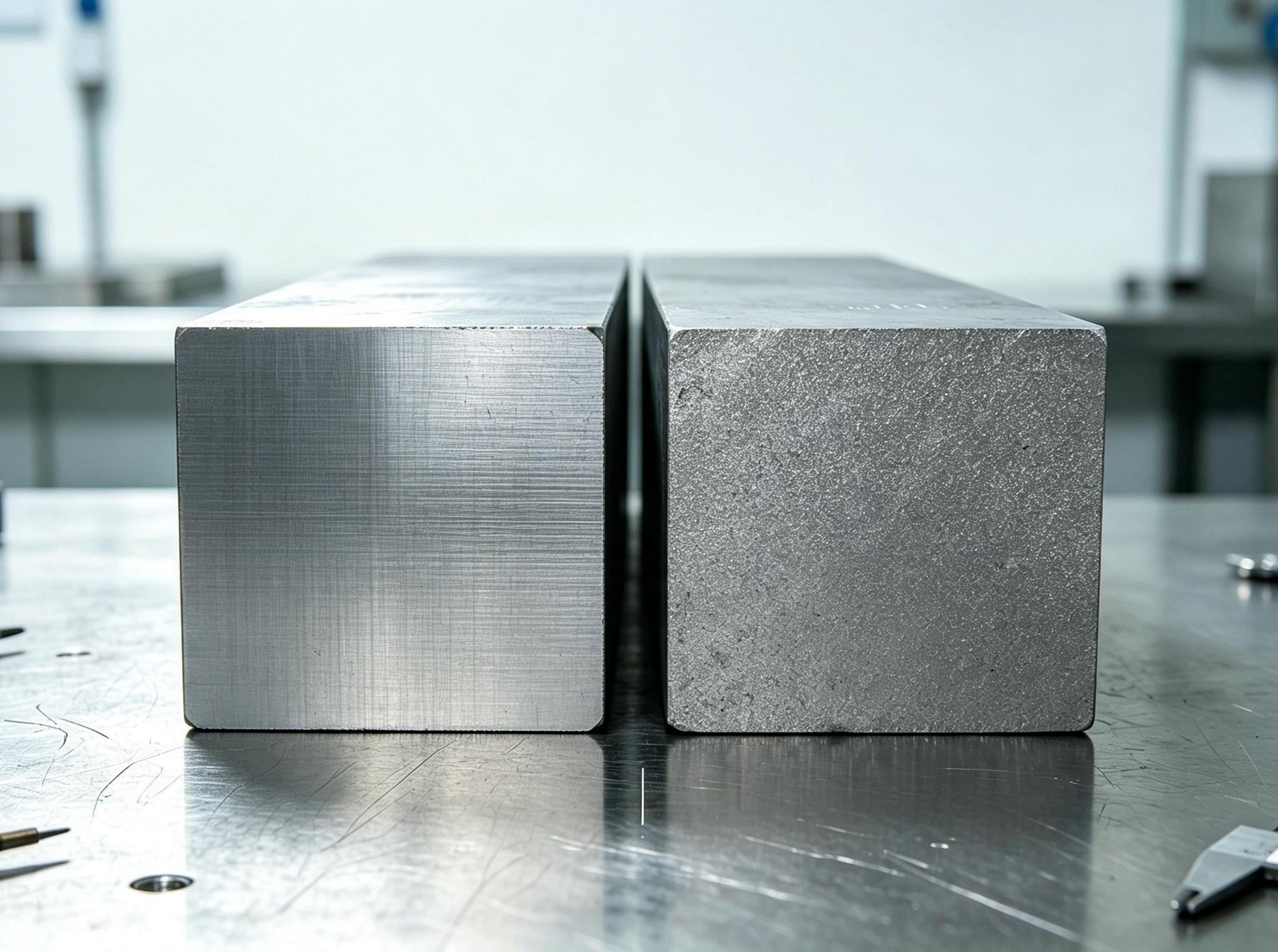
Hardness Ranges
The biggest practical difference is the hardness available during mold production and service.
| Grade | Common Supply Condition | Typical Hardness | Main Use |
|---|---|---|---|
| P20 / 1.2311 | Pre-hardened | About 28–36 HRC | General plastic molds |
| 1.2312 / P20+S | Pre-hardened | About 28–36 HRC | Large amounts of machining |
| 1.2738 / P20+Ni | Pre-hardened | About 33–38 HRC | Larger mold blocks |
| H13 / 1.2344 | Usually soft annealed before hardening | About 45–52 HRC in many working conditions | Hard inserts and demanding tooling |
| 1.2085 | Pre-hardened | About 30–36 HRC | Corrosion-resistant molds needing good machinability |
Do not read these ranges as fixed limits. Hardness depends on the exact grade, producer, section size, and heat-treatment condition.
HB and HRC are different hardness scales. About 280–330 HB is generally in the low-30-HRC region for many tool steels, but hardness conversion is only approximate. ASTM E10 covers Brinell testing, ASTM E18 covers Rockwell testing, and ASTM E140 covers approximate conversions between hardness scales.[1][2][3]
Machining Load
Soft-annealed steel normally cuts more easily. The difference becomes important when the mold needs heavy roughing, deep cavities, long cooling holes, or many small threads.
| Operation | What Gets Harder in Pre-Hardened Steel | Cost Effect |
|---|---|---|
| Heavy milling | Higher cutting load | More machine time and cutter wear |
| Deep milling | More tool deflection and chatter | More risk of dimensional and finish errors |
| Deep drilling | More heat and drill wear | Higher risk of hole deviation or drill failure |
| Tapping | Higher torque | Greater broken-tap risk |
The percentage of material removed matters. If a mold block needs only 5–10% stock removal, the difference may be small. If a deep cavity removes 30–40% of the starting block, soft machining can save meaningful machine time.
Hardness is not the only machining factor. Steel chemistry, carbides, sulfur, inclusions, and microstructure also affect cutting behavior.
1.2312 shows this clearly. It normally contains roughly 0.05–0.10% sulfur to improve machining. Sulfur is widely used in free-machining steels because it changes inclusion behavior and chip formation.[4]
The trade-off is that a sulfur-modified steel is usually not the first choice for the highest mirror-polish level. A large structural housing mold and an optical mold may therefore use different steels even when their working hardness is similar.
Heat Treatment Work
A pre-hardened mold can often go from machining directly to EDM, polishing, fitting, and assembly.
Pre-hardened route:
Cut → rough machine → finish machine → EDM/polish → assemble
A soft-annealed hardenable steel normally adds several operations.
Annealed + hardened route:
Cut → rough machine → stress relieve → semi-finish → harden → temper → inspect → finish → polish → assemble
The extra operations matter because quenching can change dimensions. Heat-treatment studies show that temperature differences, phase changes, and residual stresses can all contribute to distortion.[5]
Stress-relief temperatures for many tool steels are often in the 500–600°C range, but the correct temperature is grade-specific. A heat-treatment schedule for H13 should not be copied to P20, 1.2083, or another mold steel.
For a grade-specific example, some pre-hardened P20-type technical data use stress relief around 550°C with a hold of about two hours after the part has reached temperature. This is a scale reference, not a universal recipe.
Movement Allowance
A finished mold can move in two ways during heat treatment:
- dimensional change: a length, bore, or cavity becomes slightly larger or smaller;
- distortion: different parts move by different amounts, causing bending, twisting, or loss of flatness.
A movement of only 0.02–0.05 mm can matter on a precision shut-off, slide, insert fit, or bore.
Machining allowance must therefore be left before final hardening. Tool-steel guidance often puts allowance in tenths of a percent of the finished dimension rather than several percent.
For scale:
- 0.15% of 200 mm = 0.30 mm;
- 0.20% of 200 mm = 0.40 mm;
- 0.30% of 200 mm = 0.60 mm.
These numbers show the order of magnitude only. The correct allowance depends on grade, geometry, heat treatment, tolerance, and final finishing.
Pre-hardened steel avoids final quenching when used as supplied, but it can still move during heavy machining. Removing a large amount of steel from one side of a block can release residual stress and change flatness.
Hardenability
Hardness tells you how hard the steel is at one point. Hardenability tells you how well that hardness can develop deeper into the section.
ASTM A255 uses the Jominy end-quench method to measure steel hardenability.[6]
This difference matters much more in a 400–500 mm block than in a 40–50 mm insert.
A surface hardness result should therefore not be used as proof that the center of a large block has identical properties.
1.2738 typically contains about 0.9–1.2% nickel. The nickel-modified chemistry is one reason the grade is widely used for larger plastic mold sections where through-section properties are important.
For large blocks, purchase requirements should include:
- ordered section size;
- expected surface-to-center hardness;
- ultrasonic inspection if required;
- heat-number traceability;
- material certificate.
Wear by Plastic Type
Shot count is not enough to predict mold life.
Wear depends on resin, filler percentage, gate size, flow speed, local geometry, and steel properties.
| Molding Condition | Main Risk | Steel Property to Prioritize |
|---|---|---|
| Unfilled PP, PE, ABS | Usually moderate wear | General mold strength and machinability |
| 15–30% glass fiber | Higher abrasive wear | Wear resistance at gates and flow areas |
| 30–50% glass fiber | Severe local abrasion can develop | Hard inserts or higher-wear steel where needed |
| Mineral-filled compounds | Abrasive wear | Wear-resistant cavity and gate areas |
| Corrosive or flame-retardant compounds | Corrosion plus possible wear | Corrosion-resistant steel |
Glass-filled material is especially hard on gates, runner turns, core tips, ribs, and narrow flow areas. Injection-mold tooling research also separates general pre-hardened steels from harder tool steels used where stronger wear resistance is required.[7]
A mold making 300,000 parts from a highly abrasive compound can therefore have more local wear than a mold making one million parts from an unfilled resin.
Hardness vs Toughness
A harder steel is not always a longer-lasting steel.
| Failure | What the Steel Needs |
|---|---|
| Abrasive wear | Higher wear resistance |
| Gate erosion | Local hardness and wear resistance |
| Indentation | Hardness and compressive strength |
| Thin-core chipping | Toughness |
| Corrosion | Corrosion-resistant chemistry |
A 50–55 HRC insert may resist abrasion much better than a 30–36 HRC P20 block. But a thin core can still fail early if the selected high-hardness grade does not have enough toughness for the geometry.
Two steels at 55 HRC can also have different wear life because hardness does not describe carbide type, carbide volume, alloy content, or microstructure.
Surface Finish
High-polish molds need clean and uniform steel, not simply high hardness.
Important factors are:
- non-metallic inclusions;
- segregation;
- sulfur level;
- microstructure;
- EDM condition;
- previous weld repair.
ASTM E45 provides standard methods for rating non-metallic inclusions in steel.[8]
ESR, or electroslag remelting, is used when improved cleanliness and internal uniformity are important. The effect of the process on mold steel is covered in more detail in the article on ESR tool-steel cleanliness.
For an ordinary textured housing, premium remelted steel may add little value. For transparent, optical, medical, or mirror-polished parts, steel cleanliness can directly affect the finished cavity surface.
Corrosion Risk
P20-type steel is not stainless. Standard P20 grades contain only around 2% chromium, while stainless mold grades are much higher.
1.2083, for example, typically contains roughly 12–14% chromium and is used where corrosion resistance and polishability are important.
1.2085 is commonly supplied pre-hardened around 30–36 HRC, showing that corrosion resistance does not automatically require an annealed-and-hardened route.
Corrosion risk increases with:
- corrosive plastics;
- some flame-retardant compounds;
- condensation;
- poor cooling water;
- high humidity;
- long storage.
Cooling channels matter too. Common mold cooling passages may be around 8–16 mm in diameter. Rust and scale inside these passages reduce water flow and heat transfer even when the cavity surface still looks acceptable.
Nitriding Depth
Nitriding hardens the surface without making the complete mold section equally hard.
Typical nitrided case depths in mold applications are measured in tenths of a millimeter. A useful working scale is roughly:
- about 0.10–0.15 mm for a relatively shallow case;
- about 0.20–0.30 mm for a deeper case;
- around 0.30–0.40 mm in some longer or deeper treatments.
Surface hardness on suitable nitrided tool steels can reach around 900–1100 HV or more, depending on the grade and process. Nitriding is widely used to improve near-surface wear resistance.[9]
A 0.2 mm hard case on a 100 mm insert is therefore very different from hardening the whole insert to around 50 HRC.
Cost Break-Even
Compare the complete mold cost, not price per kilogram.
Initial Tool Cost = Steel + Machining + Cutting Tools + Heat Treatment + Transport + Finishing + Inspection + Correction
Lifecycle Cost = Initial Tool Cost + Repair + Replacement Inserts + Downtime + Scrap + Engineering Changes
Cost per acceptable part = Lifecycle Cost ÷ Acceptable Parts Produced
| Cost Item | Pre-Hardened | Annealed + Hardened |
|---|---|---|
| Rough machining | Usually higher | Usually lower |
| Cutting tools | Usually higher | Usually lower before hardening |
| Full hardening | Usually avoided | Added cost |
| Post-hardening correction | Usually avoided | Often required |
| Later machining changes | Easier around 30–36 HRC | Harder around 50+ HRC |
| Potential wear life | Enough for many normal molds | Higher when the correct wear-resistant grade is used |
If a hardened route makes a mold 15% more expensive before production, that extra 15% only makes sense if it saves more than that through fewer repairs, less scrap, longer insert life, or less machine downtime.
If a 30–36 HRC pre-hardened cavity completes the required production without serious wear, full hardening adds cost without useful return.
Mixed-Steel Mold
One mold can use several steels.
| Area | Typical Requirement | Practical Direction |
|---|---|---|
| Main cavity block | Moderate wear | 28–38 HRC pre-hardened steel |
| Gate insert | High abrasion | 45–60 HRC hardened insert |
| Thin core | Chipping resistance | Tough hardenable steel |
| Corrosive cavity area | Rust and chemical attack | Stainless mold steel |
| Shut-off | Repeated edge wear | Replaceable wear insert |
If only a 5 kg gate insert suffers severe wear, hardening a 2,000 kg cavity block to the same level may add unnecessary cost. A harder replaceable insert puts the expensive material and heat treatment only where it is needed.
Purchase Checks
Do not order an expensive mold block using only “P20” or “P20 equivalent.”
| Check | What to Specify |
|---|---|
| Grade | Exact standard or accepted equivalent |
| Size | Length × width × thickness |
| Condition | Pre-hardened or soft annealed |
| Hardness | Required range and test scale |
| Large block quality | Center hardness and ultrasonic inspection when needed |
| Surface | Machined, milled, ground, or other condition |
| Traceability | Heat number and material certificate |
| Mold use | Resin, filler percentage, polishing and texturing requirements |
ASTM A681 covers alloy tool steels and notes that selection depends on tool design, service conditions, and required finished properties.[10]
The tool and mold steel range includes different plastic mold, stainless mold, hot-work, and hardenable steels because no single grade solves every mold condition.
P20, 1.2311, 1.2312, and 1.2738 should not be treated as automatically interchangeable. The differences between AISI, DIN/EN, JIS, and GB naming are covered in the mold steel grade-equivalence guide.
For large or high-value blocks, the site's guide to preparing a mold steel purchase order lists the dimensions, hardness, inspection, traceability, and delivery information that should be defined before purchasing.
Selection Table
| Mold Condition | Starting Choice |
|---|---|
| General plastic mold, moderate wear | 28–38 HRC pre-hardened steel |
| Large cavity block | Pre-hardened steel if supplied hardness is enough |
| Short lead time | Pre-hardened steel |
| Frequent engineering changes | Pre-hardened steel |
| High glass-fiber content | Wear-resistant steel or hardened local inserts |
| Severe gate wear | 45–60 HRC replaceable insert, depending on grade |
| Thin core with chipping risk | Tough hardenable steel |
| Corrosive resin | Stainless mold steel |
| Mirror or optical finish | Clean low-inclusion steel |
| Only a few severe wear areas | Pre-hardened main block plus harder inserts |
Finally
Use the hardness requirement to separate the two routes quickly: if about 28–38 HRC is enough, pre-hardened P20-type steel usually avoids full hardening and post-quench correction. If the mold needs about 45–60 HRC, stronger abrasive-wear resistance, or a hard replaceable insert, machine a suitable steel in the annealed condition and harden it afterward. For large blocks, check center hardness and ultrasonic quality. For glass-filled plastics, focus on gates and other high-flow areas. A pre-hardened main block with hardened local inserts is often cheaper than hardening the entire mold.