

Saw-cut mold steel is usually cheaper on the purchase order. Pre-machined steel costs more upfront, but that extra cost can disappear quickly if it saves steel weight, setup time, CNC hours, and machine waiting time. For a small block and an available milling machine, saw-cut may be the obvious choice. For a large block, expensive steel, or a shop that is already busy, pre-machining can easily be the cheaper route overall.
The comparison comes down to four numbers: how much steel you buy, how much has to be removed, how long your shop spends preparing it, and what the block costs when it is finally ready for real mold machining.
What You Are Actually Buying
A saw-cut block is cut from larger plate, bar, or forged stock. The cut face is there to separate the material, not to give you a finished machining reference. It may still have saw marks, a slight angle, size variation, or enough unevenness that the first job in your shop is simply making it square.
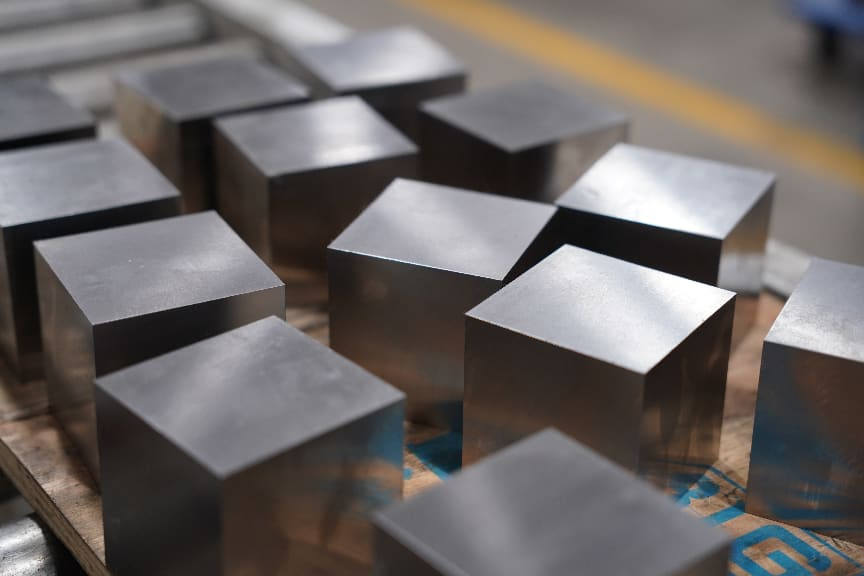
A pre-machined block has already had some of that work done. That might mean milling, grinding, squaring, chamfering, or a combination of them. It still may not be at final size. In many cases, a small positive allowance is intentionally left so the mold shop can do the last finishing pass.
One thing that causes confusion is that a block does not have to be entirely “saw-cut” or entirely “pre-machined.” A perfectly normal supply condition might be:
- Thickness ground
- Width milled
- Length saw-cut
Another block may be milled on all six faces. So when two suppliers quote the same grade, check the actual mold steel supply form and machining condition. The words “pre-machined” alone do not tell you enough.
ASTM A681 covers wrought alloy tool steels and includes requirements related to hardness, macrostructure, and decarburization, among other properties.[1] In practice, that means the condition of the parent stock matters when deciding how much material must come off before the block is truly usable.
Machining Allowance Is Not a Fixed Number
People often ask, “How much allowance should I leave?” and expect one number. There really is no universal answer.
The extra stock may need to cover several things:
- Sawing variation
- A cut that is slightly out of square
- Surface cleanup
- Flatness correction
- Final milling or grinding
- Heat-treatment movement, where applicable
Those numbers should not be blindly added together. One cut can solve more than one problem. If you face-mill a high spot flat, you may remove scale at the same time.
The useful question is simpler:
After every required surface has cleaned up, is there still enough steel left to reach final size?
Allowance also needs to be stated properly. “Add 5 mm” can mean very different things.
- 300 mm finished size + 5 mm overall = 305 mm supplied size
- 300 mm finished size + 5 mm on each face = 310 mm supplied size
On a large block, that difference can mean a lot of steel.
A Simple Weight Example
Take a finished rectangular block measuring:
300 × 250 × 80 mm
Using 7.85 g/cm³ as a practical density for weight calculations, the block weighs about:
47.1 kg
Now compare two possible starting sizes.
| Item | Saw-Cut Example | Pre-Machined Example |
|---|---|---|
| Supplied size | 310 × 260 × 88 mm | 302 × 252 × 81 mm |
| Approx. weight | 55.7 kg | 48.4 kg |
| Finished rectangular weight | 47.1 kg | 47.1 kg |
| Stock to remove | 8.6 kg | 1.3 kg |
| Material utilization | 84.6% | 97.3% |
So in this example, the saw-cut block leaves about 8.6 kg to remove. The pre-machined block leaves about 1.3 kg. That is more than six times as much stock removal on the saw-cut route.
These are example dimensions, not recommended allowances. The point is the method: calculate what you are actually buying and what your shop must later turn into chips.
Nominal Size Can Be Misleading
A rough block may look comfortably oversized and still leave very little usable stock after squaring.
Say the finished length is 300 mm and the blank measures 307 mm. At first glance, that looks like 7 mm of allowance. But if the saw-cut end is angled, part of that 7 mm disappears when the face is machined square.
A small angular error matters more on a thick block. For illustration, if the cut is 0.5° out of square:
| Block Thickness | Difference Across the Face |
|---|---|
| 100 mm | Approx. 0.87 mm |
| 300 mm | Approx. 2.62 mm |
| 500 mm | Approx. 4.36 mm |
The 0.5° figure is only a geometry example, not a typical saw tolerance. It shows why a thick block can use up several millimeters of apparent allowance just by correcting one end.
For critical blocks, it is worth asking the supplier for the cutting tolerance, minimum guaranteed size, and squareness where it matters. The largest dimension you can measure on the rough block is less important than the smallest clean rectangular block you can actually machine from it.
Surface Finish and Accuracy Are Different Things
A ground face looks better than a saw-cut face, but “ground” does not automatically mean the whole block is accurate.
These are separate requirements:
- Surface finish: how rough or smooth the face is
- Size tolerance: how far the actual size may vary
- Flatness: how flat one face is
- Parallelism: how two opposite faces relate to each other
- Squareness: how close adjacent faces are to 90°
ISO 1101 covers geometric tolerances such as form and orientation, which are separate from basic size dimensions.[2]
For example, a block may measure 100.2 mm at one side and 100.7 mm at another. Both numbers look “close to 100,” but the 0.5 mm difference can still matter if those faces need to be parallel.
The same applies to grinding. If the next operation truly needs controlled thickness, flatness, or surface finish, then surface grinding in mold steel processing can add value. If the next CNC operation immediately removes several millimeters from that face, close grinding may simply be money spent on a surface that disappears.
Flatness Can Eat Up Your Allowance
Suppose the finished thickness is 100 mm and the supplied rough block is 104 mm thick. On paper, you have 4 mm to work with.
Now imagine the first face is bowed enough that 1.5 mm has to come off the high area before you have a flat datum. You still need to machine the opposite face parallel to that new datum.
So:
104 mm supplied thickness − 100 mm finished thickness = 4 mm nominal stock
but that does not mean you have 4 mm of useful finishing allowance everywhere.
This is one reason large plates deserve more attention than small inserts. Flatness error spreads over a larger area, and the first cleanup pass can consume more stock than expected.
How Much Pre-Machining Do You Really Need?
Six-side machining is useful, but it is not automatically the best choice.
Two machined faces may be enough if you mainly need a controlled thickness and a stable reference. Four sides may be enough when the side faces matter but the ends will later be cut away. Six sides make sense when the next operation needs a complete rectangular block with controlled length, width, and thickness.
A face can be useful even if it does not remain on the final mold. It may simply give the machinist a reliable place to clamp, locate, measure, or set a CNC coordinate. ISO 5459 covers datums and datum systems used as geometric references.[3]
For repeated rectangular block preparation, duplex milling for mold bases and steel blocks can reduce the number of separate side-milling setups.
Sometimes the best answer is a mixed supply condition: ground thickness, milled width, saw-cut length. You pay for accuracy only where it saves real work.
If the supplier is also making features instead of only preparing the blank, the same thinking applies to precision machining. Outsource the operations that remove a real bottleneck; there is no advantage in outsourcing work your own shop can do more cheaply and quickly.
Lead Time: Shipping Date Is Not the Whole Story
A saw-cut block can ship faster and still reach mold machining later.
Here is a simple example:
| Step | Saw-Cut | Pre-Machined |
|---|---|---|
| Supplier processing | 1 day | 3 days |
| Transport | 2 days | 2 days |
| Internal queue and preparation | 4 days | 0.5 day |
| Ready for mold machining | 7 days | 5.5 days |
Here, pre-machining adds two days at the supplier but still puts a usable block on the machine 1.5 days earlier.
Of course, the reverse also happens. If raw stock is sitting on the rack and the supplier has a five-day machining queue, saw-cut may be faster.
Break the lead time into real steps: stock availability, sawing, supplier machining, inspection, transport, your own machine queue, and internal preparation. A three-hour machining job can easily become a three-day delay if the right machine is already booked.
Machine Time Costs More Than Cutting Time
Shops often underestimate block preparation because they count only spindle time.
A more realistic example might look like this:
| Work | Example Time |
|---|---|
| Setup and alignment | 0.75 h |
| Facing and squaring | 2.50 h |
| Measurement | 0.50 h |
| Handling and cleanup | 0.75 h |
| Total | 4.50 h |
At different shop rates, that same 4.5-hour preparation job looks like this:
| Example Shop Rate | 4.5 Hours |
|---|---|
| $60/hour | $270 |
| $80/hour | $360 |
| $100/hour | $450 |
These are calculation examples, not market rates.
One detail matters a lot: know what your hourly rate already includes. If $80/hour is a fully loaded shop rate with labor, machine depreciation, utilities, and overhead built in, do not add those costs a second time.
Capacity also matters. Three hours on an idle machine may really cost about three machine hours. Three hours on a fully booked machine can push cavity roughing, mold assembly, or another customer job later. That extra cost is real only when the delay actually happens, so it should not be added as an arbitrary “capacity fee.”
Material Cost, Scrap, and Block Size
The earlier 300 × 250 × 80 mm example gives 84.6% material utilization for the saw-cut blank and 97.3% for the pre-machined blank.
That difference matters more as steel price and block size increase.
Scrap recovery helps, but it does not make excess steel free. If steel costs $8.00/kg and scrap returns $0.80/kg:
Net waste cost = $8.00 − $0.80 = $7.20/kg
If 8 kg is removed:
8 × $7.20 = $57.60 net material loss
The $0.80/kg scrap value is only an example. Actual values vary by alloy, market, location, quantity, and whether chips are kept clean and separated.
Block size makes the effect more obvious. Using 7.85 g/cm³, each extra 1 mm of total thickness adds approximately:
| Plate Face Size | Extra Weight per +1 mm Thickness |
|---|---|
| 300 × 250 mm | 0.59 kg |
| 500 × 400 mm | 1.57 kg |
| 800 × 600 mm | 3.77 kg |
| 1,000 × 800 mm | 6.28 kg |
| 1,200 × 1,000 mm | 9.42 kg |
For a 1,000 × 800 mm plate, adding 2 mm to both large faces means 4 mm of extra total thickness:
6.28 × 4 = 25.12 kg
At the example net steel-loss cost of $7.20/kg:
25.12 × $7.20 = $180.86
That is only the extra thickness. It does not include extra width, length, or the cost of machining those 25 kg away.
Quantity Changes the Math
A small saving per block becomes meaningful very quickly on repeat work.
If pre-machining saves 1.5 internal hours per block:
| Quantity | Hours Saved | Value at $80/hour |
|---|---|---|
| 1 block | 1.5 h | $120 |
| 10 blocks | 15 h | $1,200 |
| 20 blocks | 30 h | $2,400 |
| 50 blocks | 75 h | $6,000 |
This does not mean every 50-block order saves $6,000. It means a small preparation difference can become a serious capacity issue once quantity increases.
For repeat parts, your own history is more useful than a generic allowance chart. Record supplied dimensions, purchased weight, setup time, cutting time, tool use, and any rework. After a few batches, you will know far more about the real allowance you need for that grade, supplier, and size.
Hardness, Tool Wear, and Residual Stress
Removing 10 kg of steel is not always the same machining job.
Tool life and cutting force can change with hardness, microstructure, cutting speed, tooling, and machine rigidity. Oak Ridge National Laboratory lists peer-reviewed work on modified prehardened AISI P20 showing that differences in martensitic packet size affected cutting forces and tool life even at similar hardness levels.[4]
That is why machining cost is better taken from your own shop records than estimated only from kilograms removed.
Material can also move as stock is removed. Bow, twist, or loss of flatness may appear when the stress balance inside the block changes. NIST machining research has measured distortion related to residual stresses and later material removal.[5]
Pre-machined material should not be described as “stress-free.” It simply means some stock removal has already happened before the block reaches your shop.
If a large amount of material has to come off, removing most of it from one side and removing it more evenly from opposite sides may not give the same result. The right sequence depends on the steel, heat-treatment condition, and block geometry.
Heat Treatment Changes the Allowance
Prehardened and later-hardened steels should not use the same allowance strategy.
P20-family mold steels are commonly supplied quenched and tempered so they can be machined in the delivered condition without a full final hardening treatment. Published research on 718H/P20-family mold steels describes this prehardened route.[6]
For a prehardened 1.2311 / P20-type mold steel, most rectangular preparation is therefore done at the supplied hardness.
Another tool steel may follow:
rough machining → heat treatment → finish machining or grinding
That part may still need extra material for dimensional movement after heat treatment, final grinding, and final tolerance correction.
The grade name alone is not enough. Delivery condition matters too. For larger plastic molds, 1.2738 prehardened mold steel may be considered where section size and hardenability needs differ from a basic P20-type grade.
Machined Surface Does Not Prove Internal Quality
A clean milled or ground face tells you something about the surface. It does not prove that the inside of the block is free from discontinuities.
Pre-machining can remove or expose scale, surface flaws, decarburized material, and handling damage. Internal quality is a separate issue.
For critical forgings, ultrasonic testing may be specified. ASTM A388/A388M-26 states that when ultrasonic examination is required for steel forgings, the required ultrasonic quality level should be clearly stated in the order.[7]
So “UT required” is not a complete purchasing requirement. The applicable standard and acceptance level should be stated.
Total Cost and Break-Even Point
A useful cost model is:
Total usable-block cost = material + supplier processing + freight + internal preparation + tooling + handling + inspection − scrap recovery
Use the same boundary for both options. If labor is already included in the shop rate, do not add it again.
Here is a simple example:
| Cost | Saw-Cut | Pre-Machined |
|---|---|---|
| Steel | $600 | $680 |
| Supplier machining | $0 | $70 |
| Freight | $60 | $55 |
| Internal preparation | $290 | $55 |
| Tooling | $35 | $8 |
| Handling | $30 | $10 |
| Inspection | $30 | $15 |
| Scrap recovery | -$15 | -$3 |
| Total | $1,030 | $890 |
These are example costs, not market quotations.
The more useful calculation is the break-even premium. Suppose pre-machining removes:
- $70 of excess material
- $140 of internal machining
- $25 of tooling
- $30 of handling
Total cost avoided:
$265
If the supplier charges $180 extra for pre-machining:
$265 − $180 = $85 advantage
If the supplier wants more than $265, the direct cost advantage disappears under those assumptions. You might still pay more if the shorter lead time or freed machine capacity is worth it, but now you know exactly what you are paying for.
Worked Batch Example
Now take 20 blocks with a finished rectangular size of:
400 × 300 × 100 mm
Finished weight is about:
94.2 kg per block
| Item | Saw-Cut | Pre-Machined |
|---|---|---|
| Purchased weight per block | 105 kg | 97 kg |
| Total purchased weight | 2,100 kg | 1,940 kg |
| Internal preparation per block | 2.0 h | 0.3 h |
| Total preparation time | 40 h | 6 h |
The weight difference is:
2,100 − 1,940 = 160 kg
At $8.00/kg steel and $0.80/kg scrap recovery:
160 × ($8.00 − $0.80) = $1,152
The preparation-time difference is:
40 − 6 = 34 hours
At a fully loaded shop rate of $80/hour:
34 × $80 = $2,720
Total cost avoided before tooling, handling, freight, or schedule effects:
$1,152 + $2,720 = $3,872
If supplier pre-machining costs an additional $120 per block:
$120 × 20 = $2,400
Calculated advantage:
$3,872 − $2,400 = $1,472
Under these assumptions, pre-machining saves $1,472. If your own preparation is much faster, the steel is cheaper, or the supplier premium is higher, the answer can flip. That is exactly why the calculation is more useful than a general rule.
What to Put on the RFQ
A clear mold steel purchase order should remove the points most likely to cause a size or cost problem later.
- Finished rectangular size
- Required supplied size
- Allowance per face or per overall dimension
- Which faces are saw-cut, milled, or ground
- Flatness, parallelism, or squareness where needed
- Grade and governing standard
- Delivery condition and hardness
- Material certificate
- UT standard and acceptance level, if required
- Stock availability and processing lead time
Avoid vague notes such as “leave enough allowance” or “high precision.” Those phrases sound clear until two people interpret them differently.
A practical example might be:
Material: 1.2311 / P20-type prehardened mold steel
Finished size: 300 × 250 × 80 mm
Quantity: 8 pcs
Option A: Saw-cut; state supplied dimensions, cutting tolerance, and recommended cleanup stock
Option B: Six-side milled; example allowance +0.5 to +0.75 mm per machined face, equal to +1.0 to +1.5 mm across an overall dimension with two machined faces
Hardness: 30–34 HRC as an example project requirement; supplier to confirm available range
Documents: Material certificate required
The allowance in that RFQ is only an example. The final number still has to match the real finishing, grinding, and heat-treatment route.
Check the Block Before Machining
Receiving inspection does not need to be complicated. It does need to catch the expensive problems early.
For saw-cut stock, check that the grade is correct, enough stock exists in every required direction, and there is no major bow, twist, or shipping damage.
For pre-machined stock, also verify the dimensions and geometric requirements that matter to the next operation. If certificates or UT reports were part of the order, confirm them before releasing the block.
An undersize block found at receiving is annoying. The same block found undersize after eight hours of CNC work is much more expensive.
Conclusion
Saw-cut and pre-machined mold steel are really two different ways of paying for the same preparation work. In the 300 × 250 × 80 mm example, the saw-cut blank leaves about 8.6 kg to remove, compared with 1.3 kg for the pre-machined blank. On a 1,000 × 800 mm plate, every extra 1 mm of thickness adds about 6.28 kg. In the 20-block example, reducing preparation from 2.0 to 0.3 hours per block saves 34 machine hours. Compare those numbers with the supplier's machining premium. If the saved steel and shop time are worth more than the premium, pre-machining makes sense. If not, buy saw-cut and do the preparation yourself.