

When choosing your first milling machine, many buyers face a deceptively simple question that carries years of financial consequences: spend $20,000 on a used manual mill, or $120,000 on a CNC Vertical Machining Center? According to ASME B5.54-2005, VMC prices range from $80,000 to $250,000, while a used Bridgeport fetches just $15,000-$40,000 — a fivefold gap. The wrong choice bleeds thousands of dollars every month; the right one can double your shop's output.
Basic Difference
Manual Control
A used Bridgeport runs $15,000-$40,000 and handles low-volume, high-mix work beautifully. A manual milling machine drives X/Y/Z axes through handwheels — every cut angle and feed rate is decided in real time by the operator. I visited a small medical parts shop in Vermont that had been running a single 1978 Bridgeport for ten years, machining stainless components in-house at 60% lower cost thanoutsourcing.
Manual machinist training takes 3-5 years, and the core skill is developing a physical feel for the cut — chip color turning yellow means feed is too slow, blue smoke means RPM is too high, and these judgments take thousands of hands-on hours to internalize. In the 1980s, virtually every U.S. machine shop was manual; today manual mills still represent over 30% of the global milling machine installed base because many workpieces only require 2-3 setups to complete, requiring no programming to deliver.
The core advantage of manual machines is the operator's ability to make instantaneous corrections — a sudden dimensional deviation gets compensated on the spot, without stopping to edit a program. By contrast, a VMC operator can be trained in 3-6 months: no handwheel experience required, just the ability to read blueprints and operate a controller panel.
The economics split clearly: a $30,000 used Bridgeport plus operator at $25/hour suits jobs under 20 pieces; a $120,000 VMC plus operator at $32/hour suits repeat orders of 20+ pieces. Fifty parts per month is the real watershed between the two approaches.
· Used Bridgeport: $15,000-$40,000 — low upfront, minimal floor space required
· Operator skill level: read mechanical drawings + 3 days hands-on practice, no programming needed
· Accuracy range: plus/minus 0.02-0.05 mm (skilled operator), dependent on workpiece clamping
· Typical scene: prototype fabrication, single pieces, startup shops with limited budget
CNC Control
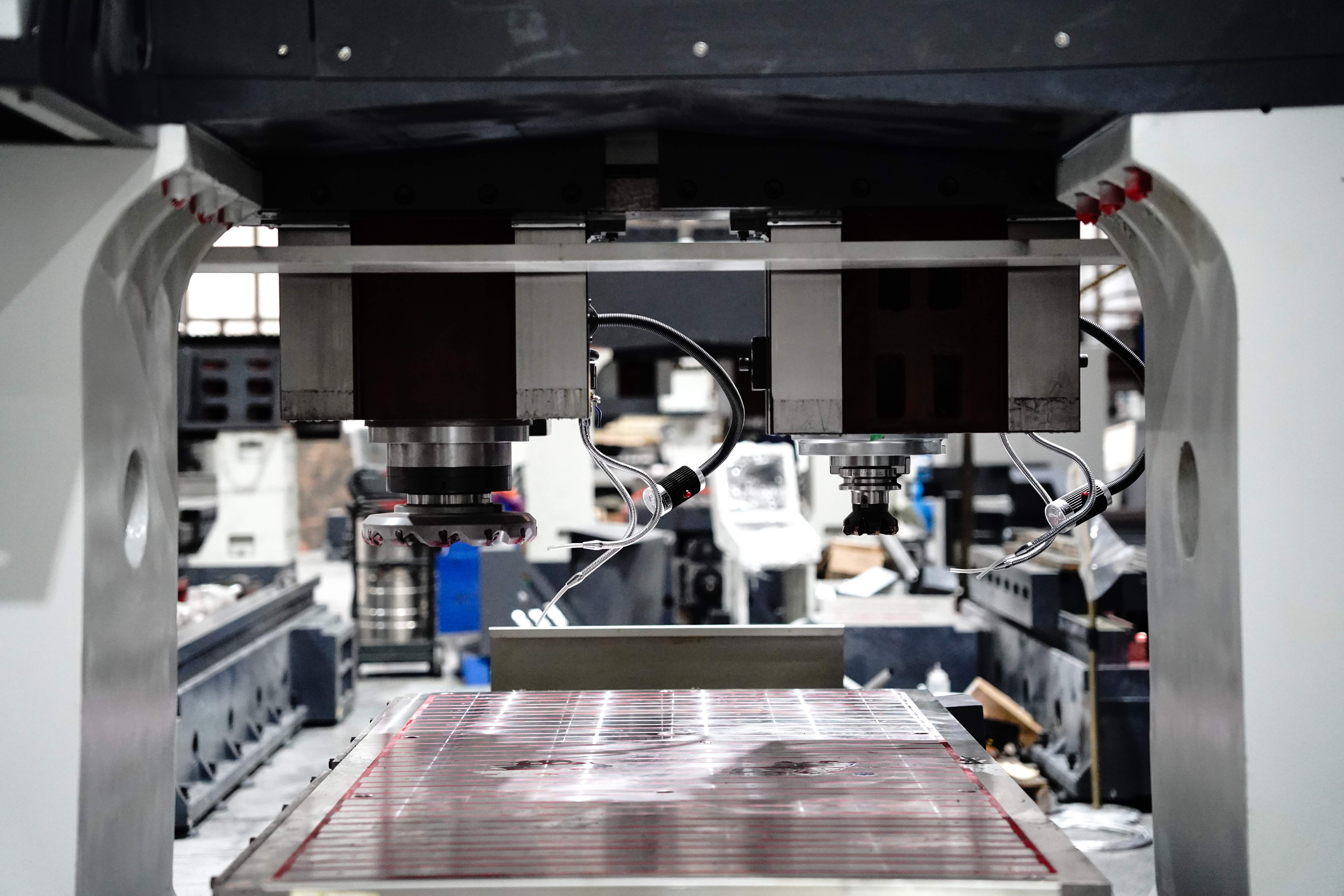
A VMC runs G-code programs through a Fanuc or Siemens 828D controller, automating the full sequence from roughing to finishing in one unattended cycle. I toured a mold shop in Chicago that consolidated three manual mills into one DMG MORI VMC — programming and debugging took two weeks, but single-part cycle time dropped from 8 hours to 1.5 hours, and they still use that case today when justifying the investment to clients.
Two programming paths exist: manual G-code preferred by veteran machinists for simple 2D profiles and drilling/tapping cycles, where one finished program can be fine-tuned by handwheel; and CAM software (Mastercam/HyperMill/Fusion 360) auto-programming from CAD models, handling complex 5-axis surfaces but requiring post-processor configuration specific to each machine. SAE AS8878 standardizes NC program formats — today's controllers receive programs via USB or network, eliminating paper tape entirely.
Fanuc 0i-M/31i series controllers compress programming time from hours to under 30 minutes, though G-code syntax itself requires structured learning. Siemens 828D's-shop cycle programming lowers the barrier further, ideal for shops without CAM infrastructure.
VMCs suit manufacturing scenarios with long product lifecycles and repeat orders — one verified program can be run indefinitely, spreading upfront cost across hundreds of parts while overnight lights-out operation reduces labor cost to near zero.
· VMC new price: $80,000-$250,000 (3-axis), premium 5-axis $250,000-$500,000
· Programming time: CAM software 30-120 min/part, manual G-code 10-30 min/part
· Best for: batch production of 500+ parts, complex 3D contours, unattended night runs
· Leading controllers: Fanuc 0i-MF (market volume), Siemens 828D (ease of use)
Machine Structure
Manual milling machines typically use V-ways or dovetail slides, relying on oil film and operator feel to maintain accuracy; VMCs extensively use linear guide rails (THK/INA/HIWIN) where preloaded ball bearings make point contact with the rail surface, rigidity independent of operator skill. ASME B5.54-2005 specifies methods for measuring axial positioning accuracy of CNC machine tools — it is the mandatory reference document for aerospace and medical device supplier audits.
Accuracy differences follow from this: manual machines achieve 0.02-0.05 mm positioning accuracy, 0.01-0.02 mm repeatability, dependent on the operator's clamping and edge-finding skill; a VMC delivers 0.005-0.01 mm/300 mm positioning accuracy, 0.003 mm repeatability, with linear guide preload ensuring wear does not accumulate over time. THK LR series linear guides are rated for over 100,000 hours before precision degradation — and during that time accuracy barely drifts.
Stiffness differences set the ceiling on cutting capability: VMC spindles typically run 12,000-20,000 RPM with BT40/CT40 tool holders, enabling aluminum high-speed cutting (HSC) and hardened steel hard milling; old manual mills top out at 1,500-3,000 RPM and struggle with materials over HRC 30.
Structural design also affects thermal stability: VMCs use one-piece mineral casting or welded steel frames with integrated headstock-spindle design, thermal deformation concentrated at the spindle nose and correctable via thermal displacement compensation algorithms; manual mill columns and bases are separately cast, more susceptible to shop floor temperature swings.
· Guide types: Manual V-way/dovetail (wears easily, hard to compensate) vs VMC linear rails (maintenance-free, stable accuracy)
· Spindle speed: VMC 12,000-20,000 RPM vs Manual 1,500-3,000 RPM — cutting efficiency 5-10x higher
· Thermal stability: VMC has spindle cooling and thermal compensation; manual machine accuracy drifts with ambient temperature
· Maintenance cost: Linear guides 100,000-hour maintenance-free vs V-ways requiring periodic scraping and repair
| Item | Manual Milling Machine | Vertical Machining Center |
| Control Method | Handwheel-driven X/Y/Z axes | Fanuc/Siemens G-code automatic operation |
| Price Range | $15,000-$50,000 | $80,000-$500,000 |
| Positioning Accuracy | 0.02-0.05 mm | 0.005-0.01 mm |
| Repeatability | 0.01-0.02 mm (clamping-dependent) | 0.003 mm (linear guides) |
| Spindle Speed | 1,500-3,000 RPM | 12,000-20,000 RPM |
| Suitable Batch | Single piece to 50 pieces | 50 to 10,000+ pieces |
| Operator Training | 3-5 years (feel-based experience) | 3-6 months (controller operation) |
| Best For | Prototypes, single pieces, low-volume | Batch production, complex geometry, lights-out |
Source: ASME B5.54-2005 — the standard for axial positioning accuracy measurement of CNC machine tools, widely cited in aerospace and medical device supplier quality audits as the definitive accuracy verification reference.
Shop Use
Small Batch Work
For batches under 50 pieces, manual machines are often the better economic choice. I visited a job shop in California that quoted $80-150/hour for manual milling (operator included) — clients pay for just 20 minutes of setup time and receive the result at that rate; against a VMC quoted at $150-250/hour (including amortized programming time), manual mills save 30-50% on jobs under 20 pieces.
The key is who bears the programming cost: VMC programming (CAM + post-processing + debugging) often runs 1-3 hours, and amortized across $150-250/hour rates, makes per-part cost actually higher for jobs under 50 pieces. Manual mills skip programming entirely — clamp and mill.
Beyond 20 pieces, the VMC's unattended advantage kicks in. An 8-hour overnight run completes automatically with zero labor cost — the $30/hour operator wage becomes $0 during night hours, and that arbitrage is the core of VMC economics.
The true dividing line is set by accuracy requirements: a tolerance window of plus/minus 0.02 mm or looser, a skilled manual operator can compensate by feel; tighter than this and manual clamping plus reading errors become uncontrollable, mandating a VMC. The mandatory zone: 20+ pieces plus tolerances tighter than plus/minus 0.02 mm.
One hidden cost that gets overlooked: manual machine accuracy is entirely dependent on the operator's shift condition — fatigue, mood, even a case of the shakes after lunch, all directly translate into part dimensional drift. I saw a night-shift ferrous parts order in Detroit where daytime parts held plus/minus 0.02 mm, but the fatigued night operator pushed the deviation to plus/minus 0.06 mm — the client rejected the entire batch. VMC has no such problem: once the program is locked, quality at 3 AM is identical to 3 PM.
· 20 pieces or fewer: Manual preferred — short setup (15-30 min), no programming, lower per-part cost
· 20-50 pieces: Crossover zone — evaluate based on tolerance and material requirements
· 50+ pieces: CNC preferred — unattended night runs spread operating cost, consistent accuracy
· Tolerance tighter than plus/minus 0.02 mm: VMC mandatory regardless of batch size
Repeat Parts
The core value of a VMC emerges in repeat production scenarios. I worked with an orthopedic implant shop in Michigan that switched to VMC and watched batch dimensional drift shrink from plus/minus 0.05 mm to plus/minus 0.008 mm — first-pass yield jumping from 78% to 99%. The root cause was not machine precision but CPK (Process Capability Index) rising from less than 1.0 to greater than or equal to 1.67.
What does CPK greater than or equal to 1.67 mean in practice? Fewer than 0.0003% defective parts per million — this is the quality threshold demanded by high-volume medical device and aerospace customers. They are not asking for "close enough"; they need every part sitting near the nominal dimension. Manual machines require re-clamping and re-setting for each new workpiece, tolerance drifts with each setup cycle, and cannot reliably achieve CPK greater than or equal to 1.33.
A real audit case: an aerospace structural supplier delivered 200 pieces — every single part measured within tolerance individually, but the customer rejected the entire lot not for individual oversize but because the batch CPK was only 1.1, below the contractual requirement of 1.33. The root cause was batch-to-batch variation introduced by manual clamping that the process itself could not absorb. This virtually never happens on a VMC.
In repeat parts scenarios, once a VMC program is debugged and tool offsets dialed in, every subsequent part is a copy of the previous one — no operator surveillance needed, per-part cost approaching the pure cutting time and tool wear.
· VMC repeatability: 0.003 mm (linear guide-guaranteed), CPK greater than or equal to 1.67 reliably achievable
· Manual repeatability: 0.02-0.05 mm, clamping-dependent, large batch-to-batch variation
· CPK thresholds: Medical devices greater than or equal to 1.67, aerospace greater than or equal to 1.33, general industry greater than or equal to 1.0
· Unattended operation: VMC runs 8 hours overnight = $0 labor cost, annual labor savings $60,000-$120,000
Source: SAE AS8878 — NC program paper tape format standard that specifies standardized G-code transmission formats, forming the basis for aerospace structural part NC program interoperability.
Setup Time
Manual mill changeover is straightforward: clamp, dial in with a test indicator, set depth, start milling — 15-30 minutes total, simple process, low training cost. VMC changeover involves: workpiece mounting, coordinate system setting, tool length compensation, program call-up, first-piece inspection — often 1-3 hours. But I have typically seen that Mazak's Quick Chuck quick-change fixture system compresses clamping time to under 10 minutes, and paired with a Renishaw OTS 3D workpiece probe for automatic alignment, comprehensive efficiency far exceeds manual.
The real gap emerges during overnight runs: once a VMC program and tools are debugged and verified, an 8-16 hour unattended overnight run completes automatically with $30/hour operator wages = $0 incremental cost. At 250 working days per year, a single VMC night shift saves $60,000-$120,000 in annual labor costs.
The programming time economics must be evaluated separately: for a "make it once" part, VMC programming and debugging time may exceed actual cutting time; for a "make it 500 times" order, a 100-minute upfront investment amortizes to just 0.2 minutes equivalent per part — far below the manual operator's hourly wage rate.
Break-even calculation: VMC programming + first-piece inspection totals 2 hours, manual mill single-part machining is 2 hours. Below 30 pieces, manual total hours (2h times quantity) is less than VMC (2h programming plus 2h times quantity); above 30 pieces, VMC starts winning; at 500 pieces, VMC equivalent per-part time is only 1.2 hours (including amortization), versus manual's steady 2 hours.
· Manual setup: 15-30 minutes, no programming, straightforward operation
· VMC setup: 1-3 hours (including programming and debugging), but standardized and repeatable
· Break-even point: greater than or equal to 30 identical workpieces, VMC total hours fall below manual
· Overnight runs: VMC saves $240 per night (8h times $30/h), $60,000-$120,000 annually
Right Choice
Part Complexity
Simple 2D planes, keyways, and drilling operations are squarely within the manual machine's comfort zone. A Bridgeport with a dividing head handles most non-standard parts' roughing and semi-finishing within 2 hours — no CAD/CAM, no programming, just re-adjust the handwheel to modify the approach.
But the manual mill's capability ceiling becomes apparent immediately in these situations: complex 3D surfaces (impellers, mold cavities, medical implants) demand continuously varying cutting directions that no handwheel can produce; hardened steel (HRC greater than or equal to 45) demands high-rigidity spindles and high-precision positioning that manual machines cannot provide without chatter; surface roughness Ra less than or equal to 0.8 micrometers requires HSC or precision milling where handwheel feed precision simply cannot reach.
I often recommend this rule of thumb: a representative case — a client machining an aluminum drone housing with internal cooling channels and optical mount features, wall thickness tolerance plus/minus 0.05 mm. Manual milling required 3 setups plus extensive hand finishing, surface Ra only reached 3.2 micrometers; the VMC completed all features in one setup, Ra reached 0.8 micrometers, total time dropped from 18 hours to 4 hours, and no hand finishing was needed.
The tighter the tolerance, the more pronounced the VMC advantage: plus/minus 0.01 mm is the manual machine's practical limit and the VMC's starting point; plus/minus 0.002 mm (e.g., NIST calibration artifacts) can only be reliably achieved by a VMC with a spindle whose runout is less than 0.005 mm.
Multi-axis indexing is a boundary manual can never cross: 4-axis rotary table plus 5-axis RTCP (Rotation Tool Center Point) compensation only exists on a VMC. I visited a Houston oilfield equipment shop running a 5-axis VDI milling body — a manual dividing head simply cannot complete this because every angle change requires re-alignment, while the VMC machined all 72 angled faces in a single setup with positional accuracy all under 0.03 mm.
· Manual limit: 2D profiles, soft materials (HRC less than 30), plus/minus 0.02 mm, Ra greater than or equal to 1.6 micrometers
· VMC coverage: 3D surfaces, hardened steel (HRC greater than or equal to 45), plus/minus 0.002 mm, Ra less than or equal to 0.8 micrometers
· 4-axis/5-axis simultaneous: VMC only, manual cannot do this
· Hard threshold: HRC greater than or equal to 45 or Ra less than or equal to 0.8 micrometers or plus/minus 0.01 mm → VMC mandatory, manual cannot deliver
Source: NIST Manufacturing Technology Laboratory Precision Gauge Artifact Machining Guide — explicitly states that artifacts with tolerances of plus/minus 0.002 mm or tighter must be machined on a VMC; manual milling machines cannot meet the requirement.
Skill Needs
I discovered that manual milling machine operator training takes 3-5 years, and the core skill is developing a physical feel for the cut — chip color turning yellow means feed is too slow, blue smoke means RPM is too high, these judgments take thousands of hands-on hours to internalize. I've watched a 20-year veteran machinist in a shop who had such precise muscle memory for a specific material's handwheel feed rate that he could hold plus/minus 0.01 mm tolerance with his eyes closed — but this experience is non-replicable and walks out the door when he quits.
CNC operator training takes 3-6 months: G-code basics or Mastercam introduction, able to independently load workpieces, call programs, and monitor machining — and they're productive on the machine. Critically, a CNC operator's skills are transferable, documented, and reproducible — one good program can run simultaneously on three VMCs, one skilled operator can supervise 2-3 machines.
Wage data illustrates the structural issue: according to the U.S. Bureau of Labor Statistics 2023 occupational employment statistics, Manual Machinist median hourly wage is $25, CNC Operator median hourly wage is $32 — a $7/hour gap that seems modest, but the 2-3x labor efficiency from multi-machine supervision is where the real value lies for manufacturing businesses.
Recruiting logic is completely different: finding a good manual millwright depends on experience and reputation, and quantifying ability during a trial period is difficult; finding a VMC operator can be tested with standard workpieces — programming ability, blueprint reading, tooling knowledge — all verifiable within one week.
· Manual machinist: 3-5 year training cycle, feel-based experience non-replicable, high turnover risk
· CNC operator: 3-6 months to productivity, transferable and documented skills, supports multi-machine supervision
· Skill verification: Manual relies on interviews and reputation; VMC uses standardized testing (quantifiable within 3 days)
· Wage gap: $25/h vs $32/h, but VMC multi-machine efficiency is 2-3x, equivalent labor cost is actually lower
Cost Check
The purchase cost comparison is stark: used manual Bridgeport approximately $20,000-$50,000 (including digital readout), new 3-axis VMC starting $80,000-$120,000, premium 5-axis VMC $250,000-$500,000. Intuitively, manual is 5-10x cheaper; but the operating ledger must be evaluated separately.
Manual machine operating cost $20-40/hour (primarily operator wages), VMC operating cost $50-120/hour (including tool wear, cutting fluid, maintenance reserve). But the VMC's true value only becomes visible on a 10-year horizon: a high-speed machining center's annual output equals approximately 3-5 manual mills, tool wear is predictable (offset compensated automatically), and 8 hours of unattended overnight operation costs $0 incremental labor.
ROI calculation: assuming VMC per-part machining time of 1.5 hours (including amortization), annual output of 2,000 parts, annual net output $180,000, 3-year payback; equivalent labor operating two manual mills at 2 hours per part, annual output only $80,000, with the added risk of operator departure causing production interruption. I recommend running the full 10-year model: after 5 years, VMC cumulative net profit is approximately $600,000, manual approximately $200,000 — a 3x gap.
Decision tree: annual output less than or equal to 1,000 parts, manual machines suffice with lower capital pressure; annual output 1,000-2,000 parts, entering the crossover zone requiring evaluation alongside accuracy requirements; annual output greater than or equal to 2,000 parts, VMC economic advantage is clear and it should be the priority choice.
· Initial cost: Manual $20,000-$50,000 vs VMC $80,000-$250,000 (5-10x gap)
· Operating cost: Manual $20-40/h vs VMC $50-120/h (including tooling, maintenance, cutting fluid)
· ROI threshold: Annual output greater than or equal to 2,000 similar parts, VMC pays back within 3 years
· Long-term perspective: 5-year cumulative net profit — VMC approximately $600,000, manual approximately $200,000 (3x gap)
Source: U.S. Bureau of Labor Statistics 2023 Occupational Employment and Wages — Manual Machinist median hourly wage $25, CNC Operator median hourly wage $32, a $7/h differential, but VMC multi-machine supervision efficiency is 2-3x that of manual, making equivalent labor cost actually lower.
Understanding the fundamental differences between these machines, the next step is to match your specific production context — part complexity, batch size, accuracy requirements, and available operator skill — against these machines rather than being guided by price tags or machine specifications alone.