

Selecting the right CNC machining center for P20 mold blocks is a critical first step in ensuring mold base accuracy and controlling the production cycle. This article systematically analyzes the overall solution for efficient P20 mold block machining from three dimensions: P20 block characteristics, WJ-800 machine performance, and mold accuracy control methods.
Know P20 Blocks
Block Size
The dimensional range of P20 tool steel blocks is the primary basis for selecting a machine's travel specifications. Standard P20 block blank sizes commonly range from 100 mm × 100 mm to 600 mm × 600 mm, with heights typically between 50 and 300 mm and weights from approximately 10 kg to over 1,500 kg. For small and medium-sized P20 blocks, the machine table must have sufficient travel to accommodate the blank while leaving adequate tool clearance space, preventing cutting tools from colliding with fixtures or machine structures — this is the fundamental prerequisite for safe machining. When selecting a machine, key factors to examine include table load capacity and travel margin, ensuring the blank has sufficient clearance at any position so that tools do not interfere with fixtures or machine guards. For large P20 blocks exceeding 400 mm × 400 mm, blank weights can reach several hundred kilograms or even over a ton; the machine table's load capacity must meet these requirements while the fixture solution balances both rigidity and stability.
| Block Spec | Size Range (mm) | Weight Range | Travel Fit |
| Small | 100×100 – 200×200 | 10 – 50 kg | Fully compatible |
| Medium | 200×200 – 400×400 | 50 – 400 kg | Fully compatible |
| Large | 400×400 – 600×600 | 400 – 1500 kg | Fully compatible |
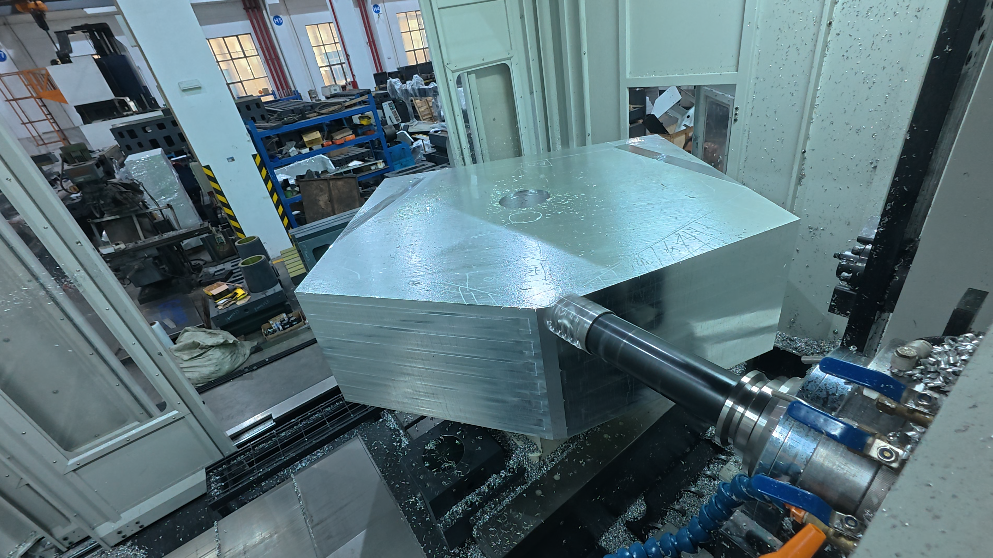
The WJ-800 delivers an 800 mm X-axis stroke and a 600 mm Y-axis stroke, accommodating most P20 block specifications in a single setup and eliminating positioning errors that arise from multiple setups. The blank's center of gravity shifts with its geometry, directly affecting fixture design and cutting parameter selection — a critical input for process planning. Programs must reserve adequate clearance distance to prevent tools from exceeding blank boundaries and damaging fixtures or the machine. For tall block workpieces, the Z-axis stroke must allow tools to fully reach the block's top surface and complete side machining while leaving adequate space for tool changes. The WJ-800's Z-axis travel is specifically engineered for P20 block machining requirements, enabling roughing and finishing of all six block faces in a single setup — significantly improving machining efficiency and positional accuracy. This single-setup capability eliminates cumulative positioning errors inherent in multi-setup approaches, where each repositioning introduces a potential accuracy loss of 0.02–0.05 mm or more, depending on the machine's repositioning accuracy and the skill of the operator in re-establishing workpiece datum references.
P20 tool steel is a pre-hardened plastic mold steel with a delivery hardness of HRC 28–35, widely used in large plastic molds and die-casting mold frame machining, offering excellent machinability and hardness stability across a wide range of operating conditions.
Cutting Load
P20 tool steel generates substantial cutting forces during roughing, requiring matched cutting tools and process parameters to achieve efficient material removal. The primary choice for roughing is cemented carbide inserts, with common grades such as YNG151 and YNG251 featuring high metal removal rate geometries; maximum depths of cut reach 4–15 mm and feed per tooth ranges from 0.3–0.8 mm. The high hardness of P20 produces significant cutting forces, demanding machines with sufficient power reserves and rigidity support. Cutting force magnitude is jointly determined by depth of cut, feed rate, and cutting speed — under identical cutting parameters, P20's cutting force exceeds that of ordinary carbon structural steel, placing higher demands on the machine's spindle power and feed system. Insufficient machine power during roughing leads to stalling, cutter digging, and other process failures that damage tools and degrade surface quality. Beyond power, the machine's dynamic stiffness — its ability to resist vibration under changing cutting forces — directly influences surface finish and tool life in P20 roughing operations.
· Roughing depth of cut: 4 – 15 mm
· Feed per tooth: 0.3 – 0.8 mm/r
· Metal removal rate: 50 – 200 cm³/min
· Spindle power utilization: 70 – 90%
Cutting power and cutting force are key parameters for determining machining sequences: during roughing, spindle power typically ranges from 2–5 kW and radial cutting force from 1–5 kN, directly affecting tool life and machining efficiency. The WJ-800 is equipped with a 30 kW spindle motor and BT50 taper interface, offering high rigidity and ample power margin to handle P20's high-load roughing with ease. Aggressive cutting parameters dramatically reduce single-part cycle time — traditional manual planing of a single P20 block typically requires 6–8 hours, while the WJ-800 completes all rough machining in only 1–2 hours. The BT50 taper provides greater cone contact area than BT40, delivering higher tool holding rigidity; under heavy depth and high feed conditions, tool vibration is reduced, effectively improving dimensional consistency and surface integrity in P20 block machining. The WJ-800's heavy-duty spindle also enables the use of larger diameter tools for roughing, further increasing metal removal rates and reducing the number of required tool passes across the workpiece surface. Larger tools distribute cutting forces across a greater edge length, reducing the specific cutting force per unit area and improving chip formation in P20's medium-hardness range, resulting in better surface integrity on the machined floor left behind after roughing.
Heavy roughing completes the majority of P20 block stock removal in 1–2 hours, delivering 3–5× the efficiency of traditional planing and significantly shortening the mold blank machining cycle for high-volume production environments.
Finish Needs
The finishing stage of P20 blocks directly determines the final surface quality of the mold base, which in turn affects mold service life and assembly accuracy of the final product. The finishing allowance — the material retained between roughing and finishing — must be properly established: excessive allowance shortens finishing tool life and reduces dimensional accuracy, while insufficient allowance risks under-machining and part scrapping. P20 finishing allowance typically ranges from 0.3–1.2 mm, with surface roughness requirements of Ra 0.8–1.6 μm for general applications. For precision plastic molds and die-casting molds, base surface quality requirements are even more stringent, with Ra needing to be controlled in the 0.4–0.8 μm range while flatness must reach 0.03 mm or better. Finishing parameter selection requires comprehensive consideration of tool material, cutting speed, cooling method, and machine rigidity to ensure process parameters match equipment capabilities and the specific requirements of each mold application.
| Mold Type | Surface Roughness | Finishing Allowance | Recommended Cutting Speed |
| Standard plastic mold | Ra 1.6 – 3.2 μm | 0.5 – 1.2 mm | 100 – 150 m/min |
| Precision plastic mold | Ra 0.8 – 1.6 μm | 0.3 – 0.8 mm | 150 – 250 m/min |
| Die-casting mold | Ra 0.4 – 0.8 μm | 0.2 – 0.5 mm | 200 – 300 m/min |
High surface quality depends on the proper matching of cutting speed, tool material, and coolant supply: high-speed cutting at 150–300 m/min with coated carbide inserts effectively suppresses vibration and reduces surface roughness values in P20 finishing operations. The WJ-800 CNC system's 0.001 mm motion resolution provides reliable technical support for precision mold base finishing, enabling the fine feed control needed for Ra 0.4 μm surfaces. Coolant selection and supply method are equally critical for surface quality — adequate coolant reduces cutting zone temperature, prevents thermal deformation and burning, and helps flush chips to prevent chip adhesion on tools that would scratch the workpiece surface. For high-precision P20 mold bases, oil-based coolants or high-quality water-based coolants are recommended, paired with appropriate nozzle angles and flow rates to ensure consistent coolant supply at the tool-workpiece interface throughout the cutting cycle.
| Precision Grade | Flatness Requirement | Surface Roughness | WJ-800 Compatibility |
| Standard mold | ≤0.08 mm | Ra 1.6 μm | Fully compliant |
| Precision mold | ≤0.05 mm | Ra 0.8 μm | Fully compliant |
| Ultra-precision mold | ≤0.03 mm | Ra 0.4 μm | Fully compliant |
Precision mold bases require flatness ≤0.03 mm; large injection mold bases can meet requirements within ≤0.08 mm. The WJ-800's high-rigidity bed structure provides a stable geometric accuracy foundation for high-precision machining under demanding production conditions.
Use WJ-800
Heavy Cutting
The WJ-800 machining center's heavy-cutting capability is the core advantage for achieving efficient P20 block machining, specifically engineered for roughing conditions involving deep depth of cut and high feed rates simultaneously. The machine delivers 30 kW of spindle power, with the BT50 spindle taper providing a high-rigidity tool clamping interface that effectively reduces tool overhang, suppresses vibration, and improves P20 high-load machining stability — this is its defining capability compared to ordinary machining centers. In P20 roughing, the combination of 4–15 mm depth of cut and 0.3–0.8 mm/r feed rate represents a standard parameter set; only machines with ample power reserves and high structural rigidity can stably achieve this range throughout an entire production run without thermal deflection or structural deformation degrading accuracy. The WJ-800's high-power spindle paired with the BT50 high-rigidity interface maintains stable cutting under heavy depth conditions, with tool life improved by 30–50% compared to ordinary machines that lack equivalent power and rigidity.
The WJ-800's 30 kW spindle power and BT50 high-rigidity interface make a P20 roughing metal removal rate of 50–200 cm³/min a reality — the core guarantee for efficient mold blank machining across all P20 block sizes.
· Spindle power: 30 kW
· Maximum depth of cut: 15 mm
· Metal removal rate: 50 – 200 cm³/min
· BT50 spindle taper — rigidity superior to standard tool holders
Compared with ordinary machining centers, WJ-800 CNC machining eliminates manual alignment procedures, delivering superior part quality consistency and high batch repeatability — an ideal process solution for high-volume mold blank production environments. Large depth of cut combined with high feed rates shortens single-part cycle time while ensuring dimensional accuracy across the entire block. The 45-degree inclined Y-axis design with heavy coolant flooding effectively flushes chips, preventing chip recutting that would damage insert edges and degrade finished surface quality. Chip accumulation during heavy cutting is a critical factor affecting both machining quality and tool life — chips piled up raise cutting zone temperatures, accelerate tool wear and thermal crack generation, and in severe cases cause tool breakage or workpiece surface damage. The WJ-800's inclined bed design leverages gravity for natural chip evacuation, paired with high-flow coolant flushing to ensure chips promptly leave the machining area, keeping the tool-workpiece interface clean and thermally stable throughout the roughing cycle. Effective chip evacuation is particularly important in P20 roughing because the material's chip forms are short and brittle, tending to wedge into corners and re-cut against the insert edge if not promptly removed. This re-cutting action generates heat and accelerates flank wear on the cemented carbide insert, directly reducing tool life between tool changes.
Stable Structure
The WJ-800 adopts a gantry frame structure with box-section columns and octagonal hydraulic cylinder design, maintaining bed stability under heavy cutting loads without measurable deflection. Column and crossrail joint surfaces undergo precision scraping and preloaded bolt connections, with joint rigidity approaching that of a solid one-piece casting. The closed-section crossrail controls Z-axis ram deflection within 0.02 mm over the full travel, providing a reliable geometric accuracy foundation for precision machining operations on large P20 blocks. Machine structural rigidity has a direct relationship with machining accuracy — under heavy cutting forces, bed deformation and vibration directly transfer to the workpiece, manifesting as dimensional oversize, surface waviness, and dimensional drift as tools wear. The WJ-800's high-rigidity design controls bed deformation within minimal limits, maintaining stable geometric accuracy even under full-load P20 roughing conditions, avoiding machining error accumulation caused by machine elastic deformation throughout extended production runs.
| Structural Parameter | Value | Effect on Machining |
| Column section form | Box section + octagonal cylinder | High rigidity, strong vibration damping |
| Deformation under 15 kN cutting force | ≤ 0.02 mm | Maintains base geometric accuracy |
| Column spacing | 800 mm | Provides spacious machining area |
| Y-axis inclination | 45-degree inclined design | Optimizes chip evacuation, enhances stability |
· Precision-scraped contact surfaces — rigidity approaching solid castings
· Spindle head internal circulating cooling, thermal deformation ≤0.01 mm
· Three-axis linear guides, friction coefficient ≤0.005
Thermal deformation is another key factor affecting precision machining accuracy — cutting heat during machining causes thermal expansion of the workpiece and machine structure, resulting in dimensional deviation that compounds over long roughing cycles. The WJ-800's spindle head uses an internal circulating cooling system that controls spindle temperature rise within 0.01 mm, effectively suppressing thermal deformation errors throughout continuous machining operations. Coolant temperature control is equally critical for large P20 block machining; precision mold base machining is recommended in temperature-controlled shops with ambient temperature fluctuation within ±1°C, ensuring consistent thermal state of the workpiece throughout the entire process from roughing to finishing. Three-axis linear guides with friction coefficient ≤0.005, paired with precision preloading design, eliminate motion clearance and provide uniform support rigidity across the full travel of each axis, enabling smooth stick-slip-free motion and providing a consistent motion foundation for P20 mold base precision finishing operations. This motion consistency is especially critical during finishing passes where the depth of cut is small — any stick-slip or irregular axis motion directly transfers to the workpiece surface as ripple marks or feed marks that degrade the Ra value achieved.
Structural rigidity determines the upper limit of machining accuracy: the WJ-800's precision structural design keeps P20 high-load cutting deformation under 0.02 mm — the essential structural foundation for achieving high-precision mold bases consistently.
Easy Setup
Fixture efficiency directly affects the overall production rate of P20 mold blocks; a proper fixture solution shortens auxiliary time and improves positioning accuracy across all operations. The WJ-800 is equipped with a T-slot table and quick-change clamping modules; the hydraulic clamping system supports synchronized multi-face clamping, with single-face setup time controlled within 30 minutes and total multi-face setup time within 1 hour. The 0.02 mm repositioning accuracy ensures positional consistency of workpieces through continuous multi-process machining, reducing accuracy loss from realignment procedures that would otherwise introduce cumulative errors across multiple setups. P20 block fixture solutions must balance both rigidity and repeatability — insufficient clamping force causes workpiece displacement under cutting forces, affecting dimensional accuracy and surface quality; excessive clamping force may cause workpiece deformation with shape errors after clamp release. The WJ-800's hydraulic clamping system can flexibly adjust clamping force according to workpiece size and machining area, achieving optimal clamping results without deformation for the full range of P20 block geometries.
· T-slot table + hydraulic clamping, single-face setup ≤30 min
· Repositioning accuracy: 0.02 mm
· Standardized fixture parameter library, parameter call-up ≤3 min
· Workpiece coordinate system storage supports rapid machining face switching
| Clamping Method | Traditional Machine | WJ-800 |
| Single-face setup time | 60 – 90 min | ≤30 min |
| Total multi-face setup time | 3 – 5 hours | ≤1 hour |
| Repositioning accuracy | 0.05 – 0.1 mm | 0.02 mm |
The built-in fixture parameter library covers standard fixture solutions for the full range of P20 blocks from 100 mm to 600 mm; operators simply call up stored parameters to complete fixture preset, dramatically shortening process preparation time at the start of each new batch. The T-slot table's standard slot spacing of 100 mm, paired with T-nuts of various specifications, adapts to clamping needs of all sizes of P20 blocks without requiring custom fixture fabrication. For batch production, changeover time is a key factor affecting overall production efficiency — if every specification change requires redesigning the fixture solution and manually adjusting parameters, production rhythm suffers and lead times extend. The WJ-800's standardized parameter library allows operators to directly call up historically verified fixture solutions, reducing new batch startup time by over 70% and effectively improving overall efficiency in multi-variety P20 block mixed production environments with frequent product changeovers.
The WJ-800's easy clamping system combined with a standardized process database significantly shortens changeover time for multi-variety P20 blocks and effectively improves overall production efficiency across diverse batch sizes and block geometries.
Get Mold Accuracy
Flat Mold Base
Flatness is the core precision indicator in mold base machining, directly determining mold quality, service life, and dimensional stability of the final plastic or die-casting product. Insufficient mold base flatness leads to assembly deviation, local stress concentration, and accelerated mold failure in production — resulting in increased maintenance costs and production downtime. P20 mold industry standards typically require flatness in the 0.03–0.08 mm range, with specific values determined by mold type and application — this is the primary parameter in mold quality control and the foundation for all subsequent machining operations on the mold cavity and core. Sources of flatness error primarily include machine geometric errors, tool wear causing accumulated cutter deflection over long machining cycles, thermal deformation error from cutting heat, and fixture deformation under clamping forces. When the WJ-800 machines P20 blocks, high-rigidity bed structure reduces elastic deformation under cutting loads, the closed-loop cooling system controls thermal deformation, and precision ball screws and guides ensure motion straightness — together controlling flatness error within the target range throughout the machining process.
Flatness out-of-tolerance is the primary cause of mold rework: the WJ-800's high-rigidity structure combined with precision cutting parameters is an effective process method for controlling P20 mold base flatness across all production volumes.
| Mold Type | Flatness Requirement | Measurement Method | WJ-800 Compatibility |
| Standard injection mold | ≤0.08 mm | CMM measurement | Fully compliant |
| Precision injection mold | ≤0.05 mm | Laser interferometer | Fully compliant |
| Precision die-casting mold | ≤0.03 mm | CMM + optical flat | Fully compliant |
Finish machining flatness control depends on using symmetric tool paths or spiral milling strategies in the final finishing operation, avoiding error accumulation from one-directional tool path deflection that builds up progressively across the workpiece surface. Precision mold bases require flatness ≤0.03 mm, while large injection mold bases can meet requirements within ≤0.08 mm for standard production applications. The WJ-800's high-rigidity machine body combined with precision-controlled cutting parameters is a reliable process solution for achieving high flatness on P20 mold bases. In the finishing stage, a strategy of small depth of cut with high cutting speed is recommended — depth of cut controlled in the 0.3–0.5 mm range, cutting speed 150–200 m/min, feed rate 0.05–0.1 mm/r — effectively reducing the impact of tool deflection and elastic recovery on flatness accuracy. Flatness measurement should be performed after the workpiece cools to room temperature, as thermal expansion during machining can mask true flatness errors that would become apparent under production temperature conditions.
Square Sides
Perpendicularity is a key precision parameter in mold sidewall machining, affecting mold assembly accuracy and guide precision — particularly important for sliding-fit components in precision plastic molds and die-casting molds. Perpendicularity error manifests as an angular deviation between the machined surface and the theoretical reference plane; excessive perpendicularity error causes mold assembly difficulties, increased fitting time on the production floor, and accelerated wear on guide components during mold operation. P20 mold sidewall perpendicularity typically requires 0.02–0.05 mm/100 mm, with high-precision molds demanding ≤0.02 mm/100 mm — a key parameter in mold assembly quality control that directly affects mold performance in production. The main causes of perpendicularity error include axis orthogonality error, tool axis to spindle axis concentricity error, fixture reference plane to machine coordinate origin deviation, and elastic deformation from cutting forces during machining. The WJ-800 addresses these through precision assembly and pre-delivery calibration, ensuring axis orthogonality errors are within acceptable tolerance bands for the intended application.
· Laser interferometer for regular axis accuracy calibration
· End milling using bidirectional or spiral milling strategies
· Right-angle milling head with CNC system perpendicularity error compensation
· CMM measurement before and after machining to verify perpendicularity
Perpendicularity error has a cumulative effect throughout the mold assembly process: the WJ-800's axis accuracy compensation function combined with regular calibration keeps perpendicularity error within the target range, ensuring P20 mold sidewall assembly quality in production.
Precision mold sidewall perpendicularity control also requires attention to machine axis orthogonality error, which originates from guide installation accuracy and ball screw clearance in the machine's drive system — corrected through regular calibration and error compensation procedures built into the CNC system. The right-angle milling head combined with the CNC system's perpendicularity error compensation function can precisely correct out-of-tolerance conditions identified during inspection, restoring the machine to specification without requiring physical realignment of machine components. Axis orthogonality error calibration should be incorporated into the machine's routine maintenance schedule, ensuring long-term stability of P20 mold sidewall perpendicularity within the target range across the machine's operational life. Thermal cycling during extended machining sessions causes differential expansion of machine components, particularly affecting the orthogonality relationship between the X and Y axes; periodic recalibration compensates for these thermally induced geometric shifts that would otherwise accumulate over successive production shifts. For high-precision P20 mold sidewalls, CMM measurement is recommended immediately after finishing to verify perpendicularity meets requirements before the workpiece is moved to the next process; compensation machining should be performed promptly if out-of-tolerance conditions are detected during this verification step.
Less Rework
Reducing rework is the core objective for improving overall P20 mold machining efficiency; the primary measures are increasing first-pass yield and reducing scrap rate to minimize the per-part cost of P20 mold block production. Traditional machine tool P20 mold base first-pass rework rates typically range from 15% to 30%, causing serious waste of time, labor, cutting tools, and measurement resources that directly erode production profitability. The WJ-800 reduces P20 mold base first-pass rework rate to under 5% through its combination of high rigidity and high precision, significantly lowering comprehensive production costs and achieving measurable return on investment within the first production batch run. Rework costs include not only secondary machining labor and tool consumption, but also losses from machine occupation time and production schedule delays during rework waiting periods — plus the resulting chain effects on subsequent production orders and delivery commitments to customers.
The core of rework reduction is prevention rather than correction: first-part inspection, process solidification, and in-process monitoring working together as a unified quality system is the key to achieving consistently low rework rates in P20 mold block production.
· 100% dimensional inspection after first-part machining: flatness, perpendicularity, and all critical dimensions
· CMM or portable CMM first-part measurement, with data comparison and compensation applied when needed
· CNC system online measurement function for real-time monitoring of key dimensions during machining
· Verified process parameter library standardizes processes, eliminating batch-to-batch variation in results
| Control Stage | Measure | Target Effect |
| First-part inspection | 100% dimensional inspection | Rework rate ≤5% |
| Process solidification | Parameter library standardization | Batch consistency ≥98% |
| In-process monitoring | Online measurement + real-time compensation | Scrap rate ≤1% |
Reduced rework hours directly convert to increased machine effective machining time — a direct and measurable method for improving overall workshop efficiency and output capacity without additional capital investment. CMM or portable CMM first-part measurement, with data comparison and compensation when necessary, combined with the CNC system's online measurement function for real-time monitoring of key dimensions during machining, provides the comprehensive technical guarantee for achieving low rework rates in P20 mold machining operations. The WJ-800's online measurement function can detect workpiece position and key dimensions in real time during the machining process, compare measurement data with target values, and automatically apply tool compensation corrections — reducing out-of-tolerance part generation before they accumulate through multiple machining operations. Standardization of process parameter libraries is the core means of eliminating batch-to-batch variation — verified cutting parameters, fixture solutions, and measurement programs are stored as standardized templates in the machine's CNC system; operators simply call up the corresponding template to start production, eliminating the need to re-establish optimal parameters for each new batch and ensuring every production run starts from a validated process foundation.
The WJ-800 CNC vertical machining center is purpose-built for P20 mold block rough machining applications, combining high-rigidity structure, high-power spindle, and standardized fixture system to effectively ensure mold base flatness and perpendicularity accuracy. This machine delivers measurable improvements in first-pass yield and batch consistency, making it the preferred equipment for shops seeking efficient, high-quality P20 mold blank production at competitive per-part costs.