

1. Introduction
In today’s highly competitive manufacturing environment, precision, consistency, and efficiency are no longer optional—they are essential.
As industries such as aerospace, automotive, and tooling demand tighter tolerances and superior surface finishes, traditional machining methods often fall short.
This is where CNC surface grinding machines play a critical role.
Combining advanced automation with ultra-precise material removal, CNC surface grinding machines have become one of the most important technologies in modern metal processing.
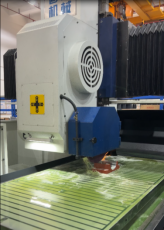
2. Achieving Unmatched Precision and Accuracy
One of the primary reasons manufacturers invest in CNC surface grinding machines is their ability to achieve extremely tight tolerances.
Unlike manual grinding, CNC-controlled systems eliminate human error and ensure consistent results across every workpiece. These machines can achieve micron-level precision, which is essential for industries where even the smallest deviation can lead to failure.
For example:
- Mold and die components require perfect flatness
- Aerospace parts demand strict dimensional accuracy
- Mechanical components rely on precise fitting surfaces
With CNC grinding, every part is produced with identical specifications—ensuring reliability and quality.
3. Superior Surface Finish and Product Quality
Surface finish directly impacts the performance, durability, and appearance of metal components.
CNC surface grinding machines use controlled feed rates and stable grinding pressure to produce smooth, uniform finishes. This process removes imperfections, burrs, and irregularities left by other machining operations.
Benefits include:
- Reduced friction and wear
- Improved corrosion resistance
- Better performance of mating components
In high-end applications such as bearings, molds, and precision tools, surface quality is often the deciding factor between success and failure.
4. Automation for Higher Efficiency and Lower Labor Costs
Modern CNC grinding machines are designed for automation.
Once parameters are programmed, the machine can complete the entire grinding cycle—including rough grinding, finishing, and spark-out—without manual intervention.
This leads to:
- Reduced dependence on skilled labor
- Increased production efficiency
- Consistent quality across batches
For manufacturers dealing with large volumes or tight deadlines, this level of automation significantly improves productivity and reduces operational costs.
5. Flexibility for Complex and Diverse Production Needs
Today’s manufacturing environment often involves:
- Small batch production
- Multiple product variations
- Frequent design changes
CNC surface grinding machines offer flexible programming, allowing operators to quickly switch between different workpieces by simply adjusting parameters or loading saved programs.
Additionally, CNC grinding can handle:
- Complex geometries
- Multi-step grinding processes
- Different materials in one setup
This flexibility makes it ideal for modern factories aiming to stay agile and competitive.
6. Capability to Process Hard and Advanced Materials
Many industrial components are made from hardened steel, carbide, or other difficult-to-machine materials.
Traditional machining methods struggle with these materials, especially after heat treatment. However, CNC grinding excels in this area by:
- Maintaining dimensional stability
- Preventing deformation
- Ensuring precise finishing
Surface grinding is often the only viable method for achieving final dimensions on hardened materials.
7. Improved Consistency and Reduced Scrap Rate
Inconsistent machining leads to rejected parts, wasted materials, and increased costs.
CNC surface grinding machines ensure:
- Repeatable results
- Stable processing parameters
- Minimal variation between parts
This consistency significantly reduces scrap rates and improves overall production efficiency—especially in mass production environments.
8. Supporting Smart Manufacturing and Industry 4.0
Modern CNC grinding machines are not just mechanical tools—they are part of intelligent manufacturing systems.
Advanced machines can:
- Monitor process data (speed, load, cycle time)
- Optimize machining parameters
- Enable predictive maintenance
This data-driven approach helps manufacturers improve decision-making and move toward Industry 4.0 smart factories.
9. Why Choose the Right CNC Surface Grinding Machine
Choosing the right equipment is just as important as understanding its benefits.
At Asiatools, we provide high-performance CNC grinding solutions designed for precision, durability, and efficiency.
Our machines are engineered to:
- Deliver stable and high-precision performance
- Support various metal processing applications
- Improve productivity while reducing costs
10. Conclusion
CNC surface grinding machines are no longer just an optional upgrade—they are a necessity for any manufacturer aiming to stay competitive in modern metal processing.
By combining precision, automation, flexibility, and efficiency, these machines enable businesses to:
- Improve product quality
- Increase production capacity
If you are looking to enhance your manufacturing capabilities, investing in a CNC surface grinding machine is one of the smartest decisions you can make.